Many homes in the Town of Pulaski and Dublin went up when those towns were railroad and early manufacturing centers. A lot of them are still multi-story houses with their original stairways. Out past town, in places like Fairlawn, Draper, Parrott and New River, farmhouses and mixed manufactured and site-built homes sit on hillsides and in hollows, often with steps both inside and out.
That mix shapes what kind of stair lift makes sense. A narrow old staircase in town calls for a different setup than a porch climb on a sloped rural lot near Claytor Lake. This page walks through the common situations we see across the county's 6 towns and the programs that may help pay for a lift.
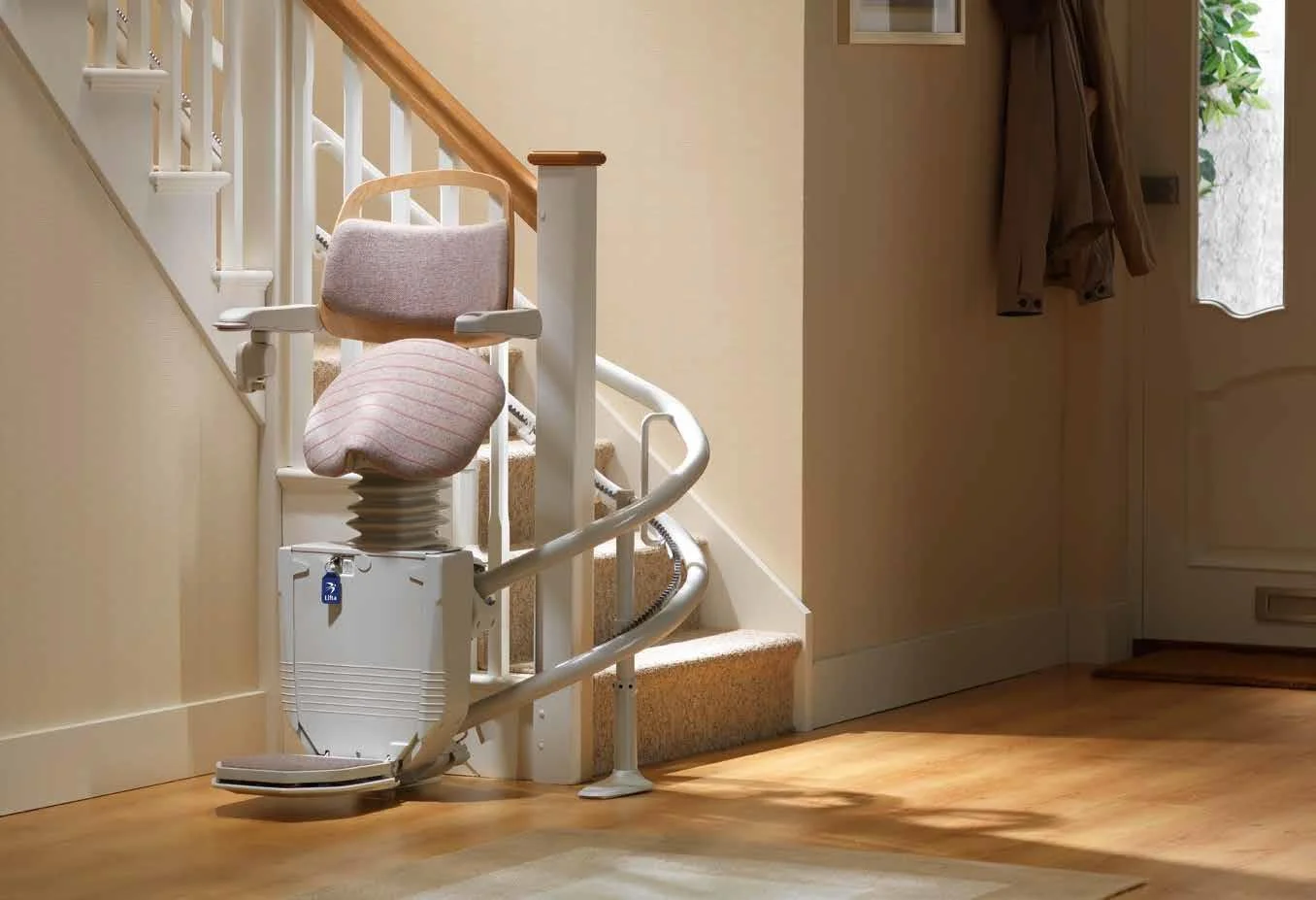
The older core of the Town of Pulaski and Dublin holds many multi-story single-family homes and detached houses with stairways that have never been rebuilt. A straight run with no turns is usually the simplest fit, since the rail mounts to the stair treads, not the wall.
If the stairway turns, has a landing partway up, or winds at the top, a curved lift with a custom-bent rail is the usual answer. We measure the stairway in person before quoting, because older stairways rarely match a standard layout.
Pulaski County covers rolling, hilly terrain along the New River, and many homes sit on sloped lots with level changes inside and out. For a family member who can manage the inside stairs but struggles with the porch or entry steps, an outdoor stair lift built for the weather can be the piece that keeps the house usable.
When someone uses a wheelchair and can't transfer to a seat, a platform lift may be the better choice than a chair-style lift. About 42.6% of county residents live in rural areas, so we plan rural visits ahead and check the approach, steps and footing on the first trip.
Walk-up apartments and low-rise buildings are part of the county's housing too. A stair lift in a rental or shared stairwell needs the owner's written permission, and a shared stairway may need to stay wide enough for others to pass.
Renters are not shut out of help with costs. Some Virginia programs listed below accept tenants who have approval from the property owner.
For many of these households, the question is how to stay in a familiar house rather than move.
A stair lift is often the most direct change for a home where the bedroom or bathroom is upstairs. It can usually be installed without tearing out walls, which matters in an older house.
The clearest funding source for many households is the Virginia Housing Accessibility Grants, which list chairlifts by name and pay up to $10,000 per household with no repayment. For people who qualify for Medicaid and a nursing-facility level of care, the CCC Plus waiver covers home modifications through a care plan.
Veterans should know that the VA HISA grant does not pay for stair glides, though the Granting Freedom track of the Virginia Housing grants does serve veterans with a service-connected disability. Statewide, it is also worth asking about the Virginia Livable Home Tax Credit (LHTC) and the Assistive Technology Loan Fund Authority (ATLFA). Details for each local program are below.
The designated aging agency for Pulaski County, offering care coordination and information and referral, generally for people 60 and older, on a sliding-scale fee. Its listing does not name stair lifts, but it connects residents to equipment and home-modification referrals; call (540) 980-7720.
Virginia's main Medicaid home and community-based waiver covers home modifications, approved through each member's plan of care, for people who meet Medicaid financial limits and a nursing-facility or hospital level of care. Screening starts with the local Department of Social Services; call (833) 522-5582.
A statewide grant of up to $10,000 per household, with no repayment, that lists installing ramps and chairlifts among covered work for eligible veterans, homeowners and renters. Applications go through a Virginia Housing-approved local agent; call (877) 843-2123.
A VA grant for medically necessary permanent alterations such as roll-in showers and entrance ramps. It specifically excludes stair glides and porch lifts, so it will not pay for a stair lift; call (800) 827-1000.
VA grants for veterans with certain severe service-connected disabilities who own their home, used to build, buy or remodel for accessibility. The VA page does not name stair lifts, so ask about your case at (800) 827-1000.
Low-interest repair loans and, for owners 62 and older, grants for very-low-income homeowners in eligible rural areas to fix health and safety hazards. The source does not name stair lifts, and eligibility for a specific address should be checked with USDA's online tool.
A Virginia DHCD program of up to $4,000 per applicant for repairs plus wheelchair ramps and other accessibility modifications, first-come, first-served. Stair lifts are not named; call (804) 371-7000 to find the current local administrator.
The independent living center serving Pulaski County offers information, vendor referrals and a Home Accessibility Checklist rather than direct grants. It does not mention stair lifts; call (540) 266-1435.
A safety-net program run from the Pulaski office for households at or below 200% of federal poverty guidelines, covering things like utilities, rent and prescriptions. It is not a home-modification grant and does not mention stair lifts; call (540) 994-9334.
Older adults
6580 Valley Center Dr., Suite 124, Radford, 24141
Veterans
335 West Monroe Street Suite 200, Wytheville, 24382
The VA HISA grant lists stair glides among excluded equipment, so it will not. Veterans with a line-of-duty service-connected disability and income at or below 80% of area median income can look at the Granting Freedom grant through Virginia Housing, which covers chairlifts. The Wytheville Office at (276) 228-5211 can help with VA benefits questions.
The New River Valley Agency on Aging generally serves people 60 and older, though some services are open to younger people with a disability. The Disability Resource Center of the New River Valley serves people with disabilities in Pulaski County regardless of age.
Through the CCC Plus waiver, home modifications are a covered category, approved by the member's care coordinator under a plan of care. You must be Medicaid-eligible and meet a nursing-facility or hospital level of care, with a 2026 income limit of $2,982 a month for a single applicant.
Yes, with the owner's written approval. The Rental Unit Accessibility Modification track of the Virginia Housing grants is for renters at or below 60% of area median income, and EHARP accepts tenants with homeowner approval.
Often it means outside steps as well as inside ones, so an outdoor lift or platform lift may be part of the plan. Rural homeowners with very low income may also want to check whether their address falls in a USDA Section 504 eligible area.
Up to $10,000 per household, and it does not have to be repaid. You apply through a Virginia Housing-approved local agent; call (877) 843-2123 to find one covering Pulaski County.
Tell us about the stairs in your home and we will explain which lift fits, what it costs and how installation works.
