Page County runs along the South Fork Shenandoah River, with the Blue Ridge Mountains on one side and Massanutten Mountain on the other. Its three towns, Luray, Shenandoah and Stanley, are surrounded by farm country where many families still live in two-story stone, log and brick farmhouses built by early Swiss and German settlers.
Those houses were built to last, not to be easy on aging knees. Narrow original staircases, sloped yards and uneven ground are part of daily life here. This page walks through what that means for a stair lift and which programs may help cover the cost.
Much of the county's older housing is 18th- and 19th-century Germanic and Federal-style farmhouses. The Heiston-Strickler House near Luray, a two-story stone dwelling from circa 1790, is listed on the Virginia Landmarks Register and the National Register of Historic Places as one of the best preserved of the Page County Germanic houses.
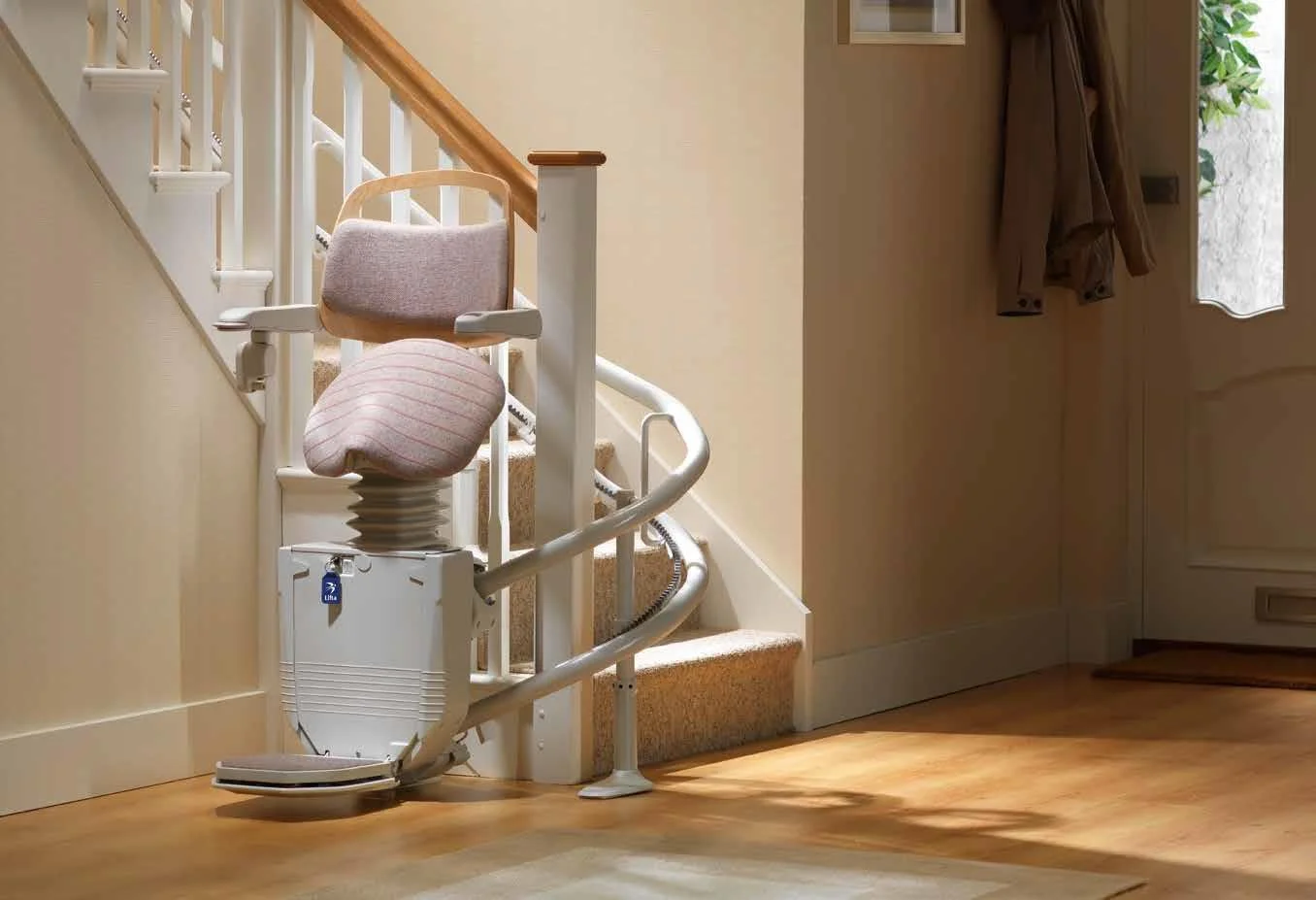
Homes like these usually have steep, narrow stairways that were never meant for accessibility. A straight stair lift rides on a rail fastened to the stair treads, not the walls, which is often a good fit for an older home. If the staircase turns or has a landing partway up, a curved rail built to that exact stair is the usual answer.
Before anything is ordered, we measure the width of the stairs, the headroom and the space at the top and bottom. In a narrow farmhouse stairway, those measurements decide which lift will work and whether the seat can fold out of the way for others using the stairs.
Between the Blue Ridge and Massanutten Mountain, many homes sit on sloped or uneven ground. For a lot of families, the hardest climb is not inside the house but the steps from the yard or driveway up to the porch.
An outdoor stair lift is built to handle weather and can cover exterior steps to a front or back door. Where a wheelchair user needs to get up a short rise, a vertical platform lift may make more sense than a seat. We look at the whole route into the home, not only the indoor staircase.
Not every home in the county is a farmhouse. Single-family and detached houses, townhouses, walk-up apartments and low-rise buildings all show up, especially in and around Luray, Shenandoah and Stanley. Townhouses and walk-ups often have a single straight flight, which tends to be the simplest installation.
About 69.4% of residents own their homes, so most can decide on a lift themselves. Renters can still get one with a landlord's agreement, and one Virginia grant track is set up for exactly that situation.
Both groups have specific programs worth checking, listed below.
The county describes itself as having an inexpensive cost of living, and that can make paying privately for a lift more reachable than it would be near a big metro area. Still, help is available, and it is worth checking before you pay out of pocket.
The strongest fit for most households is the Virginia Housing Accessibility Grants family, which names chairlifts among typical modifications and offers up to $10,000 that does not have to be repaid. There are separate tracks for homeowners, renters and disabled veterans. Applications go through a Virginia Housing-accepted agent serving Page County, and Seniors First may be able to point you to one.
Other programs, such as the CCC Plus waiver and USDA Section 504 repairs, cover home modifications but do not mention stair lifts by name, so ask directly. Veterans should know the VA HISA grant excludes stair glides. Statewide, the Virginia Livable Home Tax Credit (LHTC) and the Assistive Technology Loan Fund Authority (ATLFA) are also worth asking about.
A Medicaid waiver for people who would otherwise need nursing-facility care, paying for home adaptations up to $5,000 per calendar year; the regulation lists ramps, grab bars and doorway widening but does not name stair lifts. Apply through the local Department of Social Services, and call the CCC Plus Helpline at (844) 374-9159 with questions.
A grant of up to $10,000, with no repayment, for homeowners with a household member who has a disability and income at or below 60% of Area Median Income; chairlifts are named among covered modifications. Apply through a Virginia Housing-accepted agent, or call (804) 782-1986.
Up to $10,000, with no repayment, for Virginia service members or veterans with a service-connected disability and household income at or below 80% of Area Median Income, in owned or rented homes; the program's general modifications list, which includes chairlifts, applies to this track. Call (804) 782-1986 to find an accepted agent.
For renters, or landlords acting for a tenant with a disability, with income at or below 60% of Area Median Income; chairlift installation is listed as a typical modification and there is no application fee. Call (804) 782-1986.
Loans up to $40,000 at 1% interest over 20 years, and grants up to $10,000 for homeowners age 62 and older who cannot repay a loan, for very low-income households in rural areas like Luray and Stanley; stair lifts are not mentioned in the sources. Call the Harrisonburg Service Center at (540) 534-3106.
A VA grant for medically necessary home changes, with a lifetime maximum of $6,800 or $2,000 depending on disability status. It does not cover stair lifts: the VA excludes porch lifts and stair glides.
Grants for veterans with severe service-connected disabilities to build, buy or remodel an adapted home, up to $126,526 for SAH and $25,350 for SHA in FY2026; stair lifts are not named among examples. Call the VA at (800) 827-1000.
Page County's area agency on aging for adults 60 and older, offering information and referral, Meals on Wheels, transportation and in-home help; it does not list a stair lift grant but can point you to resources. Call (540) 635-7141.
Older adults
207 Mosby Lane, Front Royal, 22630
Veterans
1516 N Shenandoah Avenue Suite E, Front Royal, 22630
Often, yes. Many Page County farmhouses have steep, narrow original stairs, and a lift rail mounts to the treads rather than the walls. We measure width, headroom and the landings first to confirm the right model.
Yes. The Virginia Housing Accessibility Grants list chairlifts among typical modifications and offer up to $10,000 that does not need to be repaid. Call (804) 782-1986 to find an accepted agent serving Page County.
Not through HISA, which excludes stair glides and porch lifts. Veterans with a service-connected disability may qualify for the Granting Freedom grant through Virginia Housing, and the Virginia Department of Veterans Services Front Royal Office at (540) 551-8909 can help with VA benefits.
Possibly. The Rental Unit Accessibility Modification grant is for renters, or landlords on a tenant's behalf, with income at or below 60% of Area Median Income, and chairlifts are listed as a typical modification. You will need the landlord's agreement.
Seniors First serves adults 60 and older, but the CCC Plus waiver and the Virginia Housing grants have no such age limit. CCC Plus is for Medicaid members of any age who would otherwise need nursing-facility care.
Many homes here sit on sloped ground, so outdoor stair lifts for porch or entry steps are common. For wheelchair users, a vertical platform lift may be a better fit, and we can look at both during a home visit.
Tell us about the stairs in your home and we will explain which lift fits, what it costs and how installation works.
