From the farmhouses around Riner and Elliston to the split-level homes on sloped lots near Christiansburg and Blacksburg, Montgomery County has a lot of stairs. The county sits in southwestern Virginia's Valley and Ridge province, and many houses were built into hillsides, with a full flight of interior stairs between the main living area and the bedrooms or the basement.
This page covers what those homes mean for a stair lift, which type tends to fit, and which state, federal and local programs may help with the cost. It is written for older homeowners in towns like Shawsville, Prices Fork, Belview and Lafayette, and for the adult children helping them plan.
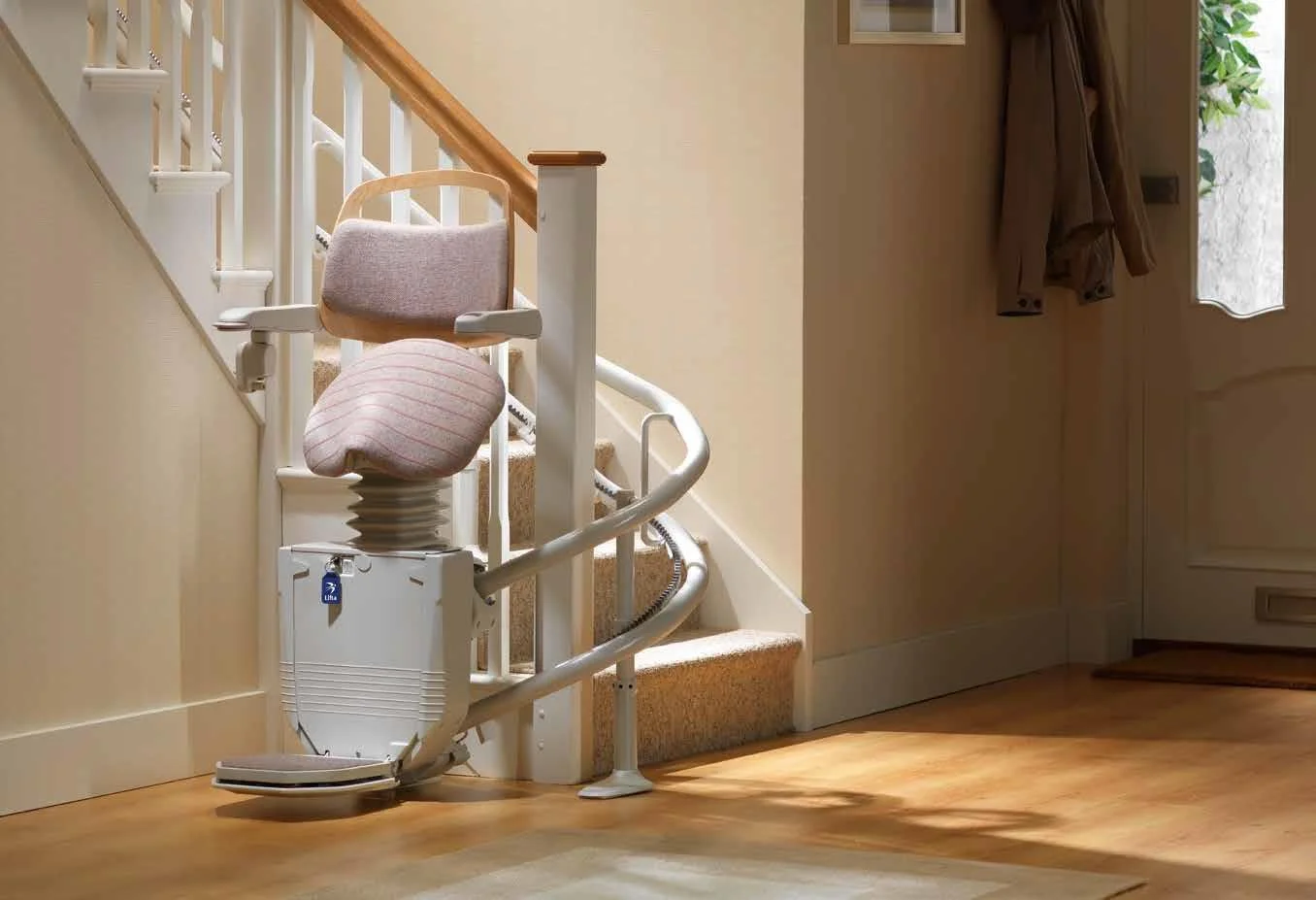
The county's homes include single-family homes, townhouses, low-rise buildings and split-level homes. Many of the older ones were built before modern accessible-design codes and have multi-level layouts with a full flight of interior stairs. That is the most common retrofit we see.
A straight staircase with no turns or landings usually takes a straight rail, which is the simplest install. Split-level homes often have short runs between levels, and stairs that turn at a landing need a curved rail built to the exact shape of the staircase. Townhouses tend to have narrow, straight stairs, so we check the width carefully before recommending a model.
Ridge-and-valley terrain means a lot of homes here sit on sloped lots. The inside stairs may be only part of the problem. Many houses have a set of exterior steps up to the porch or down from the driveway.
For those steps, an outdoor stair lift built to handle weather is one option. Where someone uses a wheelchair, a platform lift or a ramp may make more sense than a seat. We look at the whole route from the car to the bedroom before suggesting anything.
Montgomery County is younger than much of Virginia, largely because of Virginia Tech in Blacksburg. About 12.0% of residents are 65 or older, and the 2020 census put the median age at 27.5 years. That smaller, more spread-out senior population means families in the rural towns often have to seek out help themselves.
Veterans have their own office in Christiansburg and some separate grant options, covered below.
The program that most clearly names chairlifts is the Virginia Housing Accessibility Grants, up to $10,000 per household with no repayment. You apply through a Virginia Housing-accepted local agent, and income limits apply.
Other programs cover home modifications in general but do not name stair lifts on their pages, so ask before you count on them. The CCC Plus Medicaid waiver, the EHARP repair program run locally by Community Housing Partners, and USDA Section 504 repair loans and grants for rural homes all fall in that group. The VA HISA grant does not pay for stair glides.
Statewide, the Virginia Livable Home Tax Credit (LHTC) and the Assistive Technology Loan Fund Authority (ATLFA) are also worth asking about. For veterans, Montgomery County Veterans Services at 755 Roanoke Street Suite 2E in Christiansburg can be reached at (540) 382-5763.
A Virginia Medicaid waiver for people 65 and older, or under 65 and disabled, who meet a nursing facility or hospital level of care and Medicaid financial rules; it covers environmental modifications, but the official page does not name stair lifts. Call (844) 374-9159.
Grants of up to $10,000 per household with no repayment, and eligible work explicitly includes installing ramps and chairlifts. Income limits are 60% of area median income for owners and renters and 80% for veterans with line-of-duty disabilities; call (877) 843-2123 to find a local agent.
Up to $4,000 per applicant for homeowners, or tenants with owner approval, at or below 80% of area median income, first-come, first-served. It covers wheelchair ramps and other accessibility modifications but does not name stair lifts; call (804) 371-7000.
Loans up to $40,000 at 1% fixed interest, and grants up to $10,000 for homeowners age 62+ with very low income, for owner-occupied homes in eligible rural areas. Accessibility improvements are allowed, but stair lifts are not named in the source.
A VA grant for medically necessary home alterations, with a $6,800 or $2,000 lifetime maximum depending on disability status. It explicitly does not pay for stair glides or porch lifts; call (540) 982-2463.
An information, referral and care coordination agency for older adults in Montgomery, Pulaski, Giles and Floyd counties and Radford city. It does not list a stair lift or home modification fund; call (540) 980-7720.
Free insulation, air sealing and heating or cooling repairs for income-eligible households, with priority for elderly and disabled residents. It does not list stair lifts; call (888) 229-3714.
Offers advocacy, information and referral, independent living skills and peer support for people with disabilities in Floyd, Montgomery, Pulaski or Giles counties or the City of Radford. No stair lift program is listed; call (540) 266-1435.
Older adults
6580 Valley Center Dr., Suite 124, Radford, 24141
Veterans
755 Roanoke Street Suite 2E, Christiansburg, 24073
Yes. The Virginia Housing Accessibility Grants list installing chairlifts as eligible work, with up to $10,000 per household and no repayment. You apply through a Virginia Housing-accepted local agent; call (877) 843-2123.
No. The HISA grant explicitly excludes stair glides and porch lifts. Veterans with line-of-duty disabilities may instead look at the Granting Freedom grant through Virginia Housing, and Montgomery County Veterans Services can help at (540) 382-5763.
The CCC Plus waiver covers people under 65 who are disabled, as well as those 65 and older, if they meet a nursing facility or hospital level of care and Medicaid financial rules. Its environmental modifications benefit does not name stair lifts on the page reviewed, so call (844) 374-9159 to ask.
Most of unincorporated Montgomery County outside the Blacksburg and Christiansburg town limits is in a USDA-designated rural area. Check your specific address on the USDA eligibility mapping tool, and note that stair lifts are not named in the program description.
The Rental Unit Accessibility Modification (RUAM) grant through Virginia Housing is for renters at or below 60% of area median income. EHARP also accepts tenants with the owner's approval.
The New River Valley Agency on Aging in Radford offers information and assistance at (540) 980-7720. The Disability Resource Center of the New River Valley is another referral point at (540) 266-1435.
Tell us about the stairs in your home and we will explain which lift fits, what it costs and how installation works.
