Lynchburg earned the name 'City of Seven Hills' for a reason. College Hill, Garland Hill, Daniel's Hill, Federal Hill, Diamond Hill, White Rock Hill and Franklin Hill hold most of the older neighborhoods, built up on the heights while commerce and industry stayed down near the James River.
That history shows up inside the houses. The city has ten recognized historic districts and 40 buildings individually listed on the National Register of Historic Places. Much of the housing is multi-story and was built long before anyone designed for aging in place, so interior stairways are often the first thing that gets hard. This page walks through what that means for a stair lift and where people in Lynchburg can look for help paying.
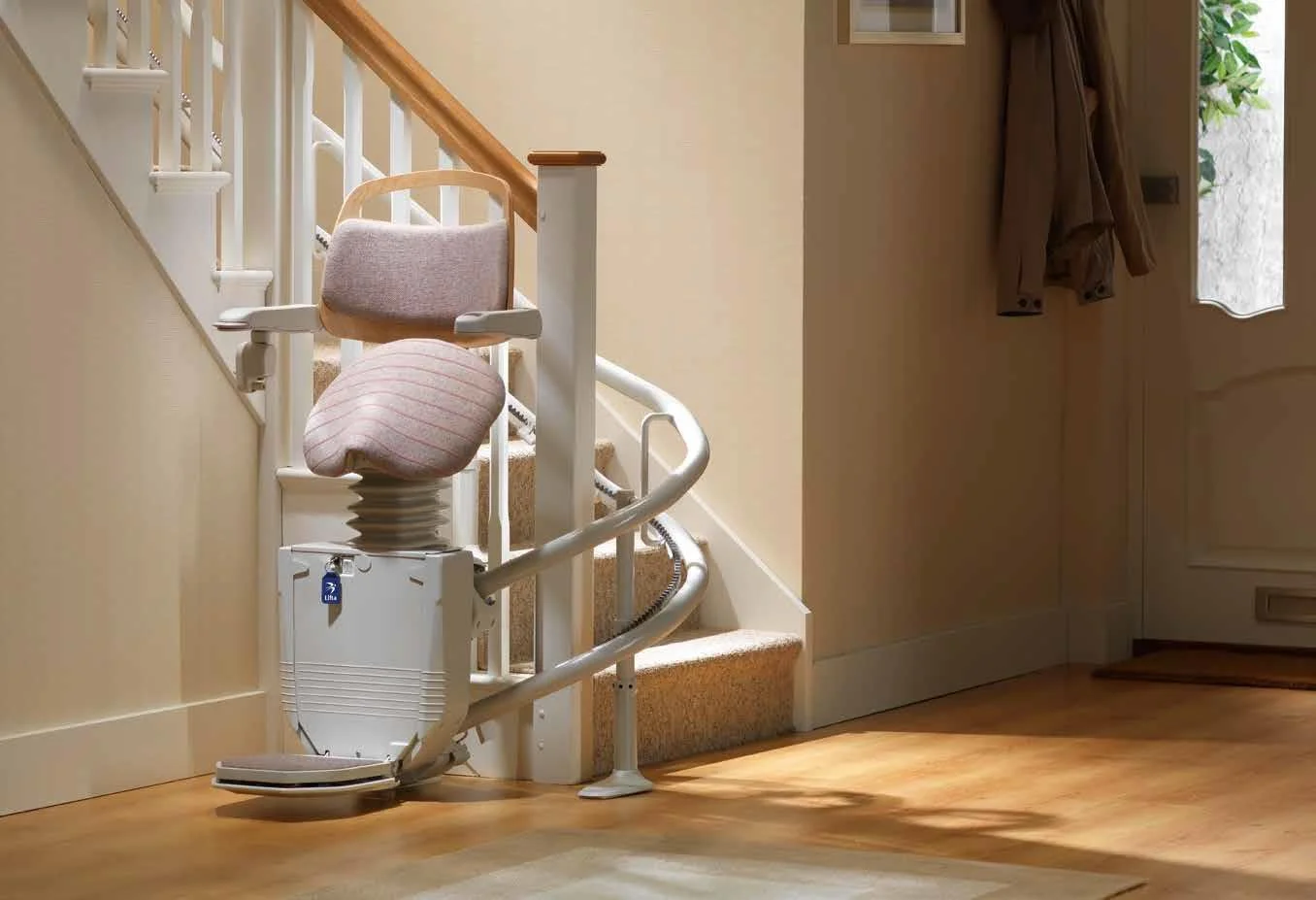
The housing here runs from 18th- and 19th-century townhouses and Victorian-era residences to downtown lofts carved out of old warehouses and mills. Across the city you also find detached houses, duplexes, low-rise buildings and walk-up apartments.
A narrow townhouse with one straight run of stairs is usually the simplest fit for a straight stair lift. Victorian homes more often have landings, turns or a curve at the top or bottom, and those call for a curved lift built to the shape of that staircase. We measure every stairway before quoting, because older stairs are rarely as square as they look.
In a walk-up apartment or a converted loft, the stairs may be shared. A lift on a common stairway is a decision the building owner has to make, so that conversation should happen early.
Lynchburg sits in the foothills of the Blue Ridge Mountains at about 630 feet, and its terraced streets gave it the 'Hill City' nickname. Many lots and driveways have real grade changes, so the trouble often starts before someone reaches the front door.
If the steep part is a set of exterior steps up from the street or driveway, an outdoor stair lift built for weather can handle it. For someone who uses a wheelchair, a vertical platform lift can take the place of porch steps. It helps to look at the whole route, from the car to the bedroom, before choosing equipment.
The city has a population of 79,255, and 14.2 percent of residents are 65 or older.
Only 49.1 percent of Lynchburg households own their homes. That matters for funding, because some programs, like USDA Section 504 and Interfaith Rebuilds, are written for homeowners. Renters should check each program's rules and talk with the property owner before planning any installation.
No program listed here states plainly that it pays for stair lifts, and one, the VA HISA grant, specifically excludes stair glides. That does not mean help is out of reach. It means you should call and ask directly about a stair lift before counting on any of them.
A good first call is the Central Virginia Alliance for Community Living at (434) 385-9070, at 501 12th Street, Suite A, Lynchburg 24504. It is the area agency on aging for the city and can point you toward its own repair program and the CCC Plus Medicaid waiver. Veterans can reach the Lynchburg Benefits Office of the Virginia Department of Veterans Services at (434) 582-5102, 519 Leesville Road Suite A, Lynchburg 24502.
Statewide, Virginia also has the Virginia Livable Home Tax Credit (LHTC) and the Assistive Technology Loan Fund Authority (ATLFA). Ask the agencies above whether either one fits your situation. The programs below are summarized from what their sources actually say.
This Medicaid waiver covers environmental modifications and assistive technology approved through a member's care plan, but the sources reviewed do not name stair lifts, so confirm with your care coordinator. It serves people 65 or older, or younger with a qualifying disability, who meet a nursing facility or hospital level of care, with a 2026 income limit of $2,982 a month for a single applicant and no waitlist; call (844) 374-9159.
EHARP funds urgent structural, safety and accessibility repairs for low-income older adults and people with disabilities in the City of Lynchburg and Amherst, Appomattox, Bedford and Campbell counties. Stair lifts are not listed as a covered item, so ask staff directly at (434) 385-9070.
These repair loans and grants go up to $50,000 combined, with grants of up to $10,000 lifetime for very-low-income homeowners 62 and older, but properties inside Lynchburg city limits are generally not eligible. Stair lifts are not named; homeowners in nearby rural parts of surrounding counties can call (804) 287-1500.
HISA pays for medically necessary home alterations for veterans, up to $6,800 lifetime for service-connected disabilities or $2,000 for other non-service-connected disabilities. It does not cover stair lifts, since it excludes removable equipment such as stair glides; call (800) 827-1000.
These grants help veterans with severe service-connected disabilities adapt a home, up to $126,526 for SAH and $25,350 for SHA in FY2026. The VA names ramps, roll-in showers and widened doorways as examples but does not list stair lifts; call (800) 827-1000.
LACIL staff help people with a documented disability in Lynchburg, Amherst, Appomattox, Bedford and Campbell find funding and vendors for items like ramps and grab bars; stair lifts are not named. Call (434) 528-4976 to schedule an intake appointment of about 90 minutes, and bring photo ID, insurance cards and income documents.
Volunteers provide free repairs and modifications for financially needy homeowners, usually elderly or disabled, within 20 miles of the Lynchburg office, with ramps specifically offered in the City of Lynchburg. Stair lifts are not mentioned; call (434) 846-6098.
Older adults
501 12th Street, Suite A, Lynchburg, 24504
Veterans
519 Leesville Road Suite A, Lynchburg, 24502
Often, yes. Victorian-era stairs frequently have turns or landings, which means a curved lift made to match that staircase rather than a straight one. We measure the stairs in person before recommending anything.
Lynchburg's hillside lots and driveways often have big grade changes. An outdoor stair lift can run along exterior steps, and a vertical platform lift can serve someone in a wheelchair at a porch or entry.
The HISA grant does not, because it excludes stair glides. The SAH and SHA grants do not list stair lifts either way, so ask the VA at (800) 827-1000 or the Lynchburg Benefits Office at (434) 582-5102.
Properties within Lynchburg city limits are generally not eligible, since the program serves rural areas. Nearby unincorporated parts of Amherst, Appomattox, Bedford and Campbell counties may qualify.
The CCC Plus waiver includes people under 65 with a qualifying disability who meet a nursing facility or hospital level of care. LACIL also works with people of any age who have a documented disability; call (434) 528-4976.
Call the Central Virginia Alliance for Community Living at (434) 385-9070. It is the area agency on aging for the City of Lynchburg and can explain its repair program and the CCC Plus waiver.
Tell us about the stairs in your home and we will explain which lift fits, what it costs and how installation works.
