Louisa County covers 511 square miles of central Virginia, and by the 2020 Census all of it was counted as rural. Around the towns of Louisa, Mineral and Blue Ridge Shores, and along the shoreline of Lake Anna, you find everything from older rural farmhouses to newer subdivisions built for retirees and commuters.
That mix matters when someone starts having trouble with stairs. Entry steps and multi-level interior layouts are common in both the older and the newer homes here, so the right lift depends on the house in front of us. This page walks through the home styles we see in the county and the programs that may help pay for a lift.
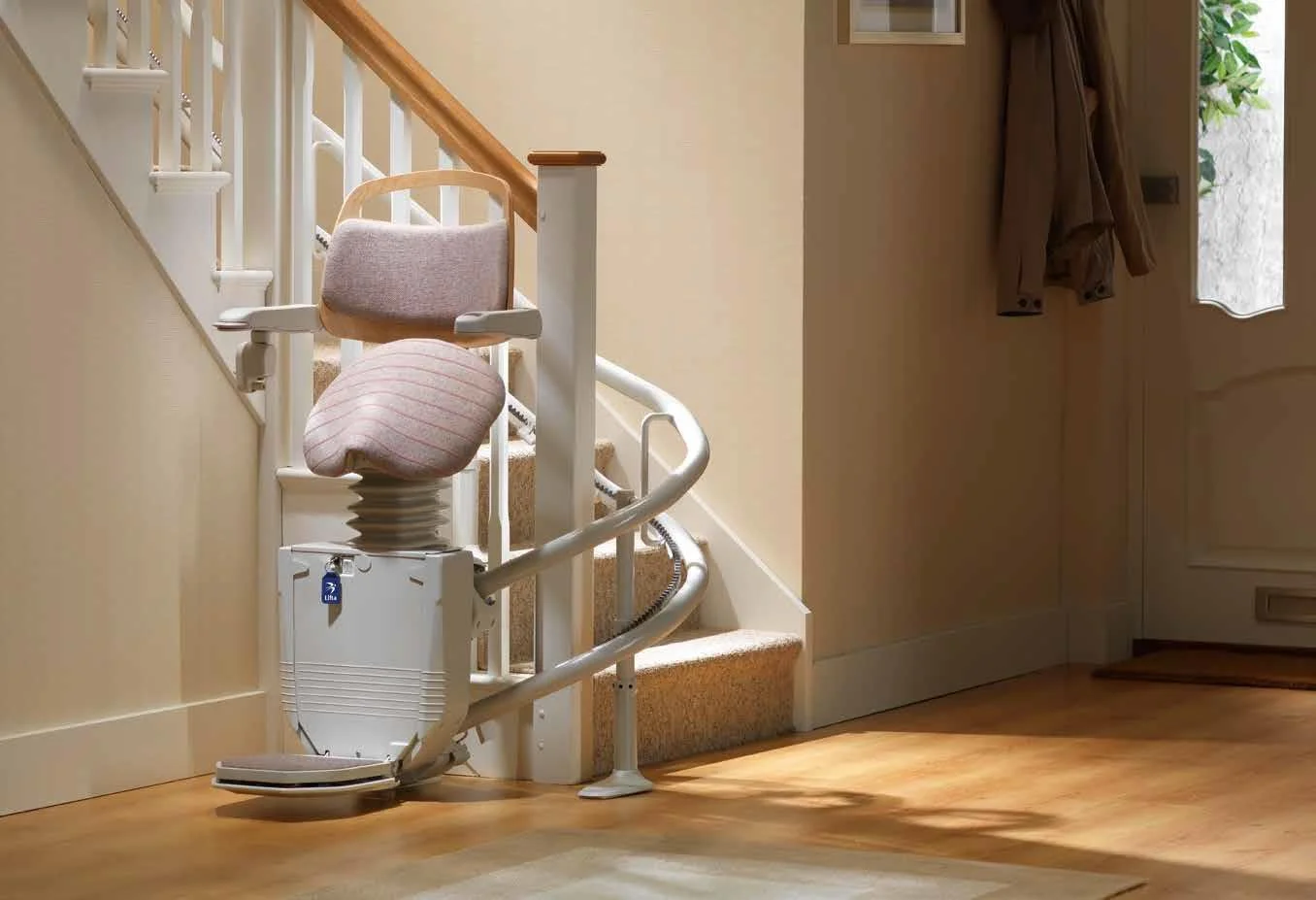
Single-family homes make up most of the housing in the county. A two-story house with one straight flight is the simplest case: a straight stair lift mounts to the treads, not the wall, and usually goes in without changes to the house.
Split-level homes are different. They often have several short flights with a landing or turn between them, which can mean a curved lift built to fit that staircase, or more than one straight lift. We measure every flight before recommending either.
Ranch-style homes may look like they need no lift at all, but many have steps down to a basement or up to the front door. In walk-up apartments and low-rise buildings, the stairs are often shared, so the building owner usually has to agree before anything is installed.
With so much of the county rural, many homes sit on lots where the front or back door is several steps above the yard. An outdoor stair lift is built to handle weather and can run along porch or deck stairs.
When a wheelchair has to come along, a platform lift may make more sense than a seat-style lift. Ramps are another option, and several of the funding programs below name ramps specifically, so it is worth comparing both before deciding.
Lake Anna, the 13,000-acre reservoir created in the 1970s alongside the North Anna Nuclear Generating Station, has drawn many retirees to the county. Commuters come too, since Richmond, Fredericksburg and Charlottesville are roughly an hour's drive or less away.
That growth shows in the age profile: 21.9% of county residents were 65 or older as of 2024, above the Virginia average of 17.8% and the U.S. average of 18%. With an 82.2% homeownership rate, most of those residents own the house they live in, which makes installing a lift a decision the family can make directly.
The most direct help for a stair lift is the Virginia Housing accessibility grant program, which lists chairlifts among the modifications it funds, up to $10,000 per household with no repayment. In Louisa County, applications go through a local agent, and Piedmont Housing Alliance serves the county.
Other programs cover home repairs or accessibility work in general without naming stair lifts, including the state's Essential Home and Accessibility Repair Program and USDA Section 504 loans and grants. Veterans have several VA grants to look at, though the HISA grant specifically excludes stair glides.
If you are not sure where to start, JABA's Senior Helpline and the Independence Resource Center can help sort out which programs fit your situation. Each program is summarized below.
Virginia's Medicaid waiver offers up to $5,000 per household for environmental modifications and up to $5,000 per individual for assistive technology, resetting each July 1, for people who meet nursing-facility level of care and Medicaid financial rules. The program's examples include ramps, wider doorways and grab bars, but stair lifts are not listed, and screening is done through the local Department of Social Services or a hospital screening team.
These grants pay up to $10,000 per household with no repayment and list chairlifts among funded modifications, with income limits of 60% of Area Median Income, or 80% for Granting Freedom applicants who are veterans or service members with a service-connected disability. Applications go through an approved local agent; Virginia Housing can be reached at (877) 843-2123.
Piedmont Housing Alliance is the local agent that takes applications for the Virginia Housing accessibility grants from Louisa County residents, with the same up to $10,000 grant and income tiers. Call (434) 817-2436 to start an application.
This state program provides up to $4,000 per applicant for repairs and accessibility work such as wheelchair ramps, for households at or below 80% of Area Median Income, first-come, first-served, and Louisa County is eligible. Stair lifts are not listed; call (804) 371-7000 for details.
Homeowners in eligible rural areas with income at or below 50% of area median can borrow up to $20,000 at 1% over 20 years, and owners 62 or older who cannot repay may get grants up to $7,500, with a combined cap of $27,500. Stair lifts are not listed in the source; call USDA Rural Development at (804) 287-1500.
HISA pays for medically prescribed structural changes for entry, bathroom or kitchen access, up to $6,800 or $2,000 over a lifetime depending on the disability. It does not cover stair lifts, since stair glides and porch lifts are explicitly excluded; call (800) 827-1000.
For veterans with certain severe service-connected disabilities, SAH provides up to $126,526 (FY2026) in up to 6 disbursements, with a Temporary Residence Adaptation option up to $50,961. Stair lifts are not listed; call (800) 827-1000.
SHA provides up to $25,350 (FY2026) for veterans with qualifying service-connected disabilities such as loss of use of both hands, with a Temporary Residence Adaptation option up to $9,100. Stair lifts are not listed; call (800) 827-1000.
JABA is the area agency on aging for Louisa County, offering information, referral and direct services to adults 60 and older, adults with disabilities and caregivers, not a home-modification grant. Its Senior Helpline is (434) 817-5244.
IRC serves people with physical and sensory disabilities in Louisa County with peer counseling, advocacy, adaptive living help and referrals to Independence Rehab Discounters for discounted adaptive equipment. Stair lifts are not listed; call (434) 971-9629.
Older adults
674 Hillsdale Drive, Suite 9, Charlottesville, 22901
Veterans
1430 Rolkin Court, Suite 202, Charlottesville, 22911
Yes. The Virginia Housing accessibility grants list chairlifts among funded modifications, up to $10,000 per household with no repayment. Louisa County residents apply through Piedmont Housing Alliance at (434) 817-2436.
The HISA grant explicitly excludes stair glides and porch lifts. The SAH and SHA grants do not list stair lifts either way, so ask the VA at (800) 827-1000 or the Virginia Department of Veterans Services Charlottesville Benefits Office at (434) 328-8993.
USDA Section 504 offers grants up to $7,500 for homeowners 62 or older who cannot repay a repair loan, for households at or below 50% of area median income. Stair lifts are not named in the program, so confirm with USDA Rural Development at (804) 287-1500.
Yes. EHARP is unavailable only in certain entitlement jurisdictions, and Louisa County is not on that list. It offers up to $4,000 for households at or below 80% of Area Median Income.
Often it can, using a curved lift built to fit the turns and landings or separate straight lifts for each flight. We measure each flight in the home before recommending one approach.
JABA, the Jefferson Area Board For Aging, serves Louisa County. Call the Senior Helpline at (434) 817-5244 or the main office at (434) 817-5222.
Tell us about the stairs in your home and we will explain which lift fits, what it costs and how installation works.
