Loudoun County splits into two very different places. In the east, Sterling, Ashburn, Cascades and Sugarland Run are full of two-story colonials and split-levels built after Dulles International Airport opened in 1962. In the west, past the Catoctin Mountain ridge, villages like Waterford, Middleburg, Round Hill and Hamilton sit among farmland and vineyards, with houses that can predate the Civil War.
That divide shapes the stairs we see inside homes and the programs that can help pay for a lift. This page walks through both halves of the county, what kind of stair lift usually fits, and the local, state and federal programs worth calling before you buy.
Planned communities such as Sterling Park, Sugarland Run, Cascades, Ashburn Village and Ashburn Farm are dominated by two-story colonial and split-level single-family homes. Both styles tend to put the bedrooms upstairs, which is exactly why so many families here start looking at a stair lift.
A colonial with one straight flight is usually the simplest job: a straight rail mounted to the stair treads, not the wall. Split-levels are different. Short runs between half floors may mean more than one lift, or a design that handles a landing, so we look at every flight before recommending anything.
Townhouses in places like Brambleton, Stone Ridge, Broadlands and South Riding often have several stacked floors. A lift between the main living level and the bedroom level is the common request, and narrow stairwells call for a careful measurement of folded width.
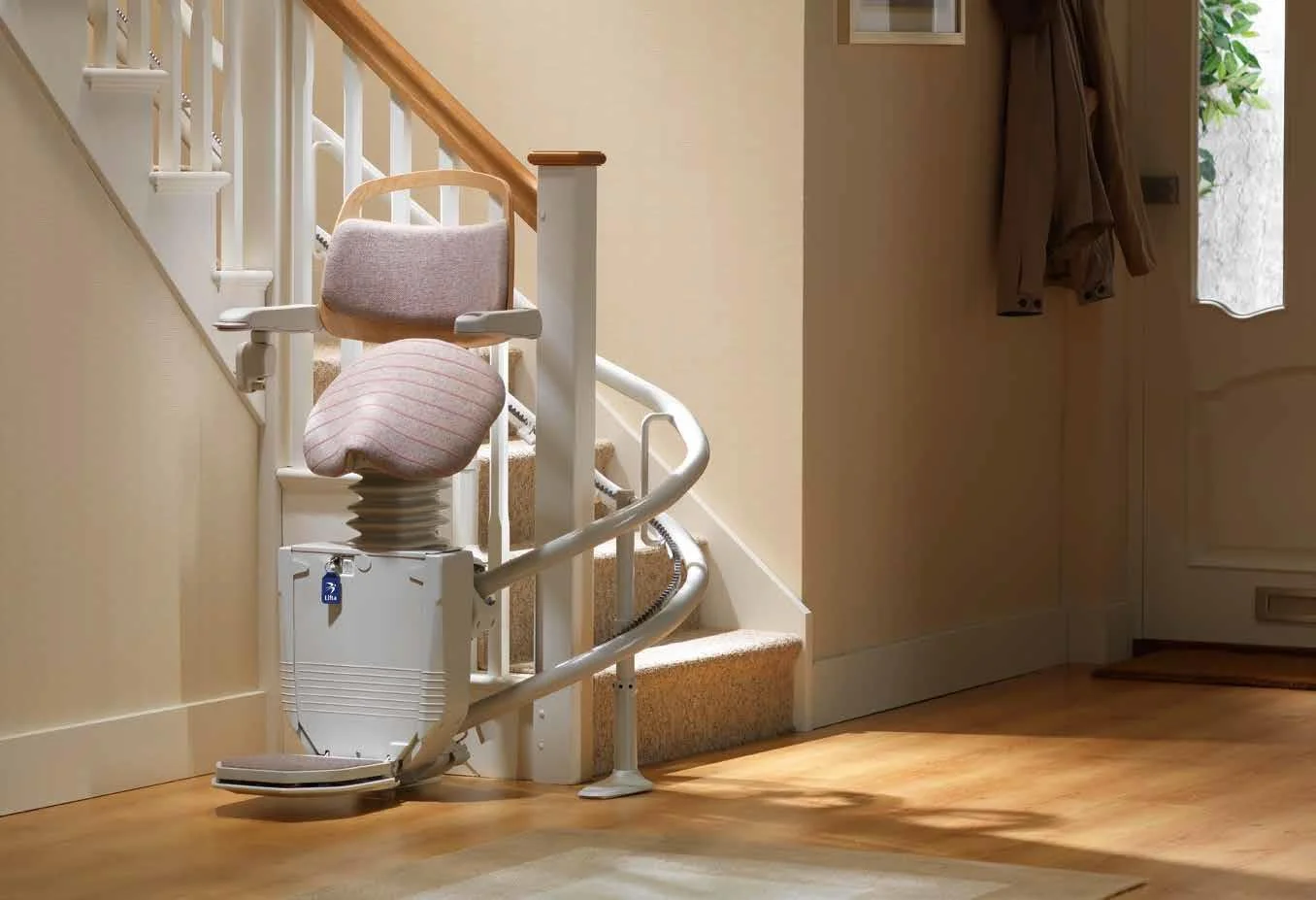
Western Loudoun keeps a much older housing base, including historic structures such as the William and Sarah Nettle House in Waterford. Older staircases are often narrower, steeper or turning, and those are the homes where a custom-bent curved rail is most likely.
The terrain matters too. Rolling ground in the east gives way to rural land in the west, and farmhouses or village homes often have exterior steps up to the front door. An outdoor stair lift or a vertical platform lift can solve the entry before anyone worries about the inside stairs.
Historic homes can also raise questions about where a rail can be anchored. We plan the mounting around the treads so original walls and trim are left alone wherever possible.
About 10.1% of Loudoun residents are 65 or older, and 76.1% are homeowners. Most lift requests come from owners who want to stay in a house they know rather than move to a single-level home.
If that includes someone in your family, the veterans programs below are worth a call, though some of them carry limits on what they will pay for.
Loudoun has a median household income of $181,765 and a median home value of $743,800. Because county programs measure income against a high Area Median Income (AMI), the dollar ceiling to qualify is higher than in most counties, so do not assume your household earns too much without checking.
The clearest local option is the Owner-Occupied Modification Grant Program, which names chairlifts directly as an eligible modification. It offers up to $10,000 for homeowners 65 and older with a mobility disability and income at or below 60% of AMI. Call Loudoun County Department of Housing and Community Development at (703) 737-8323.
Rural western addresses may qualify for USDA Section 504 repair help, while the denser eastern suburbs generally do not. Veterans should know the VA HISA grant specifically excludes stair glides. The statewide list also includes the Virginia Livable Home Tax Credit (LHTC) and the Assistive Technology Loan Fund Authority (ATLFA), which are worth asking about when you call.
Most county offices are in Leesburg, which keeps travel short for eastern residents. The Loudoun County AAA (PSA 8D) at 742 Miller Dr. SE, Leesburg, 20175 handles information and referrals for people 55 and older at (703) 777-0257.
Veterans can reach the Loudoun County Veterans Services Program at 1 Harrison Street SE, Government Center, Leesburg, 20175, by calling (571) 627-8893.
A county grant of up to $10,000 that names chairlifts among eligible modifications, for homeowners 65 and older with a mobility disability and income at or below 60% of AMI, with some exceptions under 65. Call (703) 737-8323.
A one-time deferred forgivable loan of up to $35,000 for homeowner-occupants at or below 80% of AMI; the source describes general repairs and hazard fixes and does not mention stair lifts. Call (703) 737-8323.
Grants of up to $10,000 for home or rental modifications for Virginia veterans and service members with a service-connected disability and income at or below 80% of AMI; the source does not mention stair lifts specifically. Call (703) 737-8323.
Grants of up to $10,000 to improve accessibility of rental units for renters with disabilities at or below 60% of AMI; stair lifts are not mentioned in the source. Call (703) 737-8323.
A Medicaid waiver that includes Environmental Modifications and Assistive Technology for people needing a nursing-facility level of care; the source does not mention stair lifts or a dollar cap. Apply through an LTSS screening at the local Department of Social Services and ask your MCO care coordinator about modifications.
A VA grant with a $6,800 or $2,000 lifetime maximum for medically necessary home improvements, but it lists stair glides as not covered. Call (800) 827-1000.
VA grants of up to $126,526 (SAH) or $25,350 (SHA) in FY2026 for homeowners with qualifying severe service-connected disabilities; the source does not mention stair lifts. Call (800) 827-1000.
Loans up to $40,000 at 1% and grants up to $10,000 for homeowners 62 and older with very low income in USDA-eligible rural areas, which may include parts of western Loudoun; stair lifts are not mentioned in the source.
Health, safety and accessibility repairs on a sliding-scale fee with a $50 minimum, free at or below 30% AMI; stair lifts are not named. Call (703) 737-6772.
Free home repairs and accessibility modifications for low-income homeowners, with priority for elderly residents and people with disabilities; stair lifts are not specifically named. Call (703) 771-7186.
Free skills training, peer counseling and referrals for Loudoun residents with any disability, with no age requirement; it is not a home-modification grant. Call (571) 291-9550.
The central information, assessment and referral point for residents 55 and older and their families; it does not itself list stair lift funding. Call (703) 777-0257.
Older adults
742 Miller Dr. SE, Leesburg, 20175
Veterans
1 Harrison Street SE, Government Center, Leesburg, 20175
The Owner-Occupied Modification Grant Program names chairlifts as an eligible modification and offers up to $10,000. Call the county housing office at (703) 737-8323 to ask about eligibility.
The Owner-Occupied Modification Grant makes some exceptions for people under 65 who need an accessibility improvement. LEND serves residents with any disability and has no age requirement, and the AAA serves people 55 and older.
Possibly. Loudoun programs use 60% to 80% of a locally high Area Median Income, so the dollar ceiling is higher than in most counties. Check with the county before ruling yourself out.
The VA HISA grant lists stair glides as not covered. The SAH and SHA grants and the county Granting Freedom Program do not mention stair lifts either way, so ask directly. The Loudoun County Veterans Services Program is at (571) 627-8893.
Rural western addresses are more likely to fall in a USDA-eligible area for Section 504 loans and grants, while the eastern suburbs generally do not. Eligibility is checked address by address on the USDA Rural Development map.
Turning or narrow stairs in older western Loudoun homes usually call for a curved rail built to fit that staircase. Exterior entry steps can often be handled with an outdoor lift or a platform lift.
Tell us about the stairs in your home and we will explain which lift fits, what it costs and how installation works.
