Walk through Lexington's historic district and you pass houses that range from plain Shenandoah Valley vernacular forms to Romantic Revival designs, including the Federal-style Reid-White-Philbin House from 1821 and a Gothic Revival Presbyterian Manse. Many homes in the city went up long before anyone wrote an accessibility code. They are often two or more stories tall, and the original staircases tend to be narrow.
That history shapes how a stair lift goes in. Out past the downtown blocks, the rolling hills of the Shenandoah Valley push many houses into split-level and multi-story layouts. This page covers what those homes mean for lift choice, what to plan for in the historic core, and which programs may help a Lexington household pay for the work.
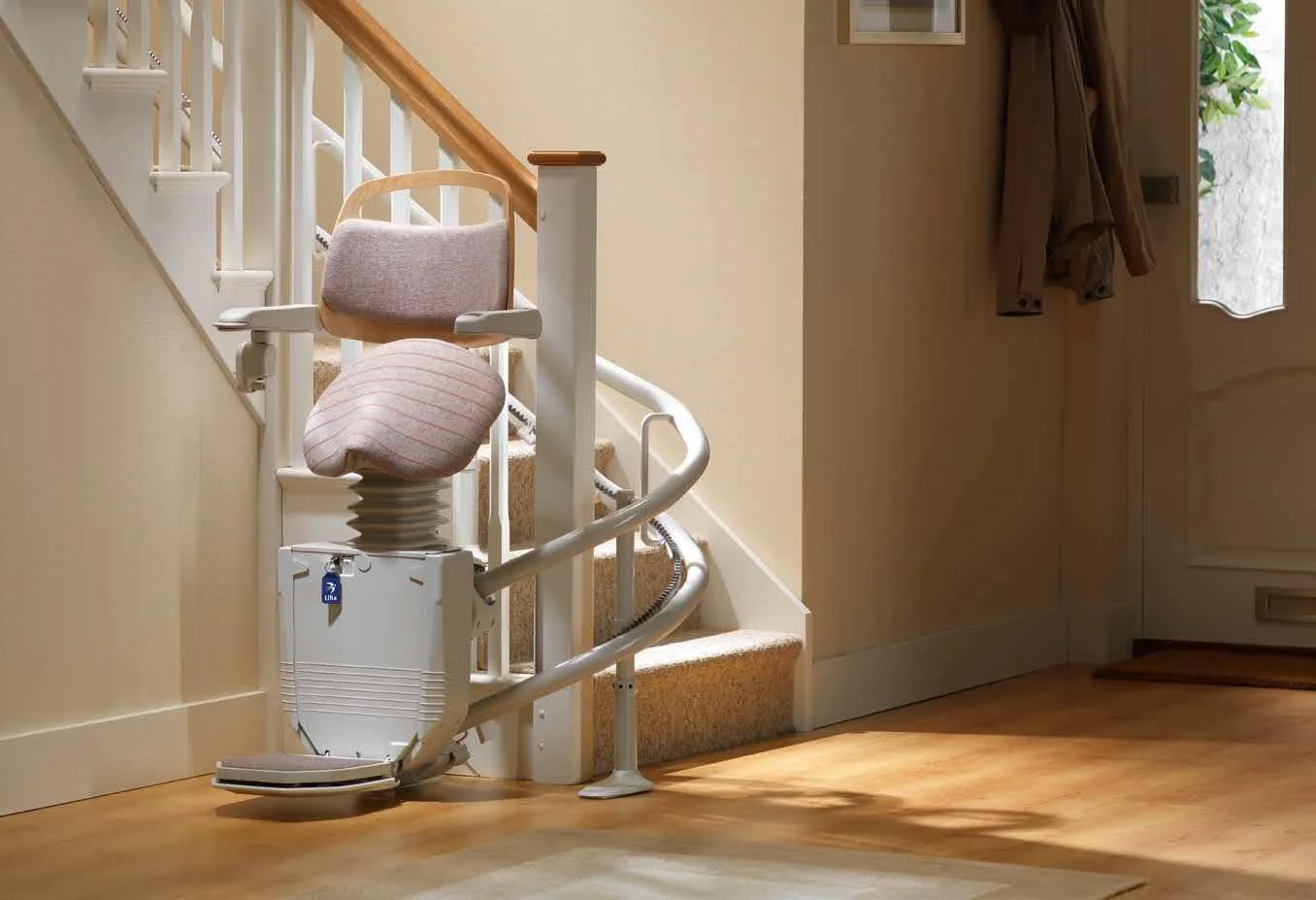
A straight stair lift rides a rail mounted to the stair treads, not the wall, so it can work on an older staircase as long as there is room for the seat and footrest. Narrow original stairs are the first thing we measure, because the folded width of the lift and the space left for others to walk past both matter.
Staircases with a landing, a turn or a winder at the top or bottom need a curved rail built to fit that exact stair. In a house built before modern codes, that is common. A curved lift takes longer to produce than a straight one, so it helps to start the conversation early.
Lexington's historic district is on the National and Virginia historic registers, and its housing stock is architecturally protected. That can bring permitting questions into a stair lift project in the historic core, so it is worth checking requirements before installation day.
Because most stair lift rails fasten to the treads, they usually leave original railings and walls alone. We look at the stair, the trim and the top and bottom landings with you so the plan fits both the person using the lift and the house itself.
The hills around Lexington, with the Blue Ridge Parkway and Natural Bridge close by, are a big reason so many local homes are split-level or multi-story. A split-level often has short runs of stairs between floors. Each run may need its own lift, or one curved rail if the flights connect.
Townhouses, walk-up apartments and low-rise buildings are also part of the city's mix. In a shared building, the stairway may not belong to the resident, which changes who must approve the work and which funding programs apply.
The City of Lexington has about 7,420 residents, and 16.4% are 65 or older. Washington and Lee University and the Virginia Military Institute anchor the local economy along with tourism, and many long-term senior residents live on fixed or retirement incomes.
Only 51.7% of households own their homes, so a large share of residents rent. That is important, because some programs serve only homeowners and at least one serves only renters.
Homeowners can look first at the Virginia Livable Home Tax Credit (LHTC), which names chair lifts as a qualifying retrofit feature. Renters with disabilities have a separate path through the Virginia Housing (VH) Rental Unit Accessibility Modification Grant, which names chairlifts.
Locally, VAIL serves people with disabilities in Lexington and lists chairlifts among its typical modifications. Medicaid waiver, state repair, USDA and VA programs may also help, but most of them do not name stair lifts, so ask before you count on them. The Valley Program for Aging Services (PSA 6) in Waynesboro, at (540) 949-7141, is another place to ask about options. The Assistive Technology Loan Fund Authority (ATLFA) is also listed among Virginia's statewide programs. Details on each program are below.
A state tax credit for homeowners who retrofit for accessibility; a retrofit must include at least one feature such as a chair lift, and the credit is 50% of retrofit cost up to $5,000 per the DBHDS sheet, though the current DHCD page lists a $6,500 cap, so confirm with DHCD at (804) 371-7000. Rental units are not eligible, and the application is due by January 31 of the year after the work is finished.
A one-time grant of $8,000 per individual for tenants with disabilities earning 80% or less of area median income, for modifications to their primary residence. Chairlifts are named as a covered modification; this program is for renters only.
A Medicaid waiver benefit of up to $5,000 per year for environmental modifications that give direct medical or remedial benefit to an eligible older adult or person with a disability; stair lifts are not specifically listed, so requests are reviewed case by case. Call (833) 522-5582.
A state home-repair grant of up to $4,000 for owner-occupied households at or below 80% of area median income, covering repairs and accessibility modifications such as wheelchair ramps; stair lifts are not specifically named. Lexington city remains eligible; call (804) 371-7000.
Federal repair loans up to $20,000 at 1% interest and grants up to $7,500 for homeowners 62 and older, for very-low-income owners in USDA-eligible rural areas. The source does not itemize repairs or mention stair lifts.
A lifetime benefit of $6,800 or $2,000 for veterans with a medically justified need for home improvements. HISA explicitly does not cover stair glides or porch lifts.
A VA grant of up to $126,526 (FY2026 maximum) to buy, build or modify a home for veterans with certain severe service-connected disabilities. Stair lifts are not specifically listed as a covered item.
A VA grant of up to $25,350 (FY2026 maximum) to adapt a residence for veterans with certain service-connected disabilities, such as loss of use of both hands. Stair lifts are not specifically listed.
An independent living center serving Planning District 6, including Lexington, that helps people with disabilities with home modifications; chairlifts are among its typical modifications, with no published dollar cap. Call (540) 433-6513.
A community action agency serving older adults and low-income residents of Lexington and nearby localities, with housing among its program areas. No stair lift or home-modification grant is listed, so call (540) 777-4673 to ask what is currently available.
Older adults
325 Pine Avenue, Waynesboro, 22980
Veterans
Greenbrier Office Complex 1600 North Coalter Street Building 1, Suite 17B, Staunton, 24401
Often, yes. Rails mount to the treads, and we measure the stair width, landings and any turns to see whether a straight or curved lift fits. Narrow original staircases are common in the city's older homes, so an in-home measurement is the first step.
Lexington's historic district is on the National and Virginia historic registers and its homes are architecturally protected, so permitting can come into play in the historic core. It is worth checking requirements before the lift is installed.
The Virginia Housing (VH) Rental Unit Accessibility Modification Grant offers $8,000 one time to tenants with disabilities earning 80% or less of area median income, and it names chairlifts. The Livable Home Tax Credit does not cover rental units.
The HISA grant specifically excludes stair glides. The SAH and SHA grants fund home modifications for certain service-connected disabilities but do not name stair lifts. The VA Staunton Office at (540) 332-8900 can talk through a veteran's options.
The Section 504 grants of up to $7,500 are for homeowners 62 and older. Loans up to $20,000 at 1% interest are part of the same program, and both require very low income and a home in a USDA-eligible rural area. The source does not mention stair lifts specifically.
Apply to DHCD by January 31 of the year after the work was completed, and you must be the one who paid for it. Call (804) 371-7000 to confirm the current cap.
Tell us about the stairs in your home and we will explain which lift fits, what it costs and how installation works.
