Downtown Fredericksburg still follows the original 1728 fifty-acre town site, and the forty-block Historic District holds over two hundred surviving Federal-period buildings next to colonial, Victorian, and Colonial Revival homes. Many of these are two- and three-story rowhouse-style and townhouse buildings with their original narrow staircases. They were never planned for single-level living or a lift shaft.
Outside the old blocks, the city climbs in rolling hills from the banks of the Rappahannock River, reaching 269 feet at its highest points. That means a lot of homes have stairs inside and a grade change outside. This page walks through what that means for a stair lift in Fredericksburg and which programs may help pay for one.
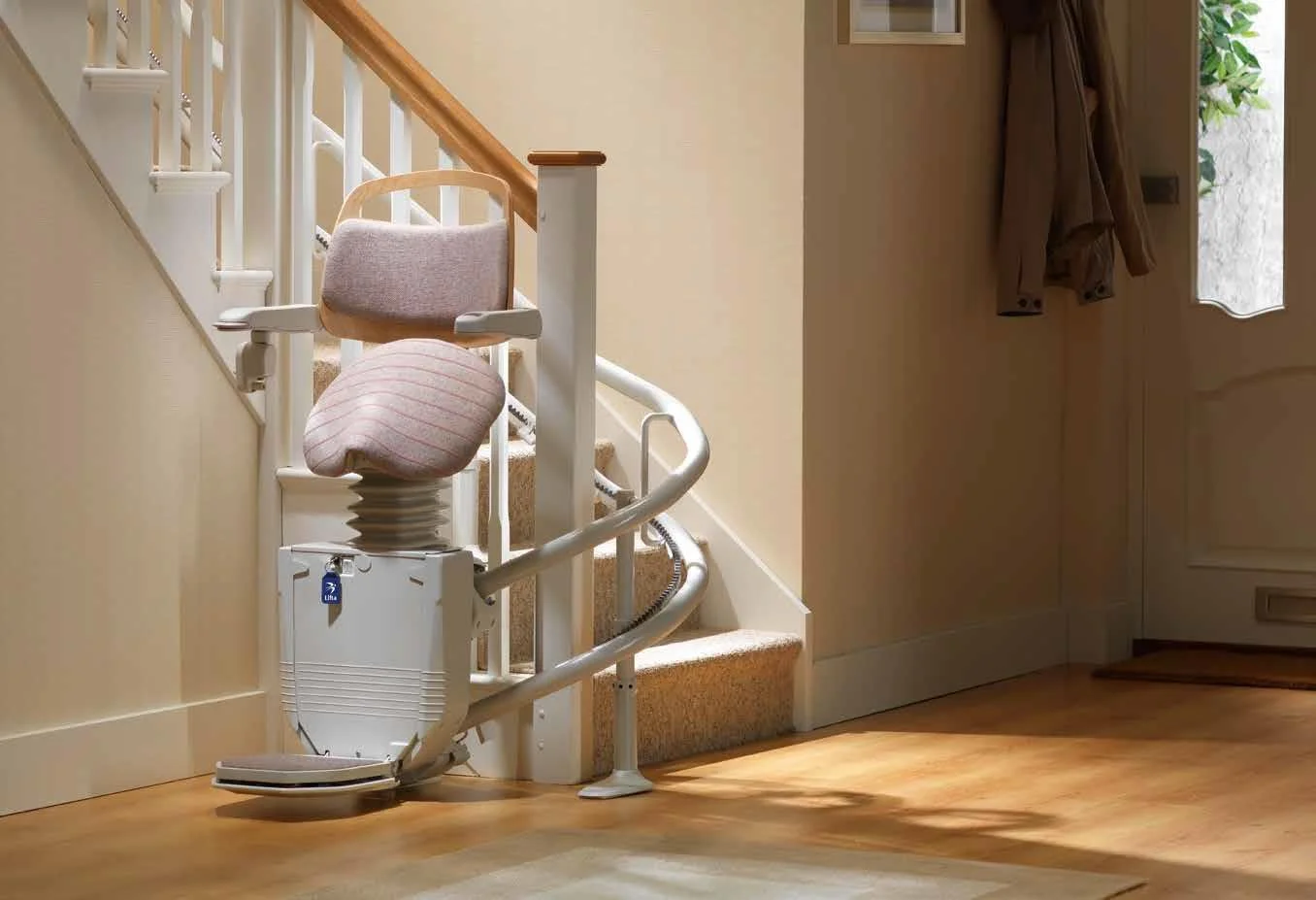
A straight stair lift is the simplest install, and it mounts to the stair treads, not the wall. That matters in Historic District homes, where we want to leave original plaster and trim alone. A narrow staircase can still take a straight rail if there is room for the seat to fold up when not in use.
Older rowhouses and townhouses often have turns, winders, or a landing halfway up. Those need a curved rail built to the exact shape of your stairs. We measure in person, because two homes on the same block can have very different stairways.
Across the city, elevations run from roughly 40 to 200 feet, so many lots sit above or below the street. Getting to the front door can be as hard as getting upstairs. An outdoor stair lift built for weather can run along exterior steps, and a platform lift can carry a wheelchair up a short rise.
When we plan a job here, we look at the whole path: driveway, front steps, and interior stairs. Sometimes a ramp handles the outside and a stair lift handles the inside.
About 41.6% of households in the city own their homes, so many older residents rent single-family homes, row houses, townhouses, or units in walk-up apartments and low-rise buildings. A stair lift in a rental needs the owner's written approval before we install anything.
Some funding is open to renters. The city's Removal of Architectural Barriers Program accepts renters with owner approval, and Virginia Housing runs a Rental Unit (RUAM) grant alongside its owner-occupied grant.
The clearest local option is the Virginia Housing accessibility grant, which lists chairlifts among covered work and offers up to $10,000 per household with no repayment. Income limits apply: 60% of area median income for owners and renters, and 80% for the veterans track. Applications go through a Virginia Housing accepted agent for Planning District 16.
VA HISA grants do not pay for stair glides, but they can cover related permanent work such as ramps and widened doorways. The Fredericksburg Office on Spotsylvania Avenue can be reached at (540) 376-7298.
Other programs below do not name stair lifts in their sources, so ask directly before counting on them. Statewide, it is also worth asking about the Virginia Livable Home Tax Credit (LHTC) and the Assistive Technology Loan Fund Authority (ATLFA).
A Virginia Medicaid waiver for people who meet a nursing-facility level of care, with Environmental Modifications and Assistive Technology each capped at $5,000 per year; stair lifts are not listed in the source, which names ramps, grab-bars, doorway widening and bathroom changes. Call (833) 522-5582.
A city grant for owners and renters (with owner approval) at or below 80% of area median income where a household member has a disability, covering ramps, railings, bath or kitchen changes, doorway widening and flashing alarms; stair lifts are not listed. Call (540) 372-1080.
Grants of up to $10,000 per household that list installing ramps and chairlifts as covered work, with no repayment. Call (877) 843-2123.
A VA grant for medically needed structural changes, with a $6,800 or $2,000 lifetime maximum depending on the disability; it does not cover stair glides but can fund ramps, roll-in showers and widened doorways. Call (800) 827-1000.
Grants for veterans with qualifying severe service-connected disabilities, up to $126,526 for SAH and $25,350 for SHA in FY2026, for building, buying or remodeling an accessible home; stair lifts are not specifically listed. Call (800) 827-1000.
The Area Agency on Aging for Fredericksburg at 460 Lendall Lane, offering meals, transportation, options counseling and referrals; it does not fund stair lifts directly but can point you to other help. Call (540) 371-3375.
A Center for Independent Living at 409 Progress Street offering skills training, advocacy, peer support and referrals, with adaptive equipment handled through its Equipment Connection program; no stair lift funding is listed. Call (540) 373-2559.
Older adults
460 Lendall Lane, Fredericksburg, 22405
Veterans
10300 Spotsylvania Avenue Suite 290, Fredericksburg, 22408
Often, yes. Straight rails mount to the treads, and stairs with turns or landings take a custom curved rail. We measure each staircase in person before quoting.
Yes. Virginia Housing's accessibility modification grants list installing ramps and chairlifts and go up to $10,000 per household. Call (877) 843-2123 to find the accepted agent for Fredericksburg.
Possibly. Virginia Housing has a Rental Unit (RUAM) grant, and the city's Removal of Architectural Barriers Program accepts renters with owner approval. Either way, the owner must agree to the installation.
The HISA grant excludes stair glides, though it can pay for ramps and widened doorways. Veterans may also qualify for Virginia Housing's Granting Freedom track at or below 80% of area median income. The Fredericksburg Office is at (540) 376-7298.
An outdoor stair lift can run along exterior steps, and a platform lift or ramp can handle a shorter rise. We look at the outside approach and the inside stairs together.
Healthy Generations Area Agency on Aging at (540) 371-3375 offers options counseling and referrals for older adults in Fredericksburg.
Tell us about the stairs in your home and we will explain which lift fits, what it costs and how installation works.
