From Stephens City and Middletown to Lake Holiday, Shawneeland and Brucetown, Frederick County sits at the northern end of the Shenandoah Valley, between the suburbs around the City of Winchester and a countryside of farms, orchards and wooded mountains. Most homes here are owner-occupied houses, not apartments, and many of them have their bedrooms upstairs.
This page explains how the county's houses and townhouses tend to work with stair lifts, what the rural layout means for planning an install, and which state, federal, veteran and local programs Frederick County residents can contact about the cost. Most of these programs do not name stair lifts directly, so we say where that is the case.
Frederick County has 38,624 housing units, and 29,800 of them are single-family detached homes. The stock is fairly new: about 15,900 units, roughly 41%, were built in 2000 or later, and only 614 date to 1939 or earlier. So the house we usually see here is a late-1990s or 2000s subdivision home, not a pre-war farmhouse.
There is also an older middle tier, with 5,154 units from the 1970s and 4,704 from the 1980s. That is the era of split-level and two-story colonial plans. Their stairs are usually straight, enclosed runs, which suit a standard straight-rail stair lift and keep the job simpler.
The county has 3,943 single-family attached, townhouse-style homes. These are normally built on two or three stacked levels, with every bedroom and full bathroom above the entry floor. There is no way to live on one level, so the stairs become the main problem once walking gets harder.
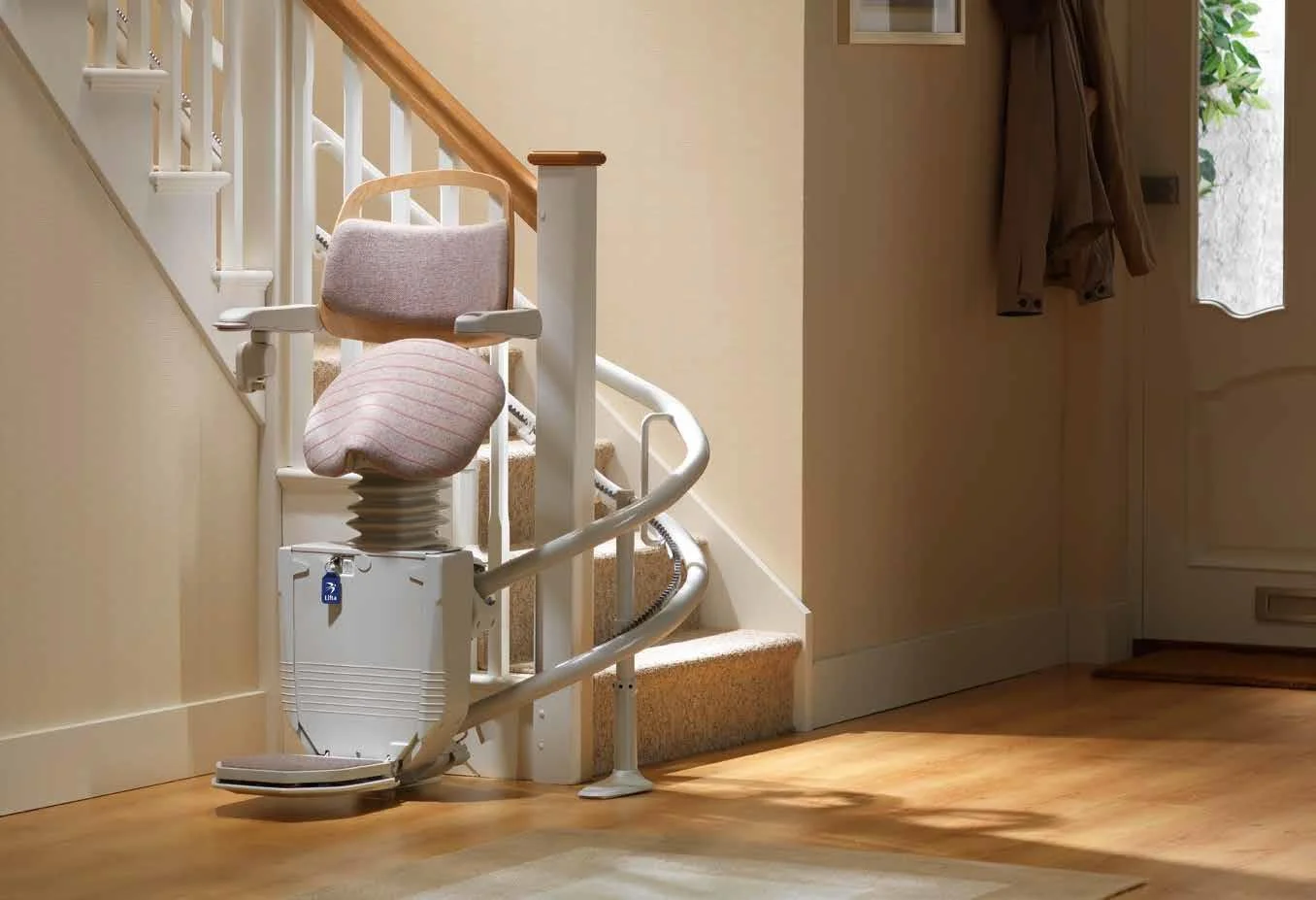
In a townhouse with stacked levels, we look at each flight and every landing. Straight flights can take a straight rail; a stair that turns at a landing usually needs a curved rail, or separate lifts on each straight section. Split-level homes have shorter runs, but the same question applies: which levels does the person need to reach every day?
Frederick County also has 2,777 mobile or manufactured homes. When the steps that matter are the ones outside at the entry, the conversation shifts to outdoor-rated lifts or a platform lift rather than an indoor chair.
In the five communities covered by this page's figures, 13.2% of residents are 65 or older and 76.6% own their homes. Ownership matters, because most of the programs below are written for homeowners, and owners can make permanent changes like a mounted rail.
VA housing grants have their own rules about stair lifts, which we cover in the programs list, so veterans should read those details before applying.
The county covers 416 square miles and borders West Virginia to the north and west, with a population density of 221.3 people per square mile as of 2020. That rural-to-suburban mix spreads older residents across long distances from town-center services.
It can also make it harder to line up contractors for accessibility work. If you live out past the subdivisions, plan ahead: get the stairs measured early and gather program paperwork at the same time so one trip can cover both.
Agriculture is still central here. The county harvested 4,400 of Virginia's 10,879 acres of apples, more than any other county, across 762 farms. Between 2012 and 2017 cash farm income fell 75%, and incomes tied to farming can swing from year to year, which makes a large one-time purchase harder to plan for older owners.
Only one program below, the Virginia Housing RUAM grant, names chairlifts as covered, and it is for renters only. Most others fund home modifications or accessibility work in general without naming stair lifts, so call and ask before you count on them. A good first call for anyone 60 or older is Seniors First at (540) 635-7141, at 207 Mosby Lane in Front Royal. Veterans can reach the Virginia Department of Veterans Services Loudoun Benefits Office in Ashburn at (703) 995-9998.
This statewide Medicaid waiver pays up to $5,000 per person per calendar year for environmental modifications for enrolled members who meet nursing facility level of care; the regulation lists items like ramps, grab bars and doorway widening, and stair lifts are not listed. Members apply through their managed care organization care coordinator, and the enrollment helpline is (800) 643-2273.
The area agency on aging for adults 60 and older in Frederick County and neighboring localities offers Meals on Wheels, transportation, in-home care and Medicare counseling; no home modification or stair lift fund is listed. Call (540) 635-7141 for information and referrals.
Serves homeowners in Frederick County, Clarke County, Shenandoah County and the City of Winchester where the owner or a household member is 60 or older, with costs on a sliding scale by income and veteran status; it names handrails, portable ramps and bathroom fixtures, but stair lifts are not listed. Call (540) 662-7066.
A state tax credit for 50% of eligible retrofit costs, up to $6,500, for adding permanent accessibility features, with unused credit carried forward up to seven years. Stair lifts are not listed, so confirm with DHCD at (804) 371-7000 before relying on it.
Provides up to $4,000 per household at or below 80% of area median income for health and safety repairs and accessibility modifications, and Frederick County is an eligible locality; stair lifts are not listed by name. Call (804) 371-7000.
A grant of up to $10,000, with no repayment, for renters with a documented disability and income at 60% or less of area median income; chairlifts are named as a covered modification. Applications go through a Virginia Housing-approved agent, and the number is (877) 843-2123.
Offers below-market-rate loans with no down payment to Virginia residents with a disability or their caregivers, with no income requirement; home modification loans are offered, but stair lifts are not listed by name. Call (866) 835-5976.
Very-low-income homeowners in eligible rural areas can get 1% loans up to $40,000, and owners 62 or older who cannot repay a loan may get grants up to $10,000; listed repairs include ramps and grab bars, and stair lifts are not listed. Eligibility should be checked by address with USDA.
Pays up to $6,800 or $2,000 lifetime, depending on disability status, for medically needed structural changes for veterans. Stair glides are specifically excluded, so this grant does not cover a stair lift.
For veterans and servicemembers with certain severe service-connected disabilities, with a maximum of $126,526 for FY 2026 that can be used up to 6 times over a lifetime. Stair lifts are not listed among the examples given.
For veterans with qualifying service-connected disabilities such as loss of use of both hands, with a maximum of $25,350 for FY 2026. Stair lifts are not listed among covered adaptations.
Older adults
207 Mosby Lane, Front Royal, 22630
Veterans
Lakes at Ashbrook Bldg 2, 44345 Premier Plaza, Suite 200, Ashburn, 20147
Often, yes. Split-level and two-story colonial plans from that era usually have straight, enclosed stair runs, which suit a standard straight-rail stair lift. We still measure each flight, since split-levels have several short runs.
Townhouses here are normally built on two or three stacked levels with bedrooms and full baths above the entry floor, so a lift is often the only way to stay in the home. Depending on the landings, that may mean a curved rail or a separate straight lift on each flight.
Seniors First and the Habitat Aging in Place program start at age 60. Programs like ATLFA, EHARP and the Livable Home Tax Credit are not tied to age, though ATLFA requires a disability and EHARP has an income limit.
The HISA grant specifically excludes stair glides. The SAH and SHA grants do not list stair lifts among their examples, so ask the Virginia Department of Veterans Services Loudoun Benefits Office at (703) 995-9998 about your situation.
Yes, renters can look at the Virginia Housing RUAM grant, which names chairlifts and pays up to $10,000 for renters with a disability and income at 60% or less of area median income. Call (877) 843-2123. EHARP also accepts renters with the owner's written approval.
For anyone 60 or older, Seniors First at (540) 635-7141 is a good starting point for referrals. If cost is the main question, call the program that best matches your situation from the list above and ask directly whether a stair lift qualifies.
Tell us about the stairs in your home and we will explain which lift fits, what it costs and how installation works.
