Covington sits at about 1,250 feet in the Alleghany Mountains, where the Jackson River meets Dunlap Creek. Many houses here were built in the late 19th and early 20th centuries, and a lot of them have more than one story with the bedrooms and bathroom up a flight of interior stairs.
That combination of older multi-story homes and steep hillside lots is why stair lifts come up so often in this city. This page walks through how Covington's houses and terrain affect the choice of lift, and which programs can help cover the cost.
The Covington Downtown Historic District was listed on the National Register in 1991 and covers roughly 40 acres of late-19th and early-20th-century commercial buildings and residences. Homes from that era usually have interior stairs between floors, and those stairs are the main barrier for someone who is having trouble with steps.
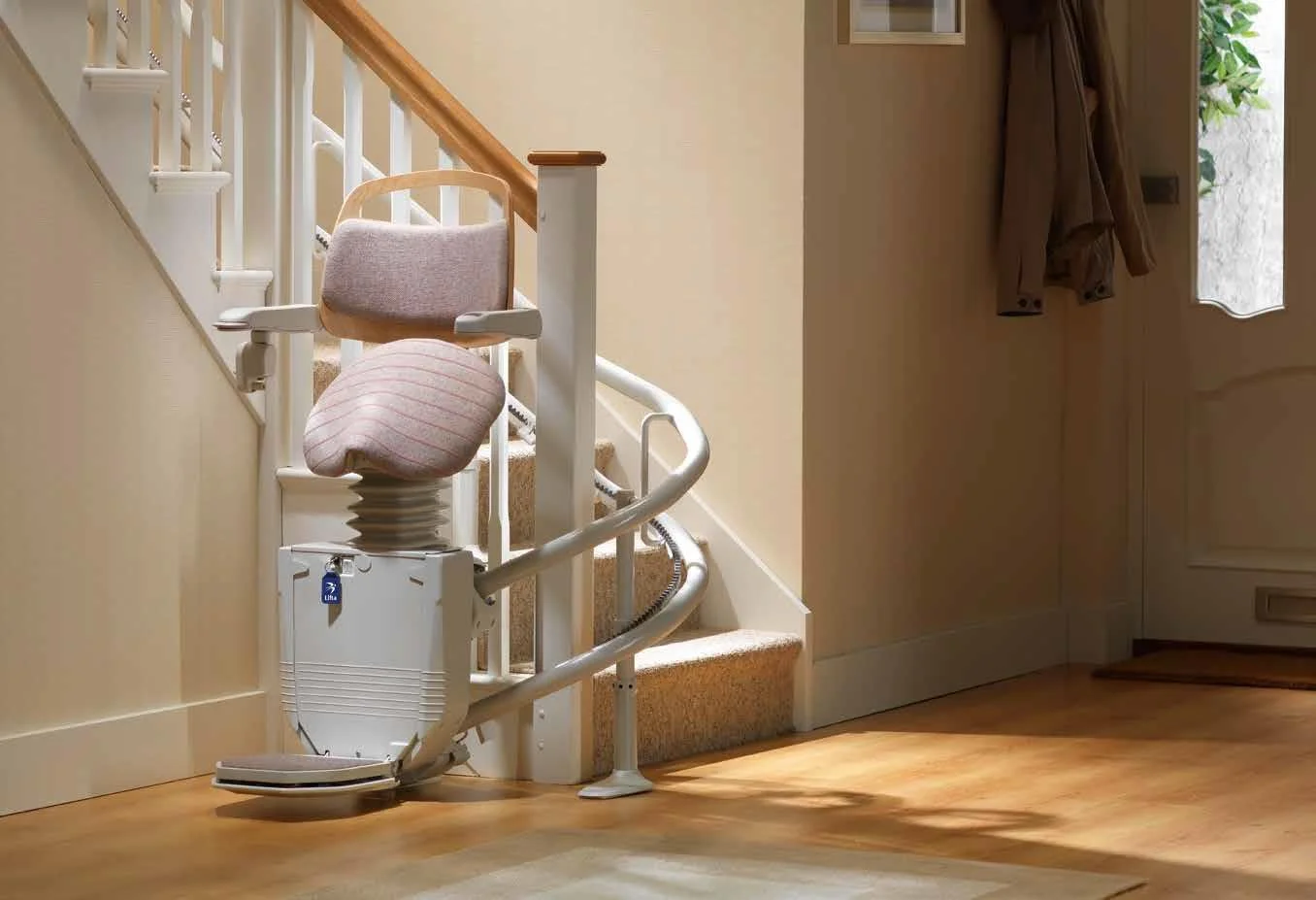
A stair lift is a retrofit that rides along the existing staircase, so it does not require rebuilding the stairs. A straight staircase is generally the simpler job, while stairs with a turn or landing call for a curved rail built to fit. We look at the staircase in person before recommending either.
The land around Covington is mountainous, with steep ridges, deep hollows and forested slopes. On a hillside lot, building an exterior ramp can be difficult because of the grade and the space a ramp needs.
For many of these homes, an interior stair lift solves the daily problem of getting between floors without fighting the slope outside. If the entry steps are the issue instead, an outdoor lift rated for weather may be worth discussing during the home visit.
Covington's housing includes single-family homes, duplexes, townhouses, walk-up apartments and low-rise buildings. Townhouses and walk-ups in particular tend to stack living space over several floors, so a lift can make the difference in staying put.
About 71.4% of residents own their homes, which makes installing a lift a straightforward decision for most households. Renters need the owner's approval, and some programs below, such as EHARP, accept tenants who have that approval.
The city has about 5,671 residents, and 19.4% are 65 or older. That is a sizable share of households where an aging parent or homeowner may already be thinking about the stairs.
It helps to know early that the VA's HISA grant does not pay for stair glides, so veterans usually look at the state and local programs listed here for a stair lift.
Household budgets here are modest; median household income was reported at $30,325 as a 2000 figure. That makes grants and waiver programs an important part of the conversation for many families.
Two programs specifically name stair lifts or chairlifts: the CCC Plus Waiver's Environmental Modifications benefit and the Virginia Housing Owner-Occupied Modification Grant, which pays up to $10,000 with no repayment. Others, like EHARP and USDA Section 504, fund repairs and accessibility work but do not name stair lifts, so ask before you count on them.
Virginia also has statewide options worth asking about, including the Virginia Livable Home Tax Credit (LHTC) and the Assistive Technology Loan Fund Authority (ATLFA). The Local Office on Aging at (540) 345-0451 is a good first call to sort out which ones fit.
Virginia's statewide Medicaid home and community-based waiver, which lists stair lifts among its environmental modifications for people 65+ or under 65 and disabled who need a nursing-facility level of care. Enrollees request it through their plan's care coordinator; call (855) 242-8282.
The area agency on aging for the 5th Planning District, including the City of Covington, offering information, referral and help connecting to CCC Plus waiver counseling. Stair lifts are not listed as a direct benefit; call (540) 345-0451.
A grant of up to $10,000 with no repayment for homeowners at or below 60% of area median income, and it lists installing ramps and chairlifts among funded work. Apply through a Virginia Housing-approved agent; call (877) 843-2123.
A Virginia DHCD program paying up to $4,000 per applicant for repairs and accessibility modifications for households at or below 80% of area median income, including tenants with owner approval. Stair lifts are not named specifically; call (804) 371-7000 and confirm an active local provider.
Repair loans up to $40,000 at 1% fixed interest, plus grants up to $10,000 lifetime for homeowners 62 and older, for owner-occupants at or below 50% of area median income in eligible rural areas. Stair lifts are not named in the source, and eligibility must be checked by address with the USDA Property Eligibility Tool.
A VA grant for medically necessary home alterations, with a $6,800 or $2,000 lifetime maximum depending on disability status. It explicitly does not cover stair glides or porch lifts; the Salem VA Medical Center Benefits Office is at (540) 982-2463.
A nonprofit serving people with disabilities in the 5th Planning District, including Covington, with referral, peer counseling, advocacy and equipment loans. Stair lift help is not listed by name; call (540) 342-1231.
Older adults
4932 Frontage Road NW, Roanoke, 24019
Veterans
Salem VA Medical Centern1970 Roanoke Blvd.nBldg. 8, Room 113, Salem, 24153
Not through HISA. That grant specifically excludes stair glides and porch lifts. Veterans can still apply for the state programs, such as the Virginia Housing Owner-Occupied Modification Grant, if they meet the income and ownership rules.
Yes. The CCC Plus Waiver covers people under 65 who are disabled and need a hospital or nursing-facility level of care, and its Environmental Modifications benefit lists stair lifts. The Virginia Housing grant has no age requirement, only income and homeownership rules.
No. The Owner-Occupied Modification Grant is a true grant of up to $10,000 with no repayment. Your household income must be at or below 60% of area median income, and you apply through a Virginia Housing-approved agent for your locality.
EHARP accepts tenants who have the owner's approval, though it does not name stair lifts specifically. Any installation in a rental also needs the landlord's permission, so start that conversation first.
It has to be checked for each address using the USDA Property Eligibility Tool. The program requires a town population under 35,000, owner occupancy and income at or below 50% of area median income.
The Local Office on Aging at (540) 345-0451 serves Covington and can point you toward CCC Plus waiver counseling and other home-modification referrals. Their office is on Frontage Road NW in Roanoke.
Tell us about the stairs in your home and we will explain which lift fits, what it costs and how installation works.
