Charlottesville sits in the upper Piedmont Plateau at the foothills of the Blue Ridge Mountains, at the headwaters of the Rivanna River. It is an independent city, not part of any county, and it is entirely surrounded by Albemarle County. At 10.24 square miles, it packs a lot of houses onto hilly ground.
Much of that housing is historic. Many homes were built in the 19th and early 20th centuries with their original multi-story floor plans and interior staircases still in place. That kind of older, multi-level house is the one we most often retrofit with a stair lift, so this page walks through what fits and how Virginia residents can pay for it.
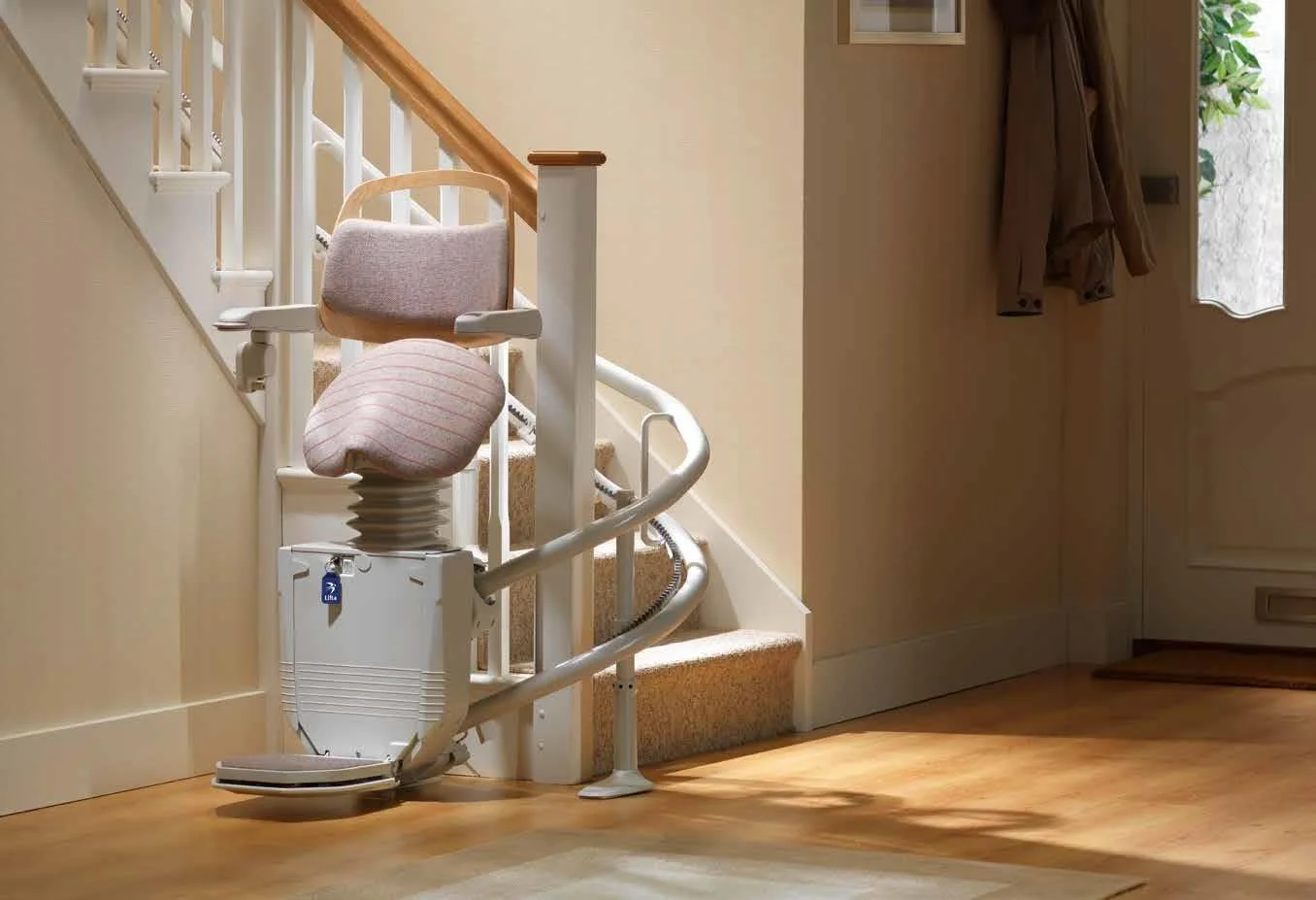
A house built in the 19th or early 20th century usually keeps its bedrooms and full bath upstairs. When climbing those stairs gets hard, the choice is often a stair lift or moving out. A lift lets the upstairs stay in use without rebuilding the floor plan.
Original staircases vary a lot. A single straight run takes a straight rail, which is the simplest install. Stairs that turn at a landing or wind around a corner need a curved rail built to that specific staircase, so we measure every step before quoting.
The city's housing mix includes detached houses, row houses, townhouses, walk-up apartments and low-rise buildings. Row houses and townhouses often have narrow stairs between floors, so we check width and clearance at the top and bottom where the seat folds and parks.
Only 43.7% of households here own their home, which matters for payment. Some programs below are limited to owner-occupied homes, while one Piedmont Housing Alliance grant is aimed at renters with disabilities.
Charlottesville's hilly Blue Ridge foothill setting is a real factor when planning for aging in place. Many homes have steps up from the street or yard before you even reach the front door.
For those, an outdoor stair lift built for weather, a platform lift, or a ramp may be the right answer. We look at the full path from the car to the bedroom, not just the indoor staircase.
The city offers the Design for Life Cville accessible-housing incentive. It refunds 25% of building-permit fees for a Visit-Able home, meaning a no-step entry and accessible doors and bathroom, and 50% for a fully Live-Able home, which adds an accessible bedroom, full bath and kitchen accessibility features.
This incentive can be paired with the state Livable Home Tax Credit. If you are planning a larger accessibility project, it is worth asking about both before work starts.
Two programs on the list below name stair lifts directly: the CCC Plus Medicaid Waiver and the Virginia Livable Home Tax Credit. The tax credit has no income limit, which makes it the first place most owner-occupants should look.
VA grants are worth knowing about, but the HISA grant specifically excludes stair glides, so veterans should plan around other sources for the lift itself. Local groups like JABA can help sort out which programs fit.
Virginia's main Medicaid home and community-based waiver for adults 65+ or under 65 with a qualifying disability who need a nursing-facility level of care, and its environmental adaptations include stair lifts. Charlottesville residents apply through their MCO (Anthem, Aetna, Molina, Optima, or UnitedHealthcare) or the local Department of Social Services.
A state income tax credit for 50% of eligible retrofit costs, capped at $6,500 per residence, and stair lifts installed as permanent fixtures qualify. It is open to owner-occupants with no income limit; call the Virginia Department of Housing and Community Development at (804) 371-7124.
A VA grant for medically necessary home alterations, up to $6,800 or $2,000 lifetime depending on the disability, but it does not fund stair lifts because stair glides are excluded as removable equipment. Call (800) 827-1000.
Grants of up to $126,526 (SAH) or $25,350 (SHA) for FY2026 for veterans with qualifying severe service-connected disabilities; the VA page does not list stair lifts as an example adaptation. Call (800) 827-1000.
1% loans up to $40,000 and grants up to $10,000 for very-low-income homeowners age 62+ in USDA-eligible rural areas; stair lifts are not specifically named. Coverage around Charlottesville is mixed, so eligibility must be checked address by address on USDA's Property Eligibility map.
A local nonprofit serving the Charlottesville region that handles home repairs, both big and small, for income-qualifying residents. Stair lifts are not mentioned in the sources reviewed, so ask AHIP directly about eligibility and service area.
RUAM funds accessible modifications to rental units for renters with disabilities, and Granting Freedom funds accessible home modifications for veterans and service members with a line-of-duty service-connected injury; stair lifts are not named specifically. Call (434) 817-2436.
A state low-interest loan fund, not a grant, for assistive technology and home modifications for Virginians with disabilities or their family members; stair lifts are not named specifically, though it covers equipment directly related to the person's disability. Call (804) 662-9000.
The Area Agency on Aging for adults 60+ and caregivers in the City of Charlottesville and surrounding counties, offering referral, respite care, meals and insurance help; it has no dedicated stair lift program. Call the helpline at (434) 817-5222.
Older adults
674 Hillsdale Drive, Suite 9, Charlottesville, 22901
Veterans
1430 Rolkin Court, Suite 202, Charlottesville, 22911
Yes, if the stair lift is installed as a permanent fixture. The credit is 50% of eligible retrofit costs, up to $6,500 per residence, and the application must be filed with DHCD by January 31 of the year after the work is done.
The Livable Home Tax Credit does not apply to rental units. Piedmont Housing Alliance runs the RUAM grant for renters with disabilities, which funds accessible modifications to a rental unit; call (434) 817-2436 to ask whether a stair lift fits.
The HISA grant does not, because its rules exclude stair glides as removable equipment. The SAH and SHA grants do not list stair lifts as an example adaptation, so call (800) 827-1000 or the Virginia Department of Veterans Services office in Charlottesville at (434) 529-6431 to ask about your situation.
The CCC Plus Medicaid Waiver lists stair lifts among its environmental adaptations. You need to qualify for Medicaid and need a nursing-facility level of care, and you apply through your MCO or the local Department of Social Services.
JABA serves people 60 and older, but ATLFA loans are open to Virginians with a disability of any age, and the CCC Plus waiver covers people under 65 with a qualifying disability. The Livable Home Tax Credit has no age or income limit for owner-occupants.
The Jefferson Area Board for Aging at 674 Hillsdale Drive, Suite 9, is the regional hub for older adults and caregivers. Its helpline is (434) 817-5222.
Tell us about the stairs in your home and we will explain which lift fits, what it costs and how installation works.
