Caroline County sits in Virginia's Piedmont about 30 miles north of Richmond, with the Rappahannock River along its northern edge near Port Royal. Homes are spread out, from Bowling Green to the lake communities of Lake Land'Or and Lake Caroline. The county averages about 58.5 people per square mile, so a lot of families live a good drive from the nearest contractor or clinic.
That distance matters when stairs start to feel risky. A stair lift can let someone keep using the whole house without waiting on outside help for every trip up or down. This page walks through how local homes affect the choice of lift and where Caroline County residents can look for help paying for one.
The county's housing ranges from very old to fairly modern. Old Mansion, built circa 1742 as a one-and-one-half story masonry house with a two-story frame rear section added in 1791, is an example of the multi-level colonial construction found here. Homes like that were built long before anyone planned for accessibility, and their staircases are often narrow, steep or turning.
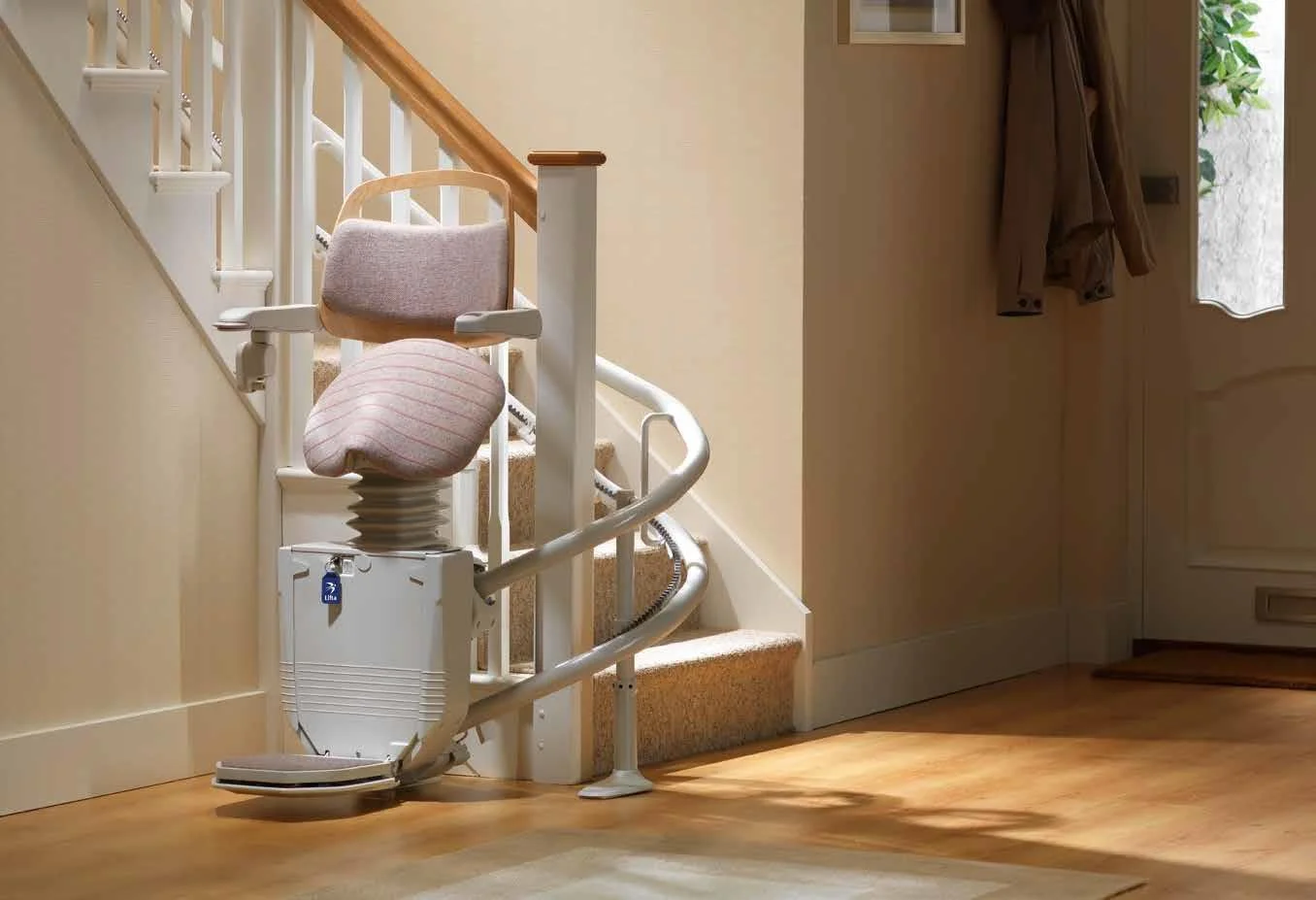
A turning or landing staircase usually calls for a curved stair lift, which rides a rail custom-bent to follow the stairs. Straight staircases in many single-family homes can take a straight lift, which is simpler to fit. Split-level homes are a special case: the short flights between levels may each need their own lift, so we look at how the person actually moves through the house before recommending anything.
Ranch-style homes often have no inside stairs at all, but the front or side entry may still have steps. An outdoor stair lift or a platform lift can handle that entry, and a platform lift is the usual answer when someone uses a wheelchair.
Walk-up apartments are harder because the stairs are shared and the renter does not own the building. Any lift there needs written approval from the owner. Some funding programs listed below do accept renters, which helps.
Per the 2020 Census, 100.0% of Caroline County's population lives in areas classified as rural. Interstate 95 and U.S. Routes 1 and 301 connect the county to Richmond and Fredericksburg, but workers here average a 37.2-minute one-way commute, well above the 26.4-minute U.S. average. Adult children who drive in to help an aging parent know that time adds up.
About 15.4% of residents are 65 or older, and 81.0% of households own their home. Owning the house makes a permanent installation and most grant programs much easier. Because service visits involve travel, it is worth asking about maintenance and repair scheduling before you buy.
The clearest match is the Virginia Housing accessibility grants, whose official page lists installing ramps and chairlifts among covered modifications, with grants up to $10,000 that do not need to be repaid. Applications go through an accepted agent, so call (877) 843-2123 to get started.
Other programs cover home repairs or accessibility work in general but do not name stair lifts, so ask before counting on them. These include EHARP, the Livable Home Tax Credit, the CCC Plus Waiver and USDA Section 504 repair loans and grants. The Assistive Technology Loan Fund Authority (ATLFA) is also listed among statewide resources worth asking about.
For veterans, note that the VA HISA grant specifically excludes stair glides. The Virginia Department of Veterans Services - Fredericksburg Benefits Office at (540) 376-7298 can help sort out which veteran benefits apply. Healthy Generations AAA at (540) 371-3375 is the right first call for local referrals for anyone 60 or older.
A Medicaid waiver for eligible older adults and people with physical disabilities who need nursing-level care, with no waiting list. It lists Environmental Modifications and Assistive Technology as services but does not name stair lifts; call (833) 522-5582.
The designated Area Agency on Aging for Caroline County, serving adults age 60 and up. It does not list a stair lift or home modification grant, but it is the right first contact for local referrals at (540) 371-3375.
A Center for Independent Living that runs HUD-funded home modification projects for older adult homeowners in its service area, which includes Caroline County. Its documents do not mention stair lifts; call (540) 373-2559 to ask what it can do for your home.
Loans up to $40,000 and grants up to $10,000 (up to $50,000 combined) for very-low-income homeowners in USDA-eligible rural areas, with grants limited to homeowners 62 and older who cannot repay a loan. The source describes removing health and safety hazards and does not name stair lifts.
A VA grant of up to $6,800 or up to $2,000 lifetime, depending on disability status, for medically necessary home modifications. Stair glides and porch lifts are specifically excluded, so it will not pay for a stair lift.
Grants of up to $126,526 (SAH) or $25,350 (SHA) for veterans with severe qualifying service-connected disabilities who own or will own the home. The VA page covers adapting a home but does not mention stair lifts.
True grants of up to $10,000 for disabled veterans, homeowners and renters who meet income limits, available statewide including Caroline County. Installing chairlifts is explicitly covered; applications go through an accepted agent, so call (877) 843-2123.
A state grant of up to $4,000 for households at or below 80% of Area Median Income, covering repairs, wheelchair ramps and other accessibility modifications. Stair lifts are not named; call (804) 371-7000 to confirm.
A Virginia income tax credit of 50% of retrofit cost up to $6,500 for existing homes, with unused credit carrying forward up to 7 years. It covers accessibility retrofits generally without naming stair lifts; call (804) 371-7000.
Older adults
460 Lendall Lane, Fredericksburg, 22405
Veterans
10300 Spotsylvania Avenue, Lee Hill Building 1, Suite 290, Fredericksburg, 22408
Yes. The Virginia Housing accessibility grants list installing chairlifts among covered modifications, with grants up to $10,000 that do not need repayment. Income limits apply, and you apply through an accepted agent. Call (877) 843-2123.
No. The official VA page excludes removable equipment such as portable ramps, porch lifts and stair glides from HISA coverage. Veterans can still look at the Granting Freedom grant through Virginia Housing, which covers chairlifts for eligible disabled veterans.
Start with Healthy Generations AAA at (540) 371-3375, located at 460 Lendall Lane in Fredericksburg. It serves adults 60 and older in Caroline County and can point you to local resources.
The RUAM program under Virginia Housing serves renters with income at or below 60% of AMI, and EHARP accepts tenants with written owner approval. Either way, the building owner has to agree to the installation.
Usually, yes. Turning or landing staircases, common in older multi-level homes, typically need a curved stair lift with a custom rail. Split-level homes may need separate lifts for each short flight. A home visit is the way to know for sure.
USDA Section 504 serves very-low-income homeowners in USDA-eligible rural areas, and Caroline County's population is classified as 100.0% rural per the 2020 Census. The program source does not name the county or stair lifts, so confirm eligibility with USDA before planning around it.
Tell us about the stairs in your home and we will explain which lift fits, what it costs and how installation works.
