Buckingham County spreads across about 584 square miles of Virginia's Piedmont, from the James River on its northern edge down through Dillwyn, Buckingham Courthouse and Yogaville. It even holds the geographic center of the state, near the Mt. Rush community. With about 29 people per square mile, homes here sit far apart, often on long rural roads.
That spread matters when a parent starts struggling with the stairs. Most houses are older, owner-occupied single-family homes, ranch-style homes and split-levels, and the right lift depends on how those stairs were built. This page walks through what fits, what a home visit involves out here, and which programs can help with the cost.
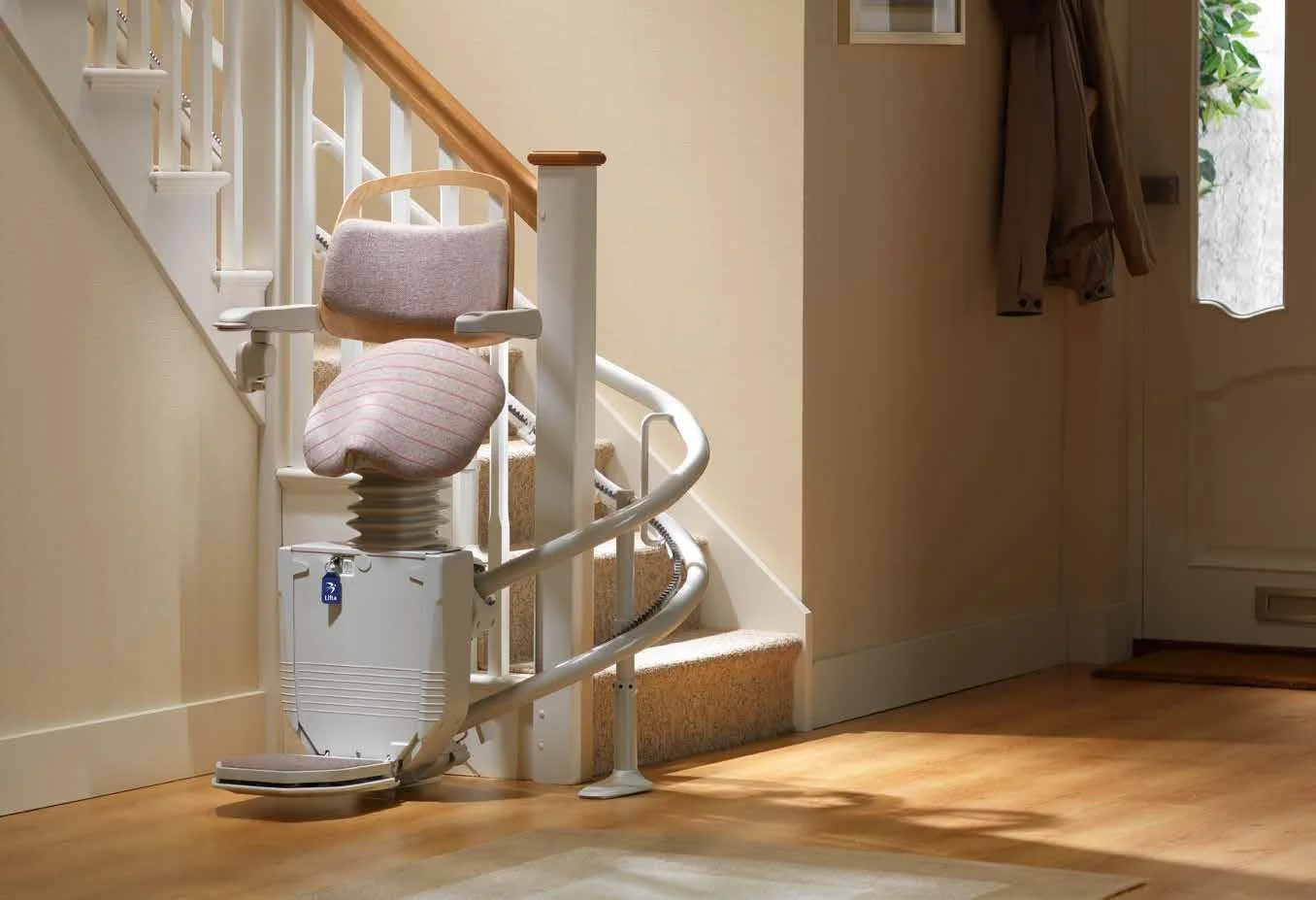
The local housing stock is mostly older and rural rather than newer suburban construction. Stairways in these homes were built to older code standards, so we measure width, rise and landing space before recommending anything.
A single straight flight in a two-story single-family home is usually the simplest job, using a rail that mounts to the stair treads. Split-level homes are different. They often have short flights between levels, and a turn or a second flight may call for a curved lift built to the shape of the staircase.
Ranch-style homes may have most rooms on one floor, but the steps up to the porch or down to a basement can still be the problem. Those spots are where an outdoor lift or a platform lift comes into the conversation. For low-rise buildings with shared stairs, the building owner's permission comes first.
Aging residents in Buckingham County are widely spread out, and there is no dense pool of local installers to choose from. Travel distance shapes how an assessment, installation and any later service calls get scheduled.
It helps to have a few things ready before the visit: a sense of which stairs are hardest, where the person needs to get to, and whether an outside entry is also an issue. Measuring every staircase on one trip saves a second drive out to the house.
The 2020 census counted 16,824 residents, with a median age of 44.1 and about 19.8% age 65 or older. About 73.8% of housing was owner-occupied, so most older residents are making decisions about a house they own.
Ownership matters for funding. Several of the programs below, including the USDA repair program and the VA adaptation grants, require that the applicant own the home.
Incomes here mean many seniors look to grants and public programs rather than paying entirely out of pocket. The program that clearly names chairlifts is the Virginia Housing Accessibility Grants, which offer up to $10,000 with no repayment, applied for through an approved agent you can find by county at VirginiaHousing.com/AccessibilityGrants.
Other options cover home modifications more broadly without naming stair lifts, so ask each one directly. Piedmont Senior Resources in Farmville, at 20 Oak Street, can help sort out referrals for people 60 and older. Veterans can reach the Lynchburg Office of the Virginia Department of Veterans Services at (434) 582-5102.
Statewide programs worth asking about also include the Virginia Livable Home Tax Credit (LHTC) and the Assistive Technology Loan Fund Authority (ATLFA). Details for each program we have verified are listed below.
Virginia's main home and community-based Medicaid waiver for adults 65+ and people with disabilities who meet a nursing-facility level of care, with a 2026 income limit of about $2,982/month for a single applicant and a $2,000 single / $4,000 couple asset limit. Environmental Modifications and Assistive Technology are covered categories, but the official page does not name stair lifts or give a dollar cap.
Serves people 60 and older in Buckingham and six neighboring counties with information and referral, at-home services and minor home repair; stair lifts are not mentioned as a specific benefit. Call (434) 767-5588 or 800-995-6918.
Offers loans up to $40,000 at 1% for 20 years and grants up to $10,000 for homeowners 62+ with household income at or below 50% of area median income in eligible rural areas. The source names ramps, grab bars and walk-in tubs but not stair lifts; call the Farmville office at (434) 392-4906.
Pays for medically necessary permanent changes such as fixed ramps, widened doorways and roll-in showers, up to $6,800 or $2,000 lifetime depending on disability status. The VA explicitly excludes stair glides, so it will not cover a stair lift; call (800) 827-1000.
For veterans who own their home and have qualifying severe service-connected disabilities, with SAH up to $126,526 and SHA up to $25,350 for FY2026 to build, buy or remodel for accessibility. Stair lifts are not named on the source page; call (800) 827-1000.
Grants up to $10,000 with no repayment for homeowners at or below 60% AMI, renters at or below 60% AMI, and disabled Virginia veterans at or below 80% AMI, and the program explicitly lists chairlifts. Apply through an approved agent for Buckingham County or call (877) 843-2123.
Older adults
20 Oak Street, Farmville, 23901
Veterans
519 Leesville Road Suite A, Lynchburg, 24502
Often, yes. Split-levels tend to have short flights between levels, and if a flight turns or connects to another, a curved lift made for that staircase is usually the fit. A measurement visit settles it.
No. The VA lists stair glides among removable equipment that HISA will not pay for. HISA covers permanent changes like fixed ramps and widened doorways instead.
The Virginia Housing Accessibility Grants list installing chairlifts among covered modifications, with grants up to $10,000. Buckingham County residents apply through an approved agent found by county at VirginiaHousing.com/AccessibilityGrants, or by calling (877) 843-2123.
Piedmont Senior Resources Area Agency on Aging serves Buckingham County residents 60 and older and can point you to funding sources. Call (434) 767-5588. The USDA grant portion starts at age 62.
The Lynchburg Office of the Virginia Department of Veterans Services is at 519 Leesville Road Suite A, Lynchburg, 24502. The phone is (434) 582-5102.
Outdoor lifts and platform lifts are designed for entry steps like these. We look at the steps, the ground and the approach during the home visit before recommending one.
Tell us about the stairs in your home and we will explain which lift fits, what it costs and how installation works.
