Bland County covers 359 square miles of ridges and small river valleys in southwestern Virginia, with the towns of Bland and Bastian strung along the Interstate 77 corridor. Many homes here sit on large, widely spaced lots or farmland. A trip to a contractor or a doctor can take a good part of the day.
That distance is a big reason families here look at stair lifts. If a parent can no longer manage the steps to a bedroom or the front door, a lift can keep daily life inside the house where it already is. This page walks through how local homes and terrain affect the choice, and which programs may help pay.
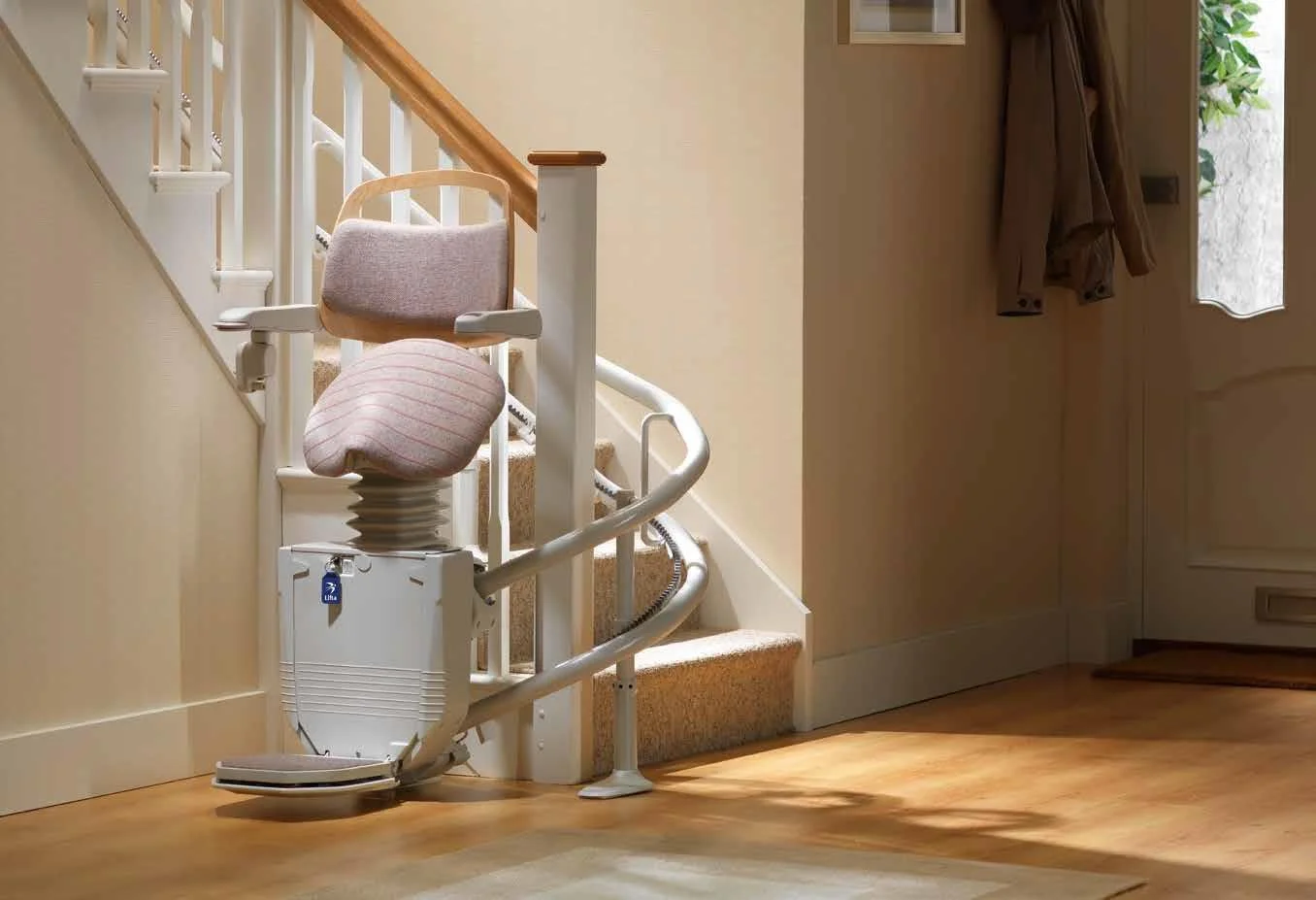
Housing in Bland County is mostly single-family homes in minimal-traditional, split-level and ranch styles. Split-level and multi-story ranch designs often put the bedrooms or main living space on a different level from the entry. That is one of the most common reasons an aging homeowner here starts having trouble at home.
A split-level usually has short runs of stairs, often straight ones. A straight stair lift is typically the simplest fit for a short, straight run. If a staircase turns at a landing, a curved lift built to that staircase is the usual answer. We measure every staircase before recommending either one.
The county sits in the Ridge and Valley Appalachian region, with the North Fork of the Holston River rising here and part of Jefferson National Forest inside its borders. Homes built on sloped ground often have steps up to the porch or down from a garage or carport.
For those entry steps, an outdoor stair lift built for weather is one option. When someone uses a wheelchair and cannot transfer to a seat, a platform lift is usually the better fit. We talk through how the person gets in and out of the house before suggesting equipment.
About 21.8% of Bland County residents are 65 or older. In a rural place with long drives to care, staying safely at home often depends on being able to reach every floor of it.
Adult children who live out of the area often start the conversation after a fall or a hard visit. A home measurement with the parent present helps everyone see what will work on the actual stairs.
Household incomes in the county are modest, so grants, waivers and veterans benefits are worth checking before paying out of pocket. Of the programs listed below, the Virginia Housing Owner-Occupied Modification (Accessibility) Grant is the one whose source names chairlifts among covered work, for up to $8,000 on a first-come, first-served basis.
Other programs cover home repairs or accessibility changes without naming stair lifts, so ask each one directly. Statewide, you can also ask about the Virginia Livable Home Tax Credit (LHTC) and the Assistive Technology Loan Fund Authority (ATLFA). Veterans can reach the Wytheville Office – Virginia Department of Veterans Services at (276) 228-5211.
A Virginia Medicaid waiver benefit for medically necessary home modifications for people who qualify for nursing-facility level care through an LTSS screening at the local Department of Social Services; stair lifts are not listed on the source page. Call Cover Virginia at (833) 522-5582.
A grant of up to $8,000 for homeowners, mainly elderly homeowners with disabilities, that lists ramps and chairlifts among covered modifications; applications go through an approved Agent, one grant per household every 5 years. The program officer can be reached at (804) 343-5818.
Provides up to $4,000 at no cost for repairs and accessibility modifications for households at or below 80% of area median income, through a southwest Virginia provider. Stair lifts are not specifically listed.
Minor repair and modification help for older adults who own their home or hold lifetime rights in the service area, which includes Bland County; stair lifts are not listed. Call (276) 783-8157.
A center for independent living that takes on funding-dependent home modification projects for people with disabilities, with Bland County served from the Wytheville office; stair lifts are not listed. Call (276) 228-8765.
Loans up to $40,000 at 1% interest and grants up to $10,000 for very-low-income rural homeowners, with grants limited to those age 62 and older who cannot repay a loan; stair lifts are not listed. Apply through the local USDA Rural Development office.
A lifetime grant of up to $6,800 or $2,000, depending on the veteran's disability, for home access changes; stair lifts are not listed, and the program page excludes stair glides as removable equipment. Call (800) 827-1000.
Grants of up to $126,526 (SAH) or $25,350 (SHA) for FY2026 for veterans with specific severe service-connected disabilities to change a permanent home; stair lifts are not listed. Call (800) 827-1000.
Older adults
4453 Lee Highway, Marion, 24354
Veterans
335 West Monroe Street, Suite 200, Wytheville, 24382
Often, yes. Split-level homes in the county usually have short runs between levels, and a straight lift is the common fit for a straight run. A curved lift is built for stairs that turn. A measurement tells you which one your stairs need.
The Virginia Housing Owner-Occupied Modification (Accessibility) Grant lists chairlifts among covered work, up to $8,000, first-come, first-served. An approved Agent submits the application. The program officer is at (804) 343-5818.
District Three Governmental Cooperative (PSA 3), at 4453 Lee Highway in Marion. Their phone is (276) 783-8157. Their chore and repair services do not name stair lifts, so ask what they can help with.
USDA Section 504 grants of up to $10,000 are limited to very-low-income homeowners age 62 and older who cannot repay a loan. The source does not mention stair lifts, so confirm with the local USDA Rural Development office.
The HISA grant page excludes stair glides as removable equipment, and the SAH and SHA grants do not list stair lifts. A veteran can still talk through options with the Wytheville Office – Virginia Department of Veterans Services at (276) 228-5211.
Tell us about the stairs in your home and we will explain which lift fits, what it costs and how installation works.
