Bedford County spreads across about 753 square miles of Virginia's Piedmont, running up toward the Blue Ridge Mountains and down to Smith Mountain Lake State Park. From Forest and Bedford to Stewartsville, Montvale and Moneta, the hills shape the houses. Walkout basements, split-level layouts and multi-story homes are common here because the land rarely sits flat.
That matters when someone in the family starts having trouble with the stairs. About 21.5% of residents are 65 or older, and most people here own the home they live in, so the question is usually how to make the current house work rather than where to move. This page walks through which kind of stair lift tends to fit local homes and which programs may help with the cost.
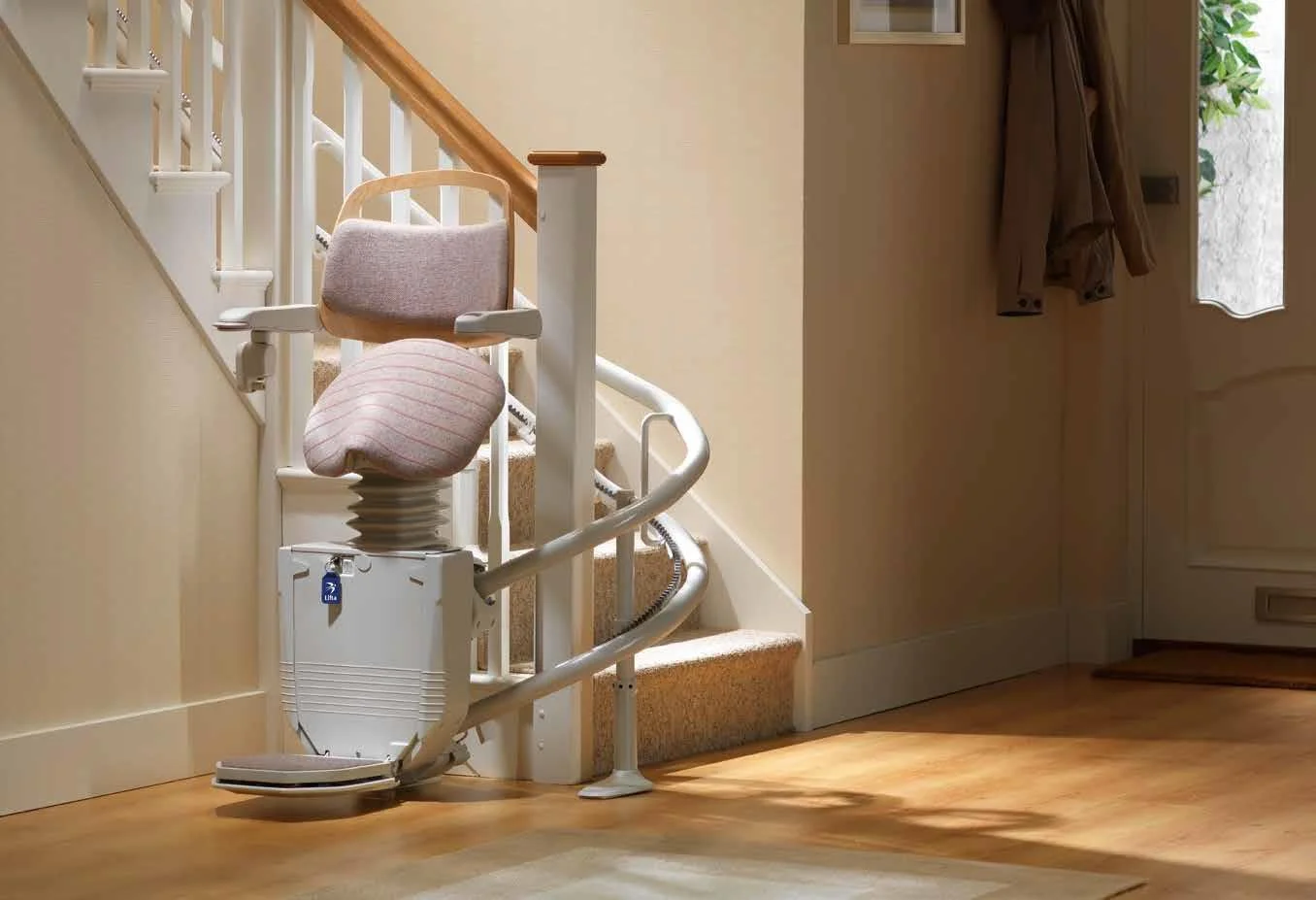
Split-level homes are one of the trickier layouts we see. Instead of one long flight, there are often two or three short runs between levels, and each run may need its own lift or a single curved rail that follows the turns.
Single-family and detached houses with a plain staircase from the first floor to the bedrooms usually take a straight stair lift. A straight rail is the simplest install and mounts to the stair treads, not the wall.
Townhouses often have narrow, steep stairs, sometimes with a landing. We measure the stair width and the space at the top and bottom carefully, since the seat needs to fold and park without blocking the hallway.
Hilly lots near the Blue Ridge and around the lake often mean a walkout basement or a home where the main entrance sits well above the driveway. If the trouble spot is outside, an outdoor stair lift built for weather exposure can run along exterior steps.
When a person uses a wheelchair and cannot transfer to a seat, a platform lift is the better fit. It takes more room, so we look at the whole approach to the door, not just the steps.
Bedford County is mostly rural and owner-occupied. About 70.7% of residents live in rural areas, and 80.8% of occupied housing units are owner-occupied, according to the 2020 census.
That helps, because many home modification programs favor people who own and live in the home. If your parent rents a walk-up apartment or townhouse, some programs still allow help with the owner's permission, so talk to the landlord early.
VA housing grants can help with some home changes, but read the rules closely before counting on them for a stair lift.
The VA HISA grant specifically excludes stair glides and porch lifts. The SAH and SHA grants do not name stair lifts either, so confirm with a VA housing grant specialist. The Virginia Department of Veterans Services Lynchburg Office at 519 Leesville Road Suite A can be reached at (434) 582-5102.
None of the programs below name stair lifts outright, so the honest answer is: ask before you apply. Several cover accessibility work broadly, and a case manager can tell you whether a stair lift could qualify.
A good first call is the Central Virginia Alliance for Community Living at (434) 385-9070, located at 501 12th Street, Suite A in Lynchburg. They run the local repair and accessibility programs and can point you to others. The Virginia Livable Home Tax Credit and the USDA Section 504 program are also worth checking for homeowners.
Up to $4,000 per applicant for low-income homeowners and renters (with owner permission) in Amherst, Appomattox and Bedford Counties, served first-come, first-served. It covers ramps, grab bars and other accessibility work, but stair lifts are not listed, so ask a case manager at (434) 385-9070.
Free energy-efficiency work such as insulation, weatherstripping and HVAC for approved homeowners and tenants in Amherst, Appomattox and Bedford Counties. It is not an accessibility program and stair lifts are not listed, but the same office at (434) 385-9070 can refer you to EHARP.
A state tax credit of up to 50% of the cost of retrofitting an existing home for accessibility, capped at $6,500, with a statewide annual cap of $2,000,000. Stair lifts are not named, so verify your installation qualifies before filing; call (804) 371-7000.
For Medicaid members who meet a nursing-facility level of care, this waiver can fund environmental modifications documented as medically necessary in the plan of care. Stair lifts are not mentioned on the program page; call (833) 522-5582.
Loans up to $40,000 at 1% interest and grants up to $10,000 for very-low-income homeowners in eligible rural areas, with grants for those 62 and older who cannot repay a loan. Grants target accessibility changes like ramps; stair lifts are not named, and you should verify your address is eligible.
Up to $6,800 lifetime for service-connected or 50%+ rated veterans, or up to $2,000 for non-service-connected, with a VA physician's medical justification. HISA does not cover stair lifts; it excludes stair glides and porch lifts. Call (434) 582-5102.
Up to $126,526 (FY2026) for veterans with qualifying severe service-connected disabilities who own or will own the home. Stair lifts are not named among covered items, so confirm with a VA housing grant specialist or apply through VA.gov.
Up to $25,350 (FY2026) for veterans with qualifying service-connected disabilities such as loss of use of both hands or certain severe burns. Stair lifts are not named; apply through VA.gov or a VA housing grant specialist.
Low-interest loans for Virginia residents with a disability or their caregivers, with special consideration for credit problems tied to disability or medical issues. Stair lifts are not named among examples; call (866) 835-5976.
Funding paid directly to the vendor for people with disabilities of any age in Bedford County, the Town of Bedford and nearby areas, covering items like ramps and bathroom changes. Stair lifts are not named; call (434) 528-4971 to ask.
Older adults
501 12th Street, Suite A, Lynchburg, 24504
Veterans
519 Leesville Road Suite A, Lynchburg, 24502
No. The HISA program excludes removable equipment such as stair glides and porch lifts. The SAH and SHA grants do not name stair lifts either, so confirm with a VA housing grant specialist before planning around them.
The CVACL Emergency Home Accessibility and Repair Program accepts renters who have the owner's permission, with up to $4,000 in assistance. Stair lifts are not named, so ask the case manager at (434) 385-9070.
The USDA Section 504 program offers grants up to $10,000 for homeowners 62 and older who cannot repay a loan, in eligible rural areas. Rural parts of Bedford County qualify, but check the specific address on the USDA eligibility site.
The Virginia Livable Home Tax Credit covers up to 50% of accessibility retrofit costs, up to $6,500. Stair lifts are not named, so confirm your project qualifies by calling (804) 371-7000 before filing.
No. Split-level homes may need a separate straight lift for each short run or a curved rail that follows the turns. An in-home measurement shows which option fits.
Start with the Central Virginia Alliance for Community Living in Lynchburg at (434) 385-9070. They handle local accessibility and repair programs and can point you to other help.
Tell us about the stairs in your home and we will explain which lift fits, what it costs and how installation works.
