Amherst County covers roughly 474 square miles of central Virginia Piedmont, from Madison Heights and the town of Amherst out to the George Washington National Forest in the northwest. Homes here range from Ranch and Cape Cod houses to Contemporary builds, Split Level designs and older Farm House styles, and many have two to five bedrooms spread across more than one floor.
That layout matters when someone starts having trouble with stairs. In split-level and older two-story farmhouse designs, bedrooms and bathrooms often sit on a different level from the kitchen and living room, so the staircase becomes part of every single day. This page walks through how a stair lift fits these homes and which local and state programs may help with the cost.
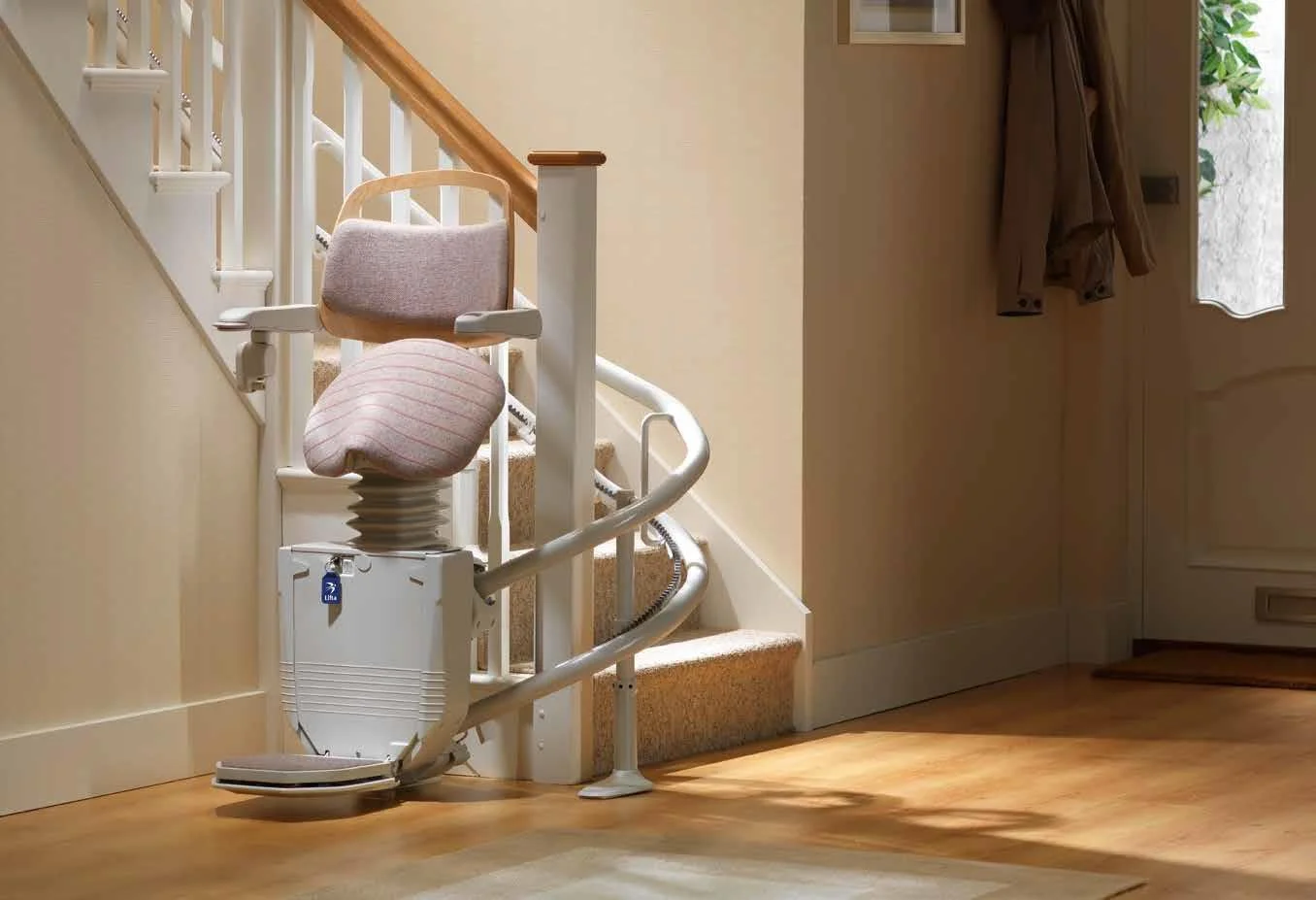
A split-level home usually has short flights between levels rather than one long run. Each flight is often straight, which makes a straight stair lift a good match, but a household that uses two separate flights may need two lifts or a careful plan for which level becomes the main living space.
Older two-story farmhouses are a different job. If the staircase turns, has a landing partway up, or narrows near the top, a curved stair lift with a custom rail is usually the answer. We measure the full staircase in person before recommending one or the other.
Ranch homes are mostly on one floor, but some have stairs down to a basement laundry or up from a garage. A short straight lift can handle those trips.
Per the 2020 census, 62.4% of county residents live in rural areas. On a rural lot, the problem is often the porch or the steps from the driveway to the door, not just the inside staircase. Outdoor stair lifts are built for weather exposure, and a vertical platform lift is an option where a wheelchair user needs to get up a porch.
The northwest part of the county, where about 25 miles of the Appalachian Trail cross the George Washington National Forest, is more mountainous and harder to reach. If you live out that way, mention it when you call so we can plan the visit and any follow-up service around the drive.
About 22.2% of residents are 65 or older, and 71.8% of households own their homes. Owners can usually make the decision on their own and choose a lift that stays with the house.
Housing in the county also includes townhouses, walk-up apartments and low-rise buildings. Renters will need the property owner's written approval before any lift goes in, and some programs, such as the Area Agency on Aging repair program, accept tenants only with that approval.
Veterans should know up front that VA programs treat stair lifts differently from ramps, which is covered in the next section.
The clearest public funding source is the CCC Plus Medicaid Waiver, whose Environmental Modifications benefit names stair lifts as an example. It is for people who meet a nursing facility or hospital level of care and the waiver's financial limits, and you apply through the local Department of Social Services or your managed care care coordinator.
Several other programs fund accessibility modifications but do not name stair lifts in their published materials. Those include Virginia Housing grants, the Central Virginia Alliance for Community Living repair program, LACIL, Amherst County Habitat for Humanity and USDA Section 504. It is worth calling each one and asking directly whether a stair lift qualifies.
Statewide, you can also ask about the Virginia Livable Home Tax Credit (LHTC) and the Assistive Technology Loan Fund Authority (ATLFA). The programs list below has the details and phone numbers we have.
The VA Home Improvements and Structural Alterations (HISA) grant specifically excludes stair glides, porch lifts and portable ramps, so it will not pay for a stair lift. It does fund permanent changes like entrance ramps and roll-in showers.
The SAH and SHA grants are larger but are tied to specific severe service-connected disabilities, and stair lifts are not named in the source materials. The Virginia Department of Veterans Services Lynchburg Office at 519 Leesville Road Suite A, (434) 582-5102, can help you sort out which benefits apply.
Virginia's main Medicaid home and community-based waiver for people 65 and older or under 65 with a disability, and its Environmental Modifications benefit lists stair lifts as an example. Apply through the local Department of Social Services or your managed care organization's care coordinator.
Grants of up to $10,000 per household with no repayment, for homeowners, renters and disabled veterans who meet income limits; the program lists ramps and chairlifts among typical modifications but does not use the term stair lift. Applications go through a Virginia Housing-approved agent; call (877) 843-2123.
Up to $4,000 per household for low-income homeowners and tenants (with the owner's written approval) in Amherst, Appomattox and Bedford counties, covering repairs plus ramps, grab bars and other accessibility modifications; stair lifts are not named. Help is first-come, first-served; call (434) 385-9070.
Serves people of any age with disabilities in Amherst County and nearby areas with free mobility equipment and case-by-case Direct Services grants for items like ramps and bathroom modifications; stair lifts are not named. Call (434) 528-4971.
Health-and-safety repairs for elderly or disabled Amherst County homeowners, generally repaid over five years unless another organization funds the work, and not available for manufactured homes; stair lifts are not mentioned. Call (434) 946-9596, and ask about their referral list if repayment is not possible.
Loans up to $40,000 at 1% fixed interest over 20 years, and grants up to $10,000 for homeowners 62 and older who cannot repay, for very-low-income owners in eligible rural areas; accessibility work is allowed, but stair lifts are not named. Check your address with USDA's online eligibility tool.
Pays up to $6,800 or $2,000 lifetime, depending on disability status, for medically necessary permanent alterations like ramps and roll-in showers. It does not cover stair lifts, which the VA lists as excluded stair glides.
SAH grants up to $126,526 and SHA grants up to $25,350 (FY2026) help veterans with specific severe service-connected disabilities build, buy or remodel a home for accessibility; stair lifts are not named in the source materials.
Older adults
501 12th Street, Suite A, Lynchburg, 24504
Veterans
519 Leesville Road Suite A, Lynchburg, 24502
Usually, yes. Split-level homes tend to have short straight flights, which suit straight stair lifts. If daily life involves two separate flights, we will talk through whether one lift and a rearranged floor plan or two lifts makes more sense.
The CCC Plus Medicaid Waiver names stair lifts as an example of an environmental modification. You must be 65 or older, or under 65 with a disability, meet a nursing facility or hospital level of care, and meet the financial limits, including a $2,000 countable asset limit for a single applicant.
The USDA Section 504 grant portion is limited to homeowners 62 and older, though younger very-low-income owners may qualify for the 1% loan. Programs like EHARP, LACIL and Virginia Housing grants do not use that age cutoff, so call them and ask whether a stair lift qualifies.
Not the HISA grant, which excludes stair glides. SAH and SHA grants are for specific severe service-connected disabilities and do not name stair lifts. The Virginia Department of Veterans Services Lynchburg Office at (434) 582-5102 can review your options.
You will need your landlord's written approval. The EHARP program accepts tenants with that approval, and Virginia Housing has a Rental Unit Accessibility Modification grant for renters at or below 60% of area median income.
The Central Virginia Alliance for Community Living, at 501 12th Street, Suite A, Lynchburg, 24504. Their phone is (434) 385-9070.
Tell us about the stairs in your home and we will explain which lift fits, what it costs and how installation works.
