In Clifton Forge and around Covington, many houses are multi-story mill-worker and Victorian-era homes built in the early-to-mid 20th century, often with their original narrow stairways. Out in the hollows and valleys near Mallow, Selma and Callaghan, you are more likely to find single-story and manufactured homes, but even those can sit on sloped lots with steps at the entry.
This page covers how those homes affect the kind of stair lift that will work, and which programs Alleghany County residents can look into to help pay for one. The county sits along the Cowpasture and Jackson Rivers, which meet near Iron Gate. That ridge-and-valley ground shapes a lot of the stair questions we see here.
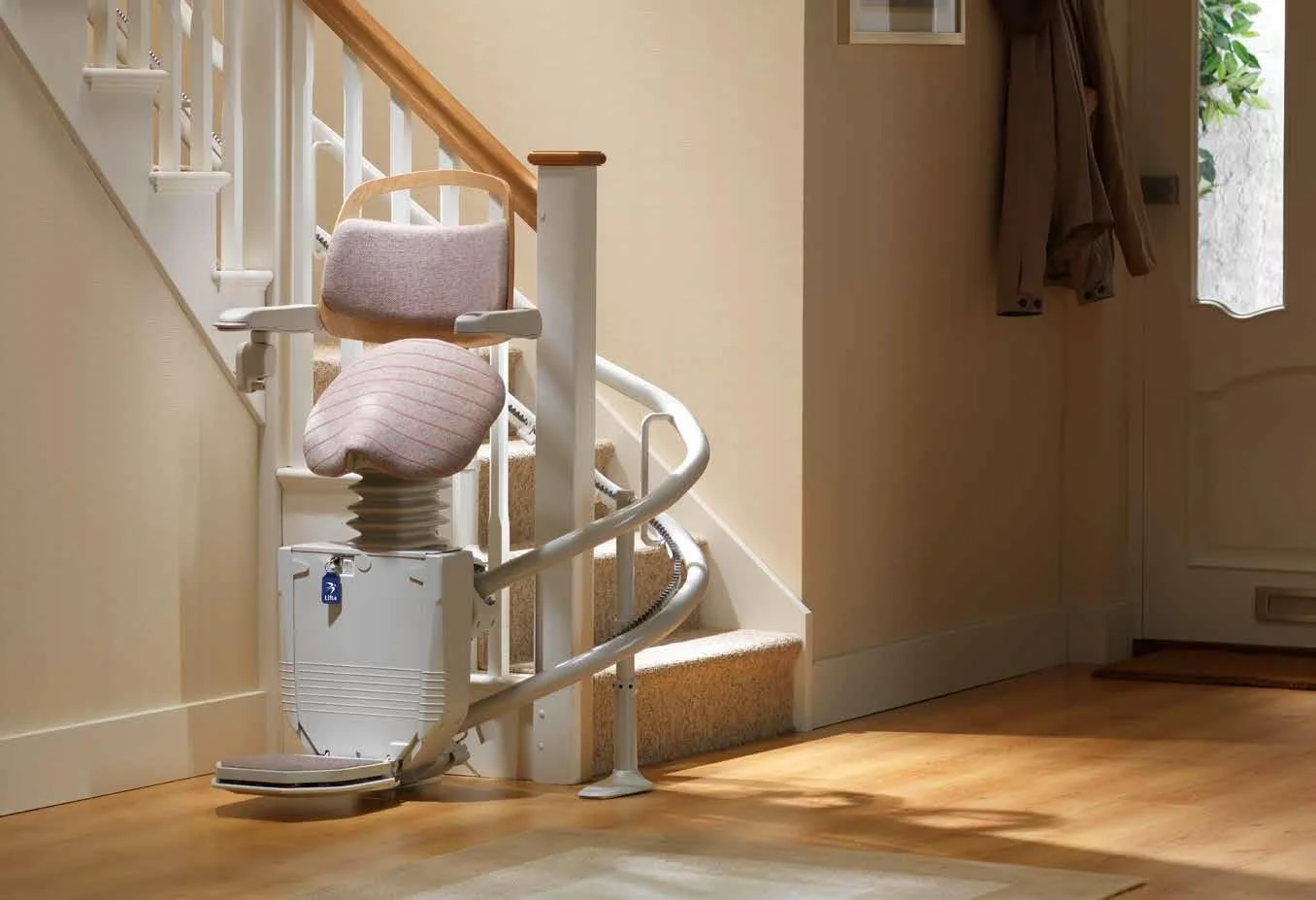
A narrow original staircase is the first thing we check in a Clifton Forge or Low Moor home. Straight stair lifts mount to the treads, not the wall, and many models fold up when not in use, so a tight stairway does not rule one out. We measure the width, the landing at top and bottom, and any doorway close to the last step.
Victorian-era stairs often turn at a landing or have winders. Those need a curved rail built to the exact shape of the stairs. A curved lift takes longer to make and install than a straight one, so it helps to start measuring early if a hospital discharge or surgery is coming up.
Because so much of the county is mountainous, many homes have multi-level entries with steps leading up from the driveway or down to a lower door. An outdoor stair lift is built to handle weather and can run along those exterior steps.
Split-level and ranch-style homes have their own patterns. A split-level often has two short flights, which may mean two straight lifts or one curved rail. A ranch-style home may have only a few steps at the entry, where a platform lift can be the better fit, especially for someone who uses a wheelchair.
The 2020 Census counted 7,934 housing units in Alleghany County, with 77.3% owner-occupied.
That matters for funding. Several grants below are open only to homeowners, some only to veterans, and some to renters with landlord permission. Knowing which group you fall into narrows the list fast.
Most of the help here is either a capped grant or a Medicaid waiver service, and few of them name stair lifts outright. The one that does is the Virginia Housing Granting Freedom grant for veterans, which lists chairlifts as an eligible modification. For others, ask the agency directly whether a stair lift can be approved in your case.
Distance is a real factor. The nearest VA medical center is in Salem, roughly 40 miles or more away by mountain road, and the Local Office on Aging and Salem DVS Office are also out of the county. Phone calls first can save a trip.
Statewide, you can also ask about the Virginia Livable Home Tax Credit (LHTC) and the Assistive Technology Loan Fund Authority (ATLFA). Check with each one for current terms, since we do not have their details on this page.
Medicaid waiver service for eligible people who would otherwise need nursing-facility care, capped at $5,000 per calendar year; stair lifts are not named in the rules, so approval depends on the case manager's review. Screening goes through Alleghany-Covington DSS at (540) 444-7100, and the state line is (833) 522-5582.
A VA grant for medically necessary home alterations, up to $6,800 or $2,000 lifetime depending on disability status. The VA specifically excludes stair glides, so it will not pay for a stair lift; call (800) 827-1000.
Larger VA grants for homeowners with severe service-connected disabilities, up to $126,526 (SAH) or $25,350 (SHA) for FY2026. The VA examples are ramps and wider doorways, and stair lifts are not mentioned; call (800) 827-1000.
Repair loans up to $40,000 at 1% for 20 years, plus grants up to $10,000 for very-low-income homeowners age 62 or older in eligible rural areas. Stair lifts are not named in the program examples; call (804) 287-1500.
Up to $10,000 per household for Virginia veterans and service members with a service-connected disability and income at or below 80% of area median income. Chairlifts are listed as an eligible modification; apply through an approved local agent or call (877) 843-2123.
Up to $10,000 per household for homeowners with a disability and income at or below 60% of area median income, applied for through an approved local agent. Our source does not clearly state whether stair lifts are covered under this grant; call (877) 843-2123.
Up to $10,000 per household for renters with a disability and income at or below 60% of area median income, with landlord permission required. Stair lift coverage is not clearly stated for this grant; call (877) 843-2123.
A state program offering up to $4,000 per applicant for households at or below 80% of area median income, first-come, first-served, and Alleghany County is eligible. It covers ramps and other accessibility modifications, but stair lifts are not named; call (804) 371-7000.
A county program for emergency repairs and accessibility improvements for low- to moderate-income families, funded through Virginia DHCD. The county says DHCD is still looking for a local provider, and stair lifts are not mentioned.
The approved local agent for Virginia Housing accessibility grants of up to $10,000 per household, serving Alleghany County and the Fifth Planning District. Its listed work includes ramps, railings and grab bars, with no stair lift mention; call (540) 342-1231.
Serves people 60 and older with a medical equipment loan closet, emergency help and referrals. It does not fund stair lifts or home modifications, but it can point you to who does; call (540) 345-0451.
Older adults
4932 Frontage Road NW, Roanoke, 24019
Veterans
1970 Roanoke Blvd. Bldg. 8, Room 113, Salem, 24153
Often, yes. Stair lifts attach to the treads and many fold up, so narrow original stairways in older mill-worker and Victorian-era homes can usually be fitted. An in-home measurement tells you for sure, and a turn or landing means a curved rail.
The Virginia Housing Granting Freedom grant lists chairlifts as an eligible modification, up to $10,000 per household, for veterans with a service-connected disability and income at or below 80% of area median income. Call (877) 843-2123 or apply through an approved local agent such as the Blue Ridge Independent Living Center.
No. The VA excludes stair glides from HISA. It can still help with other alterations, and the Salem DVS Office at (540) 982-2463 can talk through other veteran options.
The CCC Plus waiver covers environmental modifications up to $5,000 per calendar year, but stair lifts are not named in the rules. A waiver case manager would have to decide based on medical need. Screening starts at Alleghany-Covington DSS, (540) 444-7100.
The Local Office on Aging serves people 60 and older in Alleghany County, and while it does not pay for stair lifts, it offers referrals and an equipment loan closet at (540) 345-0451. Homeowners 62 or older with very low income can also ask USDA about Section 504 grants at (804) 287-1500.
Renters with a disability can look at the Virginia Housing RUAM grant, which needs landlord permission, and EHARP, which accepts tenants with owner approval. Neither clearly names stair lifts, so ask before planning around them.
Tell us about the stairs in your home and we will explain which lift fits, what it costs and how installation works.
