Wayne County covers about 2,461 square miles of the Colorado Plateau, and most of its people live in six small towns: Loa, Bicknell, Teasdale, Torrey, Lyman and Hanksville. The homes here are mostly single-family houses, ranch-style homes and manufactured homes. Many were paid off long ago and have been lived in by the same families for years.
That staying power is a good thing, but it also means a lot of people are getting older in houses that were never planned around a bad knee or a walker. A stair lift can keep the basement laundry, the upstairs bedroom or the front steps usable. This page walks through what kind of lift fits the homes in this county and where to look for help paying for it.
Census figures show 79.3% of Wayne County homes are owner-occupied (2020-2024 ACS), and 87.4% of residents have lived in the same house for at least a year. In practice that means older homes that people intend to stay in, which is the situation a stair lift is built for.
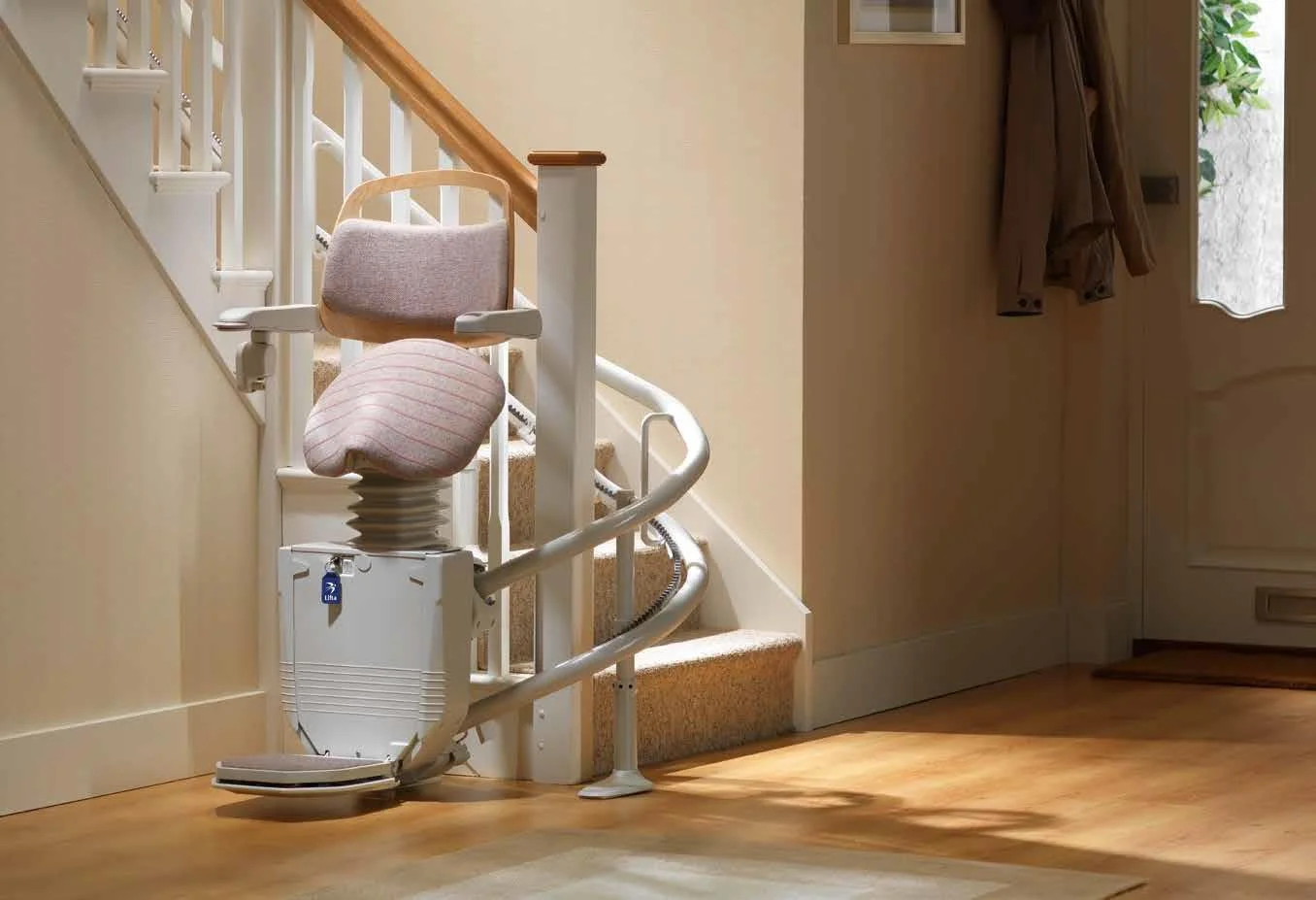
Ranch-style homes often have just one main floor, so the stairs that cause trouble are usually the ones down to a basement or the steps at the entry. A single straight run of basement stairs is usually the simplest install. If the stairway turns at a landing, a curved rail is made to fit that specific staircase.
For many manufactured homes and ranch houses, the hardest part of the day is getting from the driveway to the front door. An outdoor stair lift is built to handle weather and can run along porch or deck steps.
When someone uses a wheelchair and cannot transfer to a seat, a platform lift is usually a better match than a seated stair lift. We look at the steps, the landing space and the door before recommending either one.
The county runs from forestland in the west to dry, sloping country toward the east and south, and it reaches 11,317 feet at Bluebell Knoll. Outside the few towns, medical services, home-modification contractors and emergency response can be a long way off.
That distance is a practical reason to deal with stairs before a fall happens. It is also why we measure carefully on the first visit, so the lift fits the house without repeated trips back out.
At the 2020 census, 24.8% of Wayne County residents were 65 or older, close to a quarter of the population.
Median household income was $49,299 at the 2020 census, and 10.1% of residents lived below the poverty line. For many families, outside help with the cost is worth looking into before buying.
No program listed below names stair lifts as a covered item, and the VA HISA grant specifically excludes stair glides. Still, a few programs fund home modifications or equipment in broad terms, and the local aging office is the best first call.
Start with the Wayne Senior Center in Bicknell, run by the Six County Area Agency on Aging, at (435) 425-2089. The R6 Regional Council AAA in Richfield can be reached at (435) 893-0725. Veterans can call the Southern Utah Regional Veterans Service Office in St. George at (435) 218-5128. Each program is summarized in the list below.
A Medicaid waiver for people 65 and older who need nursing-facility level of care and meet Medicaid financial limits; it funds services such as Environmental Accessibility Adaptations and Specialized Medical Equipment, but stair lifts are not listed by name. Call (801) 538-3910, and expect a possible waiting list.
Helps people who currently live long-term in a nursing facility or other licensed facility move back into the community; people not already in such a facility cannot apply. The program page does not mention stair lifts or home modifications; call (801) 538-6155.
The aging agency for Wayne County, with local intake at the Wayne Senior Center, 475 South 300 East in Bicknell. No stair lift fund was identified, so call (435) 425-2089 and ask about current home-repair or accessibility help.
Offers very-low-income rural homeowners 1% loans up to $40,000 and, for owners 62 and older, grants up to $10,000 to remove health and safety hazards or repair the home. Stair lifts are not mentioned, and address eligibility must be confirmed through the local USDA Rural Development office.
A lifetime VA grant of up to $6,800 or $2,000 for medically necessary fixed alterations like ramps and roll-in showers. It does not cover stair lifts; the VA lists stair glides as non-covered equipment.
Grants for veterans with certain severe service-connected disabilities, up to $126,526 for SAH and $25,350 for SHA in FY2026, for building or adapting a home. Stair lifts are not named; the Southern Utah Regional Veterans Service Office at (435) 218-5128 can help with questions.
Low-interest loans from $1,000 to $50,000 for Utah residents with a disability, with UATF paying half the interest up to $2,500 per borrower. 'Lifts or elevators' are an eligible category, but stair lifts are not named; call (800) 524-5152.
Grants up to $500 for Utah residents with a disability and household income at or below 150% of federal poverty guidelines, approved by the board before any purchase. Stair lifts are not mentioned; call (435) 797-2025.
Older adults
250 North Main, Room 5, Richfield, 84701
Veterans
350 South 400 East, Suite 100, St. George, 84770
No. The HISA grant page lists porch lifts and stair glides as non-covered removable equipment. HISA pays for fixed changes like ramps, entry modifications and roll-in showers instead.
The Wayne Senior Center in Bicknell, run by the Six County Area Agency on Aging, at (435) 425-2089. They handle local intake for Wayne County seniors and can tell you what home-repair or accessibility help is currently available.
The USDA Section 504 program offers grants up to $10,000 to very-low-income homeowners 62 and older to remove health and safety hazards. Stair lifts are not named in the program, and your address has to be confirmed as eligible through USDA Rural Development.
The Utah Medicaid Aging Waiver, for people 65 and older who need nursing-facility level of care, covers broad categories like Environmental Accessibility Adaptations and Specialized Medical Equipment. Stair lifts are not listed by name, so call (801) 538-3910 to ask about your situation.
The UATF Loan Program lends $1,000 to $50,000 to Utah residents with a disability, and UATF pays half the interest up to $2,500. The program does not name stair lifts, so ask at (800) 524-5152 whether yours would qualify.
Yes. An outdoor stair lift can run along entry or porch steps, and a platform lift is an option if a wheelchair user cannot move to a seat. We check the steps and landing space on a home visit before recommending one.
Tell us about the stairs in your home and we will explain which lift fits, what it costs and how installation works.
