A two-story house in Northwest Hills and a raised pier-and-beam bungalow in Hyde Park have very different problems. Travis County holds 26 towns and communities, from Austin and Pflugerville to Lakeway, Lago Vista, Manor and Webberville, and the homes in them were built in different eras for different ground.
This page walks through what that means for a stair lift in your home, which local and state programs may help with the cost, and who to call. Most of the programs below do not name stair lifts, so we tell you plainly where coverage is open, where it is ruled out, and where you will need to ask.
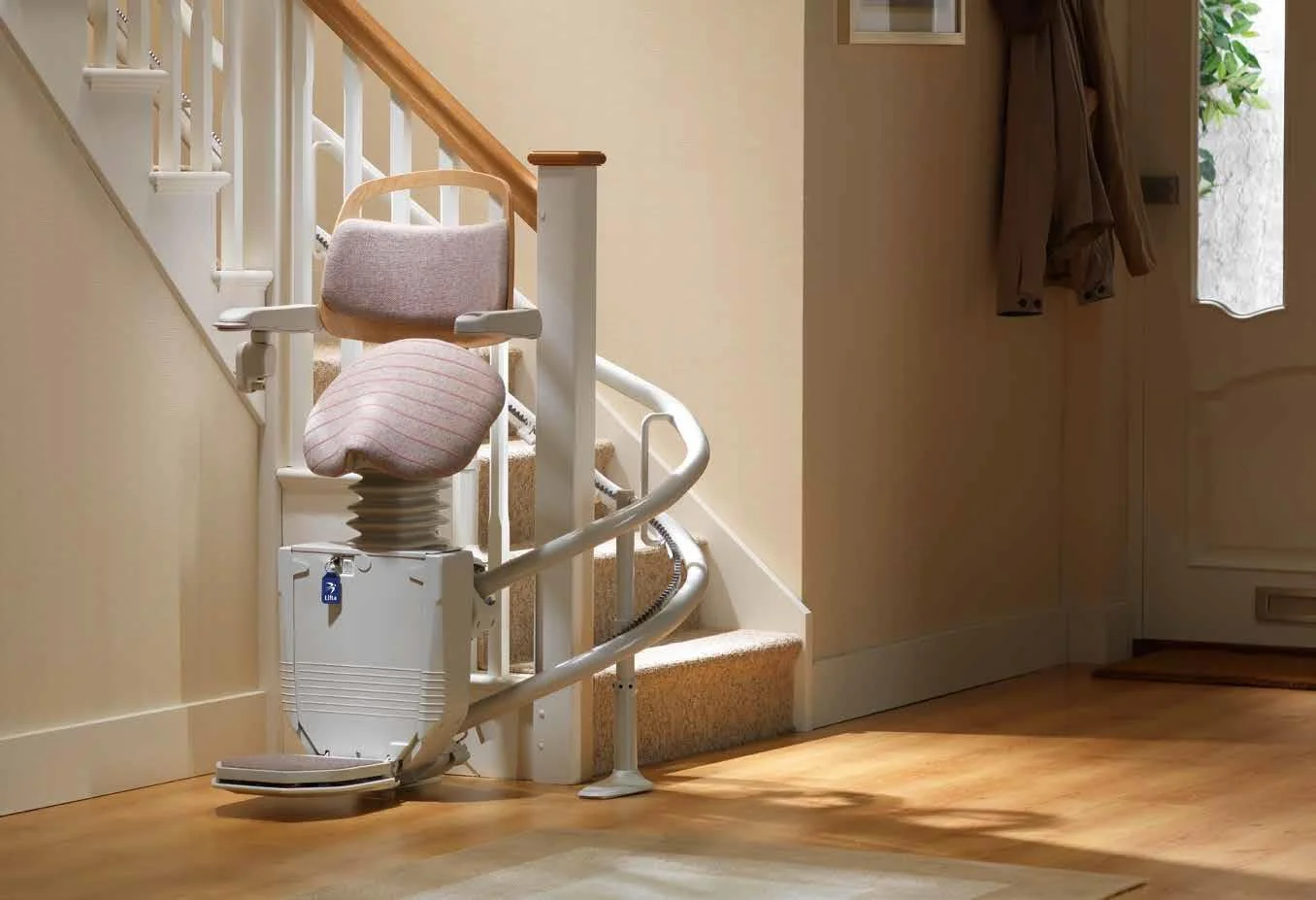
Many two-story homes built roughly 1960 to 1990 sit in neighborhoods such as Northwest Hills, Travis Country and Tarrytown. A lot of them put the bedrooms on the second floor. When a knee, hip or heart condition turns the stairs into a barrier, a stair lift restores access to every room in the house.
If the staircase runs in one straight line, a straight rail is usually the simplest install. Stairs with a landing, a turn or a curve need a custom curved rail built to the exact shape of the staircase, so we measure before quoting anything.
Older inner-Austin neighborhoods like Hyde Park and Cherrywood are largely pier-and-beam construction. These houses sit higher off the ground than slab homes, so the entry steps are taller, and that is a real fall risk. For those front or back steps, an outdoor stair lift or a vertical platform lift is often the better fit than an interior unit.
Mid-century neighborhoods such as Allandale and Brentwood are mostly single-story ranch homes. Those layouts already suit aging in place, and the question there is usually just the few steps at the door.
The county covers 989 square miles on the eastern edge of the Edwards Plateau, split by the Balcones Escarpment, with elevation running from about 400 to 1,300 feet. West of Austin, homes in places like Lakeway, Lago Vista, Steiner Ranch and Bee Cave often sit on sloped lots.
Slopes can mean outdoor steps between a driveway, a porch and the front door. Outdoor stair lifts are built for weather exposure, and a site visit tells us whether a rail or a platform makes more sense for your grade.
Roughly 49.3% of households own their home.
That last figure matters for funding. Most repair grants below require the applicant to own and live in the home, so renters in townhouses, row houses or walk-up apartments have fewer options and should talk with the landlord before any install.
No program in our list names stair lifts as a covered item, and the VA HISA grant rules out stair glides by name. Several programs do cover accessibility work such as ramps, railings and grab bars, and some leave room for a case-by-case decision.
A good first call is the Capital Area AAA (CAPCOG) at (512) 916-6062, 6800 Burleson Road, Bldg. 301, Suite 165, Austin 78744. Veterans can reach the Travis County Veterans Service Office at (512) 854-9340, 5325 Airport Boulevard, Suite 1100, Austin 78751. Statewide, it is also worth asking about the Amy Young Barrier Removal Program (AYBR) and the Community Living Assistance and Support Services (CLASS) Waiver.
Texas Medicaid managed care for residents 65+ or adults with a qualifying disability who meet nursing-facility level-of-care criteria; it provides home modifications approved through the member's service plan, but stair lifts are not named, so confirm with your health plan. Call (800) 964-2777.
A free county home-repair program for low-income homeowners who are current on property taxes; it offers limited accessibility work such as ramps, railings and grab bars, and stair lifts are not mentioned. The page shows an expired status and a waitlist, so call (512) 854-7250 to check intake.
A grant of up to $20,000 for owner-occupants inside Austin city limits at or below 80% Median Family Income; named work includes wheelchair ramps and handrails, and stair lifts are not listed. Call (512) 974-3100.
Loans up to $40,000 at 1% fixed interest and grants up to $10,000 for very-low-income homeowners 62+ in USDA-eligible rural areas, which excludes much of urban Austin. Stair lifts are not named; coverage depends on whether the local office treats one as a health and safety repair.
A lifetime VA grant of $6,800 or $2,000, depending on disability status, for medically necessary structural changes to a home the veteran owns or rents. It does not cover stair lifts: stair glides and porch lifts are excluded by name.
Grants for veterans with severe service-connected disabilities: SAH up to $126,526, SHA up to $25,350, and TRA up to $50,961 or $9,100. The program funds structural adaptations like ramps and doorway widening; stair lifts are not named.
A nonprofit program for low-income homeowners, including seniors, veterans and adults with disabilities, covering ramps, grab bars, bathroom changes and other accessibility work; stair lifts are not mentioned. It has a waiting list; call (512) 476-6325.
Nonprofit programs for low-income, disabled, senior or veteran owner-occupants, with Safe at Home modifications at no cost; named items include grab bars, handrails, ramps and low-rise steps, not stair lifts. Call (512) 993-8230.
The regional aging agency for adults 60+, people with disabilities and caregivers, offering benefits counseling and referrals rather than direct grants; stair lifts are not listed. Call (512) 916-6062 to ask what in-home accessibility help is active now.
Older adults
6800 Burleson Road, Bldg. 301, Suite 165, Austin, 78744
Veterans
5325 Airport Boulevard, Suite 1100, Austin, 78751
Not through the HISA grant, which excludes stair glides and porch lifts by name. The SAH and SHA grants fund larger structural adaptations but do not name stair lifts, so ask the Travis County Veterans Service Office at (512) 854-9340.
The Safety Repairs and Modifications Program offers up to $20,000 to owner-occupants at or below 80% Median Family Income, which is $106,800 a year or less for a 4-person household. Stair lifts are not named, so ask at (512) 974-3100 whether your project qualifies.
Only at addresses USDA maps as rural. Much of urban Austin is excluded, while outlying unincorporated parts of the county may qualify. Grants require the homeowner to be 62 or older.
Pier-and-beam homes sit higher than slab homes, so the entry steps are taller. An outdoor stair lift or a vertical platform lift is usually the option to look at for those steps.
Start with the Capital Area AAA (CAPCOG) at (512) 916-6062 or (888) 622-9111. It serves adults 60 and older and people with disabilities in Travis County and can point you to programs taking applications.
STAR+PLUS includes home modifications for eligible members, approved one by one through the health plan. Stair lifts are not named in the program material, so confirm with the plan or call (800) 964-2777.
Tell us about the stairs in your home and we will explain which lift fits, what it costs and how installation works.
