San Saba County stretches across 1,135 square miles of the Edwards Plateau, with the San Saba River cutting through ranch and pecan country. The county seat, San Saba, is the place many people know as the "Pecan Capital of the World," and it is where most of the county's homes and services are clustered.
A lot of the housing here is older, built in the same rural Texas tradition as the brick and sandstone courthouse and the 1896 Beveridge Bridge. Much of it predates modern accessibility design, so interior stairs and porch steps are common. This page walks through what that means for a stair lift and where to look for help paying for one.
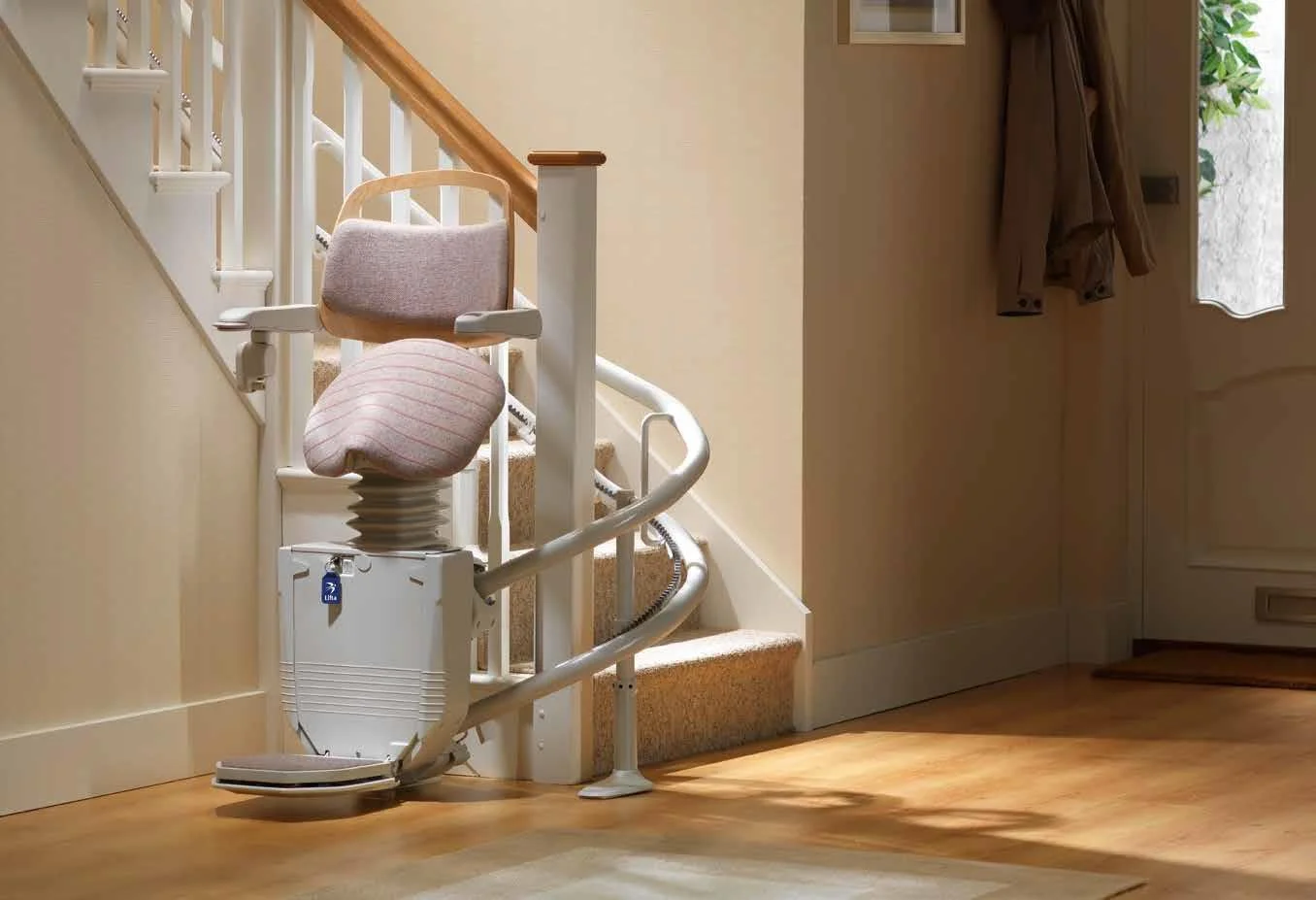
Homes in the county are mostly single-family and detached, with a mix of ranch-style and split-level layouts. Each one asks something different of a stair lift, so the first step is always to look at the actual stairs.
A split-level house usually has short runs of stairs between floors. If a run goes straight from bottom to top, a straight stair lift is often the simplest fit. If the stairs turn at a landing, a curved lift with a custom rail is the usual answer.
Ranch-style homes often keep living space on one floor, but the porch steps out front can still be the hardest part of the day. That is where an outdoor stair lift or a platform lift for a wheelchair or walker comes into the conversation.
Older homes often have narrower staircases and steeper steps than newer construction. A rail-mounted stair lift attaches to the stair treads rather than the wall in most cases, but we still measure width, pitch and clearance at the top and bottom before recommending a model.
Outdoor steps take a lift built for weather. In rural homes the porch may be the only way in and out, so it is worth planning for both inside and outside stairs at the same visit.
With so much land and so few people, San Saba County does not have many in-county offices for home accessibility. Residents usually depend on regional providers based outside the county, in places like Belton or San Angelo.
That makes it worth lining up the assessment, the funding questions and the install so they happen in as few trips as possible. Calling the aging and veterans offices listed below before the home visit can save time later.
The county has its own veterans office: Veteran's Service – San Saba County, at 500 E. Wallace, Suite 104, San Saba, 76877, phone (830) 347-0512.
Be aware that the VA HISA grant specifically excludes stair glides, so it will not pay for a stair lift. The larger SAH and SHA grants do not name stair lifts either way, and the veterans office can help check whether a particular case qualifies.
No single program in the county is set up just to buy stair lifts. Several programs fund home modifications or repairs in general, and whether a stair lift counts is decided case by case. The list below covers each one and who to call.
For anyone 60 or older, a good first call is the Area Agency on Aging of Central Texas at (254) 770-2330. The Central Texas AAA office at 2180 N. Main St., Belton, 76513, can also be reached at (254) 933-7075. They can point you to the waiver or repair program that fits your situation.
A Texas Medicaid program for residents 65 and older, or 21 and older with a disability, who meet nursing facility level of care and want to stay at home. It covers minor home modifications but does not name stair lifts, so a managed-care case manager decides what is approved.
Offers very-low-income rural homeowners loans up to $40,000 at 1% interest and, for homeowners 62 and older, grants up to $10,000 to remove health and safety hazards; San Saba County is eligible. Stair lifts are not named, so confirm with USDA at (800) 414-1226.
Pays for medically needed home alterations for eligible veterans, with a lifetime maximum of $6,800 or $2,000 depending on the disability. It does not cover stair lifts, since the VA excludes stair glides and porch lifts from this benefit.
Provides up to $126,526 for FY2026 to veterans with certain severe service-connected disabilities who own or will own the home. The VA does not list stair lifts among covered adaptations.
Provides up to $25,350 for FY2026 to veterans or qualifying family members with service-connected loss of use of both hands, severe burns or certain respiratory injuries. Stair lifts are not specifically listed.
A one-time grant up to $22,500 for accessibility modifications in households that include a person with a disability and earn no more than 80% of Area Median Family Income. Stair lifts are not named, and the program is not available in all areas of Texas, so check whether it serves San Saba County.
Offers care coordination, caregiver support and benefits counseling to people 60 and older and their caregivers in San Saba County. It does not run a stair lift program itself but is the right first call at (254) 770-2330 or 800-447-7169.
A nonprofit that builds wheelchair ramps at no cost for qualifying homeowners with a referral from a social-services agency, healthcare professional, EMS, fire/rescue or police. It does not mention stair lifts, and coverage of San Saba County should be confirmed at (214) 558-0339.
Older adults
2180 N. Main St., Belton, 76513
Veterans
500 E. Wallace, Suite 104, San Saba, 76877
Not through the HISA grant, which explicitly excludes stair glides. The SAH and SHA grants do not name stair lifts, so ask Veteran's Service – San Saba County at (830) 347-0512 to review your case.
The STAR+PLUS HCBS Waiver covers minor home modifications but does not name stair lifts. A managed-care case manager decides what gets approved, case by case.
The aging agency serves people 60 and older, but STAR+PLUS accepts residents 21 and older with a disability, and the Amy Young Barrier Removal Program is based on disability and income rather than age.
USDA Section 504 grants go to homeowners 62 and older to remove health and safety hazards, and stair lifts are not named. Call (800) 414-1226 to ask whether your project qualifies.
For people 60 and older, start with the Area Agency on Aging of Central Texas at (254) 770-2330. They offer options and benefits counseling and can connect you to the right program.
Yes. Outdoor stair lifts are built for weather, and a platform lift is an option when a wheelchair or walker has to come along.
Tell us about the stairs in your home and we will explain which lift fits, what it costs and how installation works.
