Kinney County covers about 1,359 square miles at the edge of the Edwards Plateau, with just two towns: Brackettville and Fort Clark Springs. The land runs level to rolling in the south and rugged in the north, and most homes here are single-family houses, many of them ranch-style or split-level.
After the floods of 1880 and 1899, Brackettville residents moved their homes to higher elevations about the community, and some of the area's oldest buildings were made of limestone blocks quarried nearby. Those details still shape what a stair lift job looks like here, from the number of entry steps to how a rail gets anchored.
A ranch-style home often has its only stairs at the front or back door. In that case the question is less about an indoor lift and more about getting from the yard to the porch, which points toward an outdoor stair lift or a platform lift.
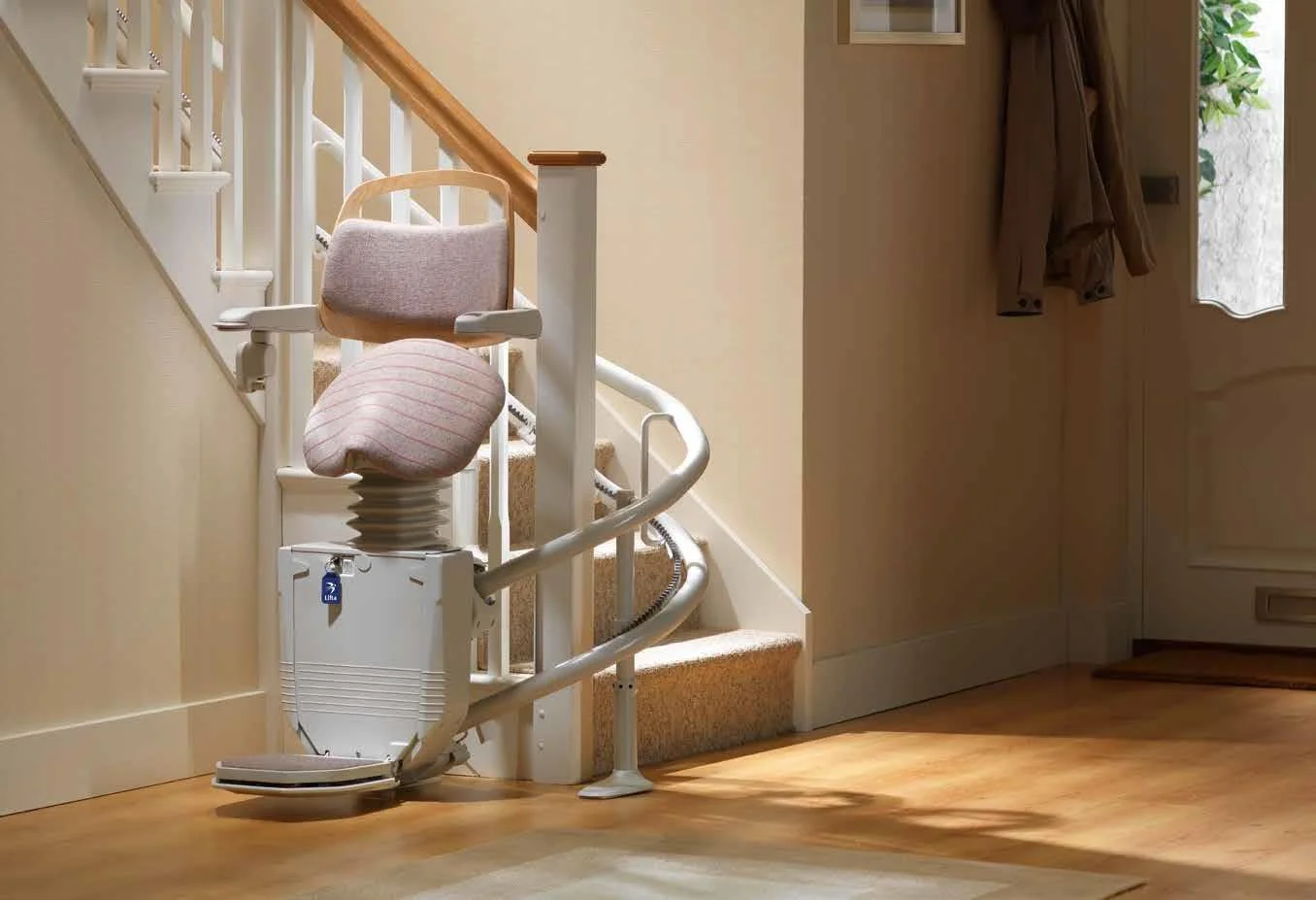
Split-level homes are a different story. They usually have short flights between levels, and a straight stair lift handles a single short run well. If the stairs turn at a landing, a curved lift built to that staircase is the usual answer.
In older masonry or limestone structures, we look closely at the walls and treads before choosing how the rail is mounted. Every staircase gets measured in person, because no two older homes in the county are laid out quite the same.
July in Kinney County averages a range of 74 to 96°F, and the county gets about 22 inches of rain a year. An outdoor lift here needs to be rated for sun and heat, and the seat and controls should be covered when not in use.
Homes built on higher ground or on the rugged northern terrain can have long or uneven runs of exterior steps. A platform lift is worth considering when someone uses a wheelchair or walker and would struggle to transfer onto a seat.
About 29.3% of Kinney County's 2,617 residents are 65 or older, and 75.8% own their homes. Owning the home matters, since some funding programs require the applicant to be the homeowner living there.
There are no VA facilities listed in the county, so veterans usually work with the VA by phone or through the Texas Veterans Commission San Antonio Office at 5788 Eckhert Road (2nd Floor), San Antonio, 78240, (210) 699-5076.
Incomes here are largely tied to ranching, hunting leases and tourism, with per capita income of $30,431 in 2019. That makes outside help worth looking into before paying out of pocket.
Be aware that none of the programs below name stair lifts as a covered item, and the VA HISA grant excludes stair glides outright. Some still fund home repairs or accessibility changes, so it is worth asking each one directly what it will pay for.
A good first call is the Middle Rio Grande AAA office at 307 W. Nopal St., Carrizo Springs, 78834, (830) 876-3533. The Amy Young Barrier Removal Program (AYBR) also appears among Texas statewide programs and is another one to ask them about.
Kinney County ranks among the most sparsely populated counties in the nation. Residents typically travel to Uvalde or Del Rio for medical care and for specialized home-modification contractors.
Because several programs require a doctor's or therapist's evaluation, it helps to schedule that during a trip you are already making for medical care. Bring the stair measurements and photos so the conversation stays concrete.
A Medicaid waiver for Texans 21 and older who need nursing facility level of care; its home modifications benefit lists items like grab bars and wheelchair ramps, but stair lifts are not listed, and the waiting list is reported as many years. Call (877) 438-5658.
A Medicaid waiver for people whose disability began before age 22, with a $10,000 lifetime limit on minor home modifications. Ramps, grab bars and handrails are itemized, but stair lifts are not on either list.
Serves adults 60 and older and family caregivers in Kinney and six neighboring counties with referral, benefits counseling, care coordination and meals; it does not list a stair lift program but can point you to help. Call (830) 757-6122.
Offers very-low-income rural homeowners loans up to $40,000 at 1% fixed interest and grants up to $10,000 for homeowners 62 or older who cannot repay a loan. Stair lifts are not named, though grants go toward removing health and safety hazards.
A lifetime grant of up to $6,800 or $2,000 for medically necessary structural changes for veterans enrolled in VA health care. It specifically excludes stair glides and porch lifts, so it will not pay for a stair lift. Call (800) 698-2411.
Grants for veterans with certain severe service-connected disabilities, up to $126,526 (SAH) or $25,350 (SHA) for FY2026. The VA describes ramps and widened doorways, but stair lifts are not named. Call (800) 698-2411.
Older adults
307 W. Nopal St., Carrizo Springs, 78834
Veterans
5788 Eckhert Road (2nd Floor), San Antonio, 78240
The Middle Rio Grande AAA serves adults 60 and older. Younger adults may look at STAR+PLUS, which starts at age 21, or the CLASS waiver if the disability began before age 22. Neither program lists stair lifts by name.
The VA HISA grant explicitly excludes stair glides. The SAH and SHA grants do not name stair lifts, so ask the VA at (800) 698-2411 about your specific case.
For exterior entry steps, an outdoor stair lift or a platform lift is usually the better fit. A platform lift makes sense if someone uses a wheelchair.
Stair lifts are not named on the USDA Section 504 page. Loans can be used to repair, improve or modernize a home, and grants for homeowners 62 or older must remove health and safety hazards, so ask whether your project qualifies.
Start with the Middle Rio Grande AAA at (830) 876-3533 or (830) 757-6122. Veterans can also contact the Texas Veterans Commission San Antonio Office at (210) 699-5076.
Tell us about the stairs in your home and we will explain which lift fits, what it costs and how installation works.
