Marshall's oldest neighborhoods climb northward over seven hills, and the antebellum and Victorian homes around Rusk and Houston streets were built as two-story houses long before anyone wrote accessibility standards. Out past the county seat, in Hallsville, Waskom, Scottsville and Nesbitt, the homes are more often single-family and detached houses, with some townhouses, duplexes and split-level homes mixed in.
That spread matters when someone in the family starts struggling with the stairs. A tall front staircase in a late 1800s house, a short half-flight in a split-level and a sloped walk up from the street each call for a different kind of lift. This page walks through what fits Harrison County homes and where local families can look for help paying for it.
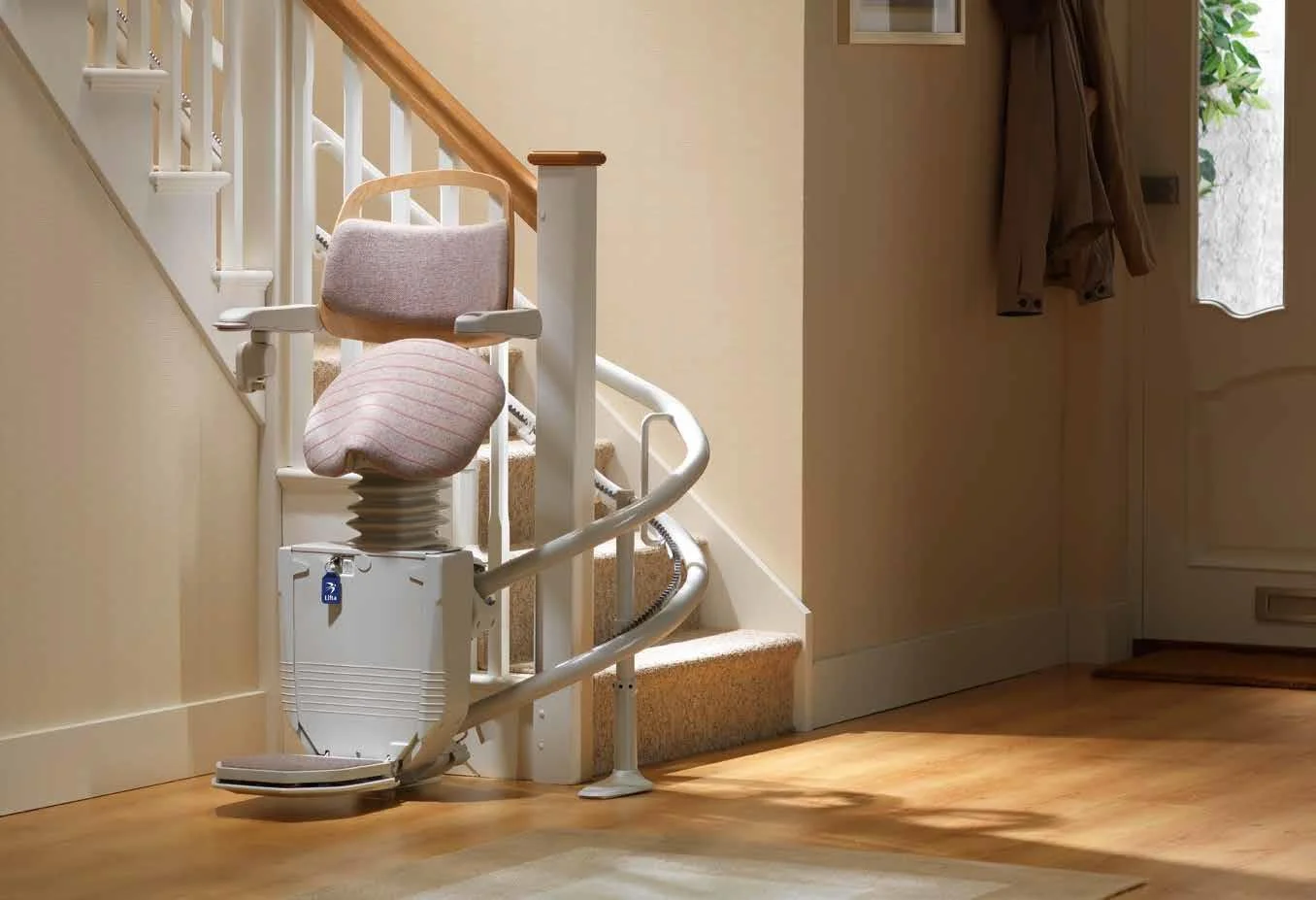
Many of Marshall's historic houses date to the late 1800s and early 1900s. Their staircases tend to be steep, and some turn at a landing or wrap around a wall, which usually means a curved rail built to the exact shape of the stairs.
When a staircase runs straight from bottom to top, a straight rail is the simpler job. We measure every flight before recommending either one, because two houses on the same street can have very different stairs.
Some historic homes outside downtown have been noted as continuing to deteriorate. Before a lift goes in, the stair treads and the wall or floor it mounts to need to be solid, so a quick look at the condition of the stairs is part of every visit.
In Marshall's older section, the trouble often starts before the front door. Lots set on a grade can mean exterior steps up from the drive or a sloped walkway to the porch.
An outdoor stair lift is built to handle weather and can run along porch or entry steps. Where a wheelchair user needs to get up a few feet at the entrance, a platform lift may make more sense than a seat-style lift.
Split-level homes have short flights between floors, and sometimes more than one of them. A short straight lift on each flight is common, though the layout decides what works.
Townhouses and duplexes often have a single straight staircase against a wall, which is a good fit for a straight rail. Across the county, 54.9% of residents lived in rural areas as of the 2020 Census, and installers and home-modification contractors tend to be based in and around Marshall, so it helps to plan the visit ahead for homes farther out.
No single program here pays for stair lifts by name, so families usually piece together options. The STAR+PLUS waiver lists home modifications and adaptive equipment among its services, and the Area Agency on Aging of East Texas offers minor repairs and modifications for adults 60 and older. Both have eligibility rules and limited funding.
Rural homeowners may want to ask the local USDA Rural Development office about Section 504 repair loans and grants. The Harrison County Veterans Service Officer in Marshall can be reached at (903) 935-8415.
For general aging services, the East Texas AAA office in Kilgore is at (903) 984-8641. Each program is summarized below.
A Texas Medicaid waiver for people 65 and older, or 21 and older with a qualifying disability, who meet nursing facility level of care; its services include home modifications and adaptive equipment, though stair lifts are not listed by name. Call HHSC Long-Term Care at (800) 252-7031 to start the interest list process.
Minor repairs or modifications essential for the health and safety of an older person age 60 and older, depending on funding and need; stair lifts are not listed by name. Call (800) 442-8845.
Grants up to $10,000 for very-low-income rural homeowners 62 and older, and loans up to $40,000 at 1% over 20 years, combinable up to $50,000. The official source does not list stair lifts, so confirm with the local USDA Rural Development office first.
A lifetime grant of up to $6,800 or $2,000, depending on disability status, for medically necessary structural changes to a veteran's home. Stair glides are specifically not covered.
Lifetime grants of up to $126,526 (SAH) or $25,350 (SHA) for veterans with qualifying severe service-connected disabilities to buy, build or adapt a home. Stair lifts are not listed by name.
A nonprofit center for independent living serving East Texas, including Harrison County, that offers information and referral on housing and adaptive equipment rather than direct funding; stair lifts are not listed. Call (936) 544-2811.
Critical home repairs for low-income homeowners in Gregg, Harrison and Upshur counties, decided case by case; stair lifts are not listed as a covered repair. Call (903) 236-0900.
Older adults
3800 Stone Rd., Kilgore, 75662
Veterans
102 W Houston St, Marshall, 75670
Often, yes. Many of these two-story homes have turning stairs that need a curved rail, and the stairs must be in sound condition to hold the lift, so we check that during the measuring visit.
The VA HISA grant specifically excludes stair glides. The SAH and SHA grants do not list stair lifts by name, so ask the Harrison County Veterans Service Officer at (903) 935-8415 what applies to your situation.
The Area Agency on Aging of East Texas Residential Repair service covers minor repairs or modifications for people 60 and older when funding allows. Stair lifts are not named, so call (800) 442-8845 to ask.
The STAR+PLUS waiver includes home modifications and adaptive equipment, but stair lifts are not itemized by name. Slots are capped and there is an interest list, so call (800) 252-7031 early.
USDA Section 504 repair loans and grants serve very-low-income homeowners in eligible rural areas, with grants for those 62 and older. Confirm with the local USDA Rural Development office that a stair lift qualifies before you rely on it.
Outdoor stair lifts are built for entry and porch steps, and a platform lift can work where a wheelchair needs to rise a few feet. Sloped lots in Marshall's older hills often call for one of these.
Tell us about the stairs in your home and we will explain which lift fits, what it costs and how installation works.
