Harris County covers 36 towns, from Houston, Pasadena and Baytown to Tomball, Crosby and the small villages like Bunker Hill Village and Piney Point Village. The housing ranges just as widely: single-family homes, detached houses, townhouses, walk-up apartments and low-rise buildings. Each one puts stairs in a different place, and that shapes which lift makes sense.
In the Houston Heights historic districts, many older houses sit on pier-and-beam foundations with the first floor four to five steps above the ground. For a lot of residents there, the first problem is getting in the front door, not getting upstairs. This page walks through what local homes mean for a stair lift and which programs may help with the cost.
The City of Houston's preservation manual describes most Heights homes as raised roughly two and a half to three feet, behind front porches at least six feet deep. Those are short runs of steps, which is the kind of spot where an outdoor stair lift or a platform lift is usually considered.
A deep porch gives room to work with at the top landing. Inside, most Heights houses are one or two stories in Queen Anne and Craftsman forms, so some families need help at the porch only, while others also have a straight flight to the second floor.
Because these blocks are protected, any change to the outside of the house may need to fit preservation rules. It is worth checking with the City of Houston before planning permanent exterior work.
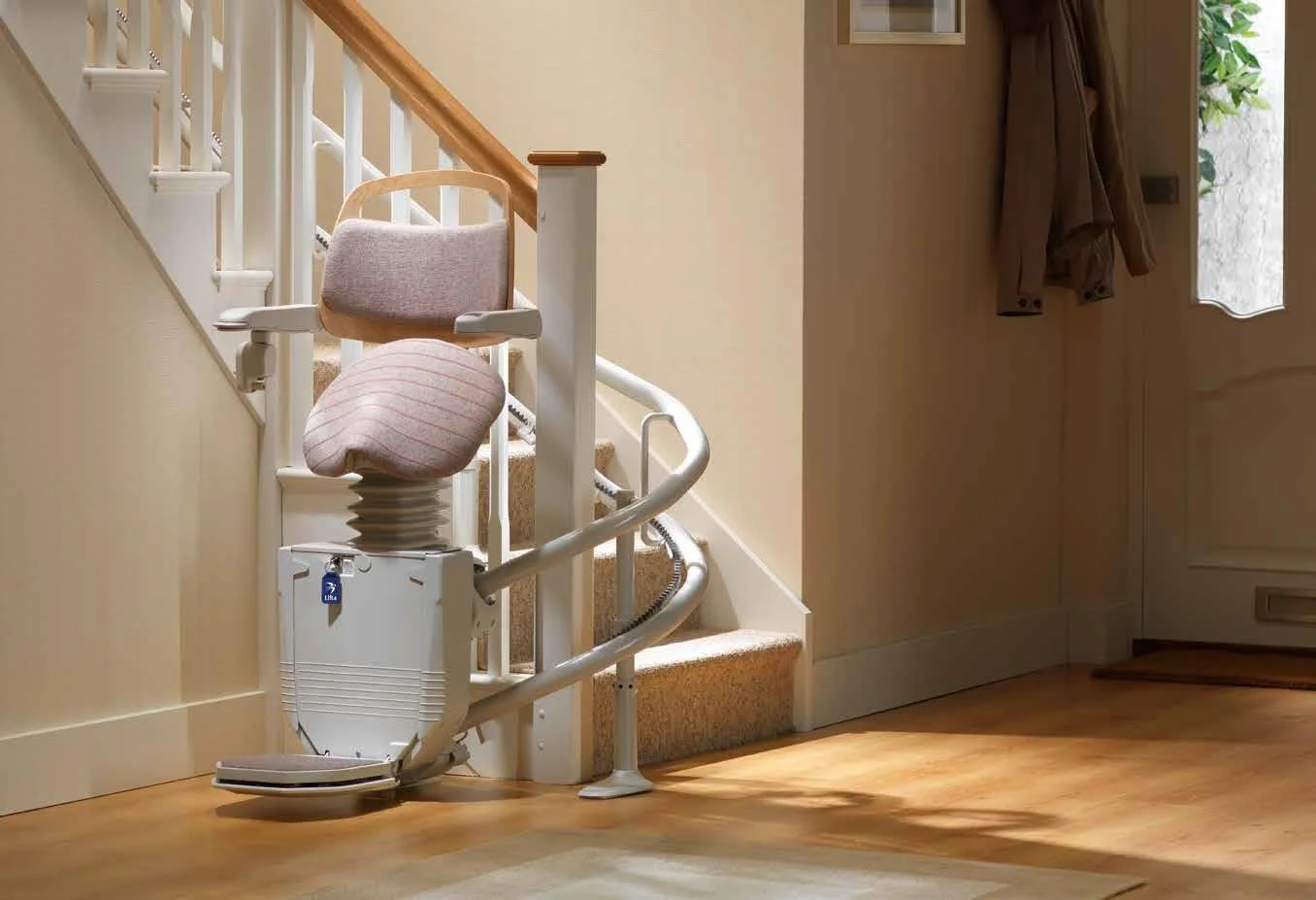
A straight interior staircase in a two-story single-family home is the simplest case and the most common one we look at. Townhouses often stack living space over several floors, and stairs with landings or turns may call for a curved rail built to the staircase.
Walk-up apartments and low-rise buildings raise a different question: who owns the stairs. With 47.9% of Harris County households owning their homes, many residents rent, and a renter will need the owner's approval before anything is attached to a shared stairway.
Harris County is flat and low. Downtown sits at about 50 ft, and the highest point in the county is roughly 150 ft. The county relies on an engineered drainage system, and flat terrain plus heavy development has worsened flood risk.
That matters for stairs. In a flood or a power problem during the humid subtropical summer, a person may need to move between floors or reach an exit quickly. A lift that is easy to use every day is also one that helps in those moments, and outdoor units here have to handle heat and humidity.
Cost is a real concern locally. Homeowners' insurance premiums rose 17% to an average of $2,303 a year countywide, and 24.4% of Harris County homeowners spend 30% or more of their income on housing.
Two Texas Medicaid waivers name stair lifts directly: STAR+PLUS and TxHmL. Other programs below fund home repairs or modifications but do not mention stair lifts, so call first and ask. The Amy Young Barrier Removal Program (AYBR) is also listed as a statewide program worth asking about.
Veterans should know that the main VA home modification grant, HISA, excludes stair glides, so other routes are often needed.
This Medicaid waiver can pay toward a stair lift for adults 65+ or adults 18+ with disabilities who qualify, with a physician letter of medical necessity and a place on the interest list. Call (877) 438-5658.
For people enrolled in Texas Home Living with an intellectual or developmental disability, this benefit lists stair lifts and pays up to $7,500 lifetime plus up to $300 per year for repairs. Call (877) 438-5658.
HCS waiver members may get up to $7,500 lifetime for minor home modifications such as ramps and door widening; stair lifts are not listed. Call (877) 438-5658.
CLASS members have a $10,000 limit for minor home modifications during enrollment, though the regulation does not name stair lifts. Ask your case manager or call (877) 438-5658.
A referral and supportive services agency for Harris County residents 60 and older and their caregivers; stair lift funding is not listed. Call (832) 393-4619.
Health and safety repairs for low-income homeowners 62 or older or disabled, but it is currently accepting only septic and well projects and stair lifts are not mentioned. Call (832) 927-4955 to check current scope.
Repair or reconstruction for Houston homes damaged by the May 2024 Derecho or Hurricane Beryl, listed as coming in August 2026; stair lifts are not listed. Call (832) 394-6200.
Low-interest loans up to $40,000 and grants up to $10,000 for very-low-income homeowners, with grants for those 62+, but only in USDA rural areas and stair lifts are not listed. Call (254) 742-9700.
Funds permanent changes like ramps and widened doorways for eligible veterans, but explicitly excludes stair glides. For local VA help, call the Harris County Veterans Services Department at (281) 876-6600.
Larger grants for veterans with specific severe service-connected disabilities, used to buy, build or adapt a home; stair lifts are not named. The Harris County Veterans Services Department is at (281) 876-6600.
Helps people with disabilities of any age get equipment and home modifications through its Purchase Services Program, though stair lifts are not named. Call (713) 974-4621.
Free exterior wheelchair ramps and volunteer repairs for low-income seniors, veterans and families who own their homes; stair lifts are outside its scope. Call (713) 659-2511.
Older adults
8000 N. Stadium Dr., 3rd Floor, Houston, 77054
Veterans
2100 Travis Suite 210, Houston, 77002
It can, through the STAR+PLUS HCBS waiver for adults who qualify, and through the TxHmL waiver for people enrolled in it. STAR+PLUS uses an interest list, so getting on it early matters. Call (877) 438-5658.
The HISA grant explicitly excludes stair glides. SAH and SHA grants do not name stair lifts and are limited to specific severe disabilities. The Harris County Veterans Services Department at (281) 876-6600 is a local place to ask.
Yes, some. STAR+PLUS covers adults 18+ with disabilities, the Harris County Home Repair Program accepts disabled homeowners of any age, and the Houston Center for Independent Living cites no age restriction.
With the first floor four to five steps up behind a deep porch, an outdoor stair lift or platform lift is usually the starting point. Check with the City of Houston about preservation rules before permanent exterior work.
Probably not. Most of urban and suburban Houston does not count as rural for USDA, though some unincorporated fringe areas may. Call (254) 742-9700 to check your address.
The City of Houston's DR24 program is listed for August 2026 for homes damaged by the May 2024 Derecho or Hurricane Beryl, with seniors and people with disabilities given initial priority. Call (832) 394-6200.
Tell us about the stairs in your home and we will explain which lift fits, what it costs and how installation works.
