Gonzales County stretches across about 1,067 square miles of South Texas, between San Antonio, Austin and Victoria, with the Guadalupe and San Marcos rivers running through it. Most people here live out in the country rather than in Gonzales, Nixon, Waelder or Smiley. That changes how a stair lift project gets planned, from the first visit to the final install.
Many homes in the county look like one-story houses from the road. Inside and at the front door, a lot of them still have steps: split-level layouts, raised-pier foundations and porch entries that get harder to manage every year. This page walks through what those homes mean for a stair lift and which programs may help with the cost.
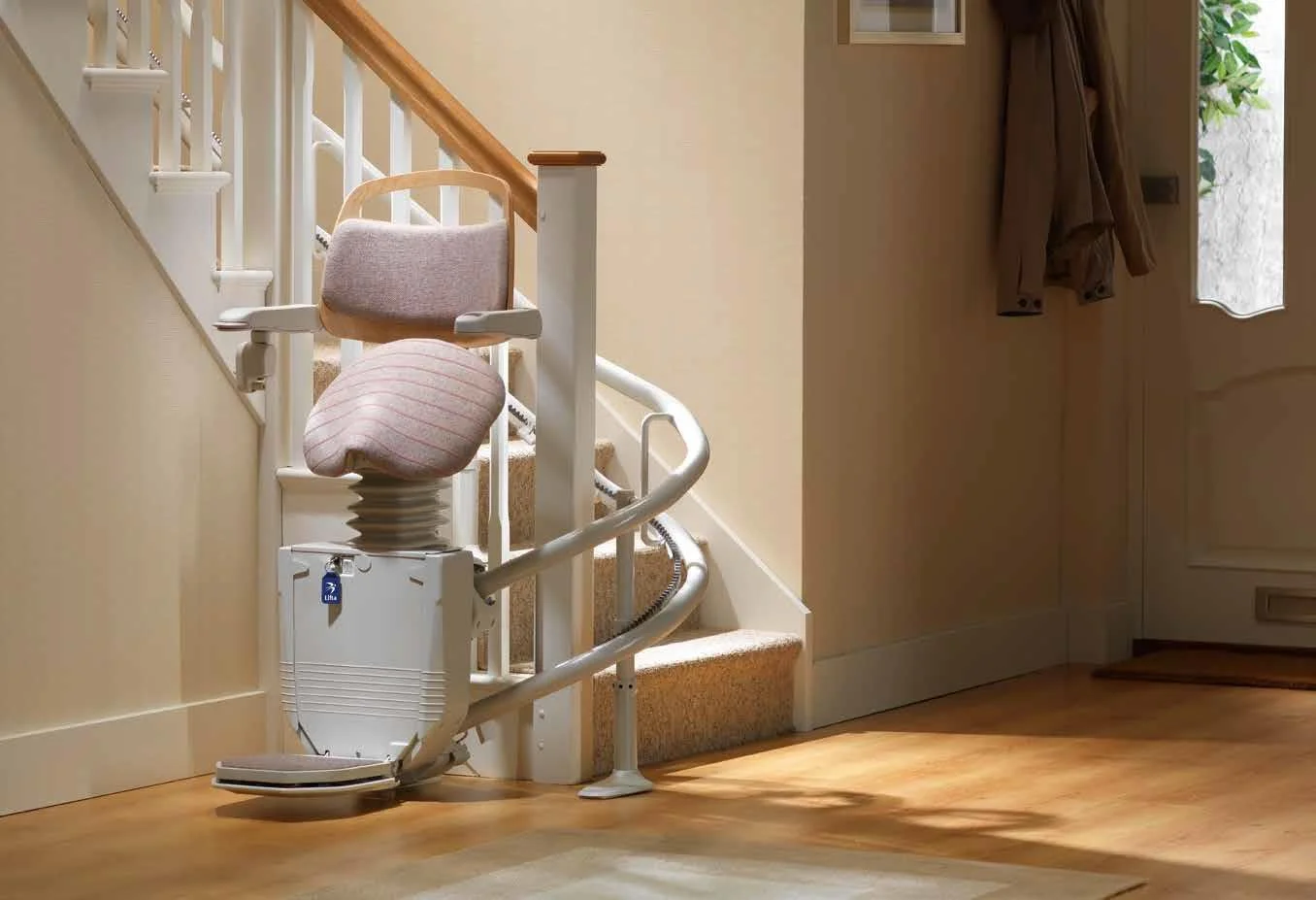
The county's housing is mostly older single-story rural and small-town homes, the kind you see across a farming and ranching community. Ranch-style homes and split-level homes are common, and so are houses built up on raised-pier foundations.
A raised-pier house can sit several steps above the yard, so the hardest climb is often getting in the front or back door. In that case an outdoor stair lift on the entry steps, or a platform lift, may do more good than anything inside.
Split-level homes usually have short runs between levels. Some take a simple straight stair lift; others have a landing or turn that calls for a curved rail. We measure each run before recommending one or the other.
Townhouses and walk-up apartments tend to have a full straight flight, which is the simplest and most common stair lift install. In a rental or shared stairwell, the owner or manager needs to sign off before any rail goes in.
Gonzales, the county seat, keeps a substantial historic downtown and courthouse square. The Gonzales County Courthouse, built in the Second Empire style, was added to the National Register of Historic Places in 1972. Preservation of historic downtown buildings can limit changes to the outside, so an indoor stair lift that mounts to the stair treads, not the walls, is often the easier fit there.
About 64.6% of county residents live in rural areas, and many seniors live well outside the town centers. Installers, home modification contractors and equipment suppliers are often based in San Antonio, Austin or Victoria.
That means more travel and more lead time. If stairs are already a problem, it helps to start the measuring and paperwork early, especially if you plan to apply for a grant or loan that takes time to approve.
Median household income in the county was approximately $53,317 (2018 estimate), so grant and loan programs matter. The one program in our list that names stair lifts directly is the USDA Section 504 repair program, which serves rural homeowners. Since most of the county is rural, it is worth checking first.
The Texas Medicaid waivers, STAR+PLUS HCBS and CLASS, include minor home modifications, but a stair lift is decided case by case. Texas also has the Amy Young Barrier Removal Program (AYBR) statewide, and the Golden Crescent Area Agency on Aging is a good place to ask what is open right now.
The Gonzales County Veterans Service Office, at 414 St. Joseph Street, Suite 105, in Gonzales, can be reached at (830) 672-3244 to sort out which VA benefits apply. One caution: the VA HISA grant does not pay for stair lifts.
Information, referral, benefits counseling and care coordination for adults 60+ in a seven-county region that includes Gonzales County; its source does not list stair lifts or a home modification fund. Call (361) 578-1587 to ask about current in-home accessibility help.
Nonprofit home repair help for income-constrained homeowners in the Golden Crescent region; stair lifts and accessibility work are not listed, and the program says it is not accepting new applications at this time. The program line is (361) 573-2511.
A Medicaid waiver for adults 21+ who need a nursing-facility level of care and want to stay at home; it covers minor home modifications and adaptive aids, but stair lifts are not named and are decided through your service plan. Call (877) 782-6440.
A Medicaid waiver with no age limit for people with a related condition that began before age 22; it includes minor home modifications, though stair lifts are not named, and interest-list waits are common. Call (877) 438-5658.
Loans up to $40,000 at 1% fixed interest and grants up to $10,000 for homeowners 62+ who cannot repay a loan, combinable up to $50,000, for very-low-income rural homeowners. Stair lifts are listed among covered accessibility changes; confirm details with the local USDA Rural Development office.
A lifetime grant of up to $6,800 or $2,000, depending on disability status, for medically necessary fixed alterations such as entrance access and bathroom changes. Stair lifts are explicitly not covered.
Grants for veterans with specific severe service-connected disabilities, up to $126,526 for SAH and $25,350 for SHA (FY2026), to buy, build or adapt a home. Stair lifts are not named in the source, so ask the Gonzales County Veterans Service Office at (830) 672-3244 whether one could be part of an approved plan.
Older adults
120 S. Main St., Suite 100, Victoria, 77901
Veterans
414 St. Joseph Street, Suite 105, Gonzales, 78629
Not through the HISA grant, which explicitly excludes stair glides and porch lifts. SAH and SHA grants cover home adaptations for certain severe service-connected disabilities, but the VA page does not list stair lifts by name. The Gonzales County Veterans Service Office at (830) 672-3244 can help you check.
The program serves USDA-eligible rural areas with populations under 35,000, and most of Gonzales County outside larger towns qualifies. Income must be below 50% of area median income for grants or 80% for loans. Confirm your address with the local USDA Rural Development office.
The Golden Crescent Area Agency on Aging serves adults 60+. The STAR+PLUS waiver starts at age 21, and the CLASS waiver has no age limit for people with a qualifying related condition.
When the main climb is the entry steps, an outdoor stair lift or a platform lift on those steps is often the right fit. We look at the number of steps, the landing and the ground below before suggesting one.
The Golden Crescent Habitat for Humanity General Repairs Program does not list stair lifts, and it currently states it is not accepting new applications. You can call (361) 573-2511 to ask when it may reopen.
Start with the Golden Crescent Area Agency on Aging at (361) 578-1587, at 120 S. Main St., Suite 100, in Victoria. It handles intake and referral and can point you to the programs that fit your situation.
Tell us about the stairs in your home and we will explain which lift fits, what it costs and how installation works.
