From Columbus at the old Dewees Crossing on the Colorado River to Eagle Lake, Weimar, Garwood, Rock Island and Glidden, most homes in Colorado County are older single-family houses spread across farm country. Very few are multi-story urban buildings. That shapes what a stair lift job here usually looks like.
Many families assume a ranch-style house means no stairs at all, and then find the trouble is the front steps, a split-level half flight, or a second floor added later. This page walks through how local homes and land affect the choice of lift, and which programs a Colorado County household can call about paying for one.
The housing here is mostly single-family homes, detached houses, ranch-style homes and split-level homes, with some low-rise buildings. Settlement started around 1821 with colonists from Stephen F. Austin's Old Three Hundred, and the towns grew as low-density agricultural communities rather than dense neighborhoods.
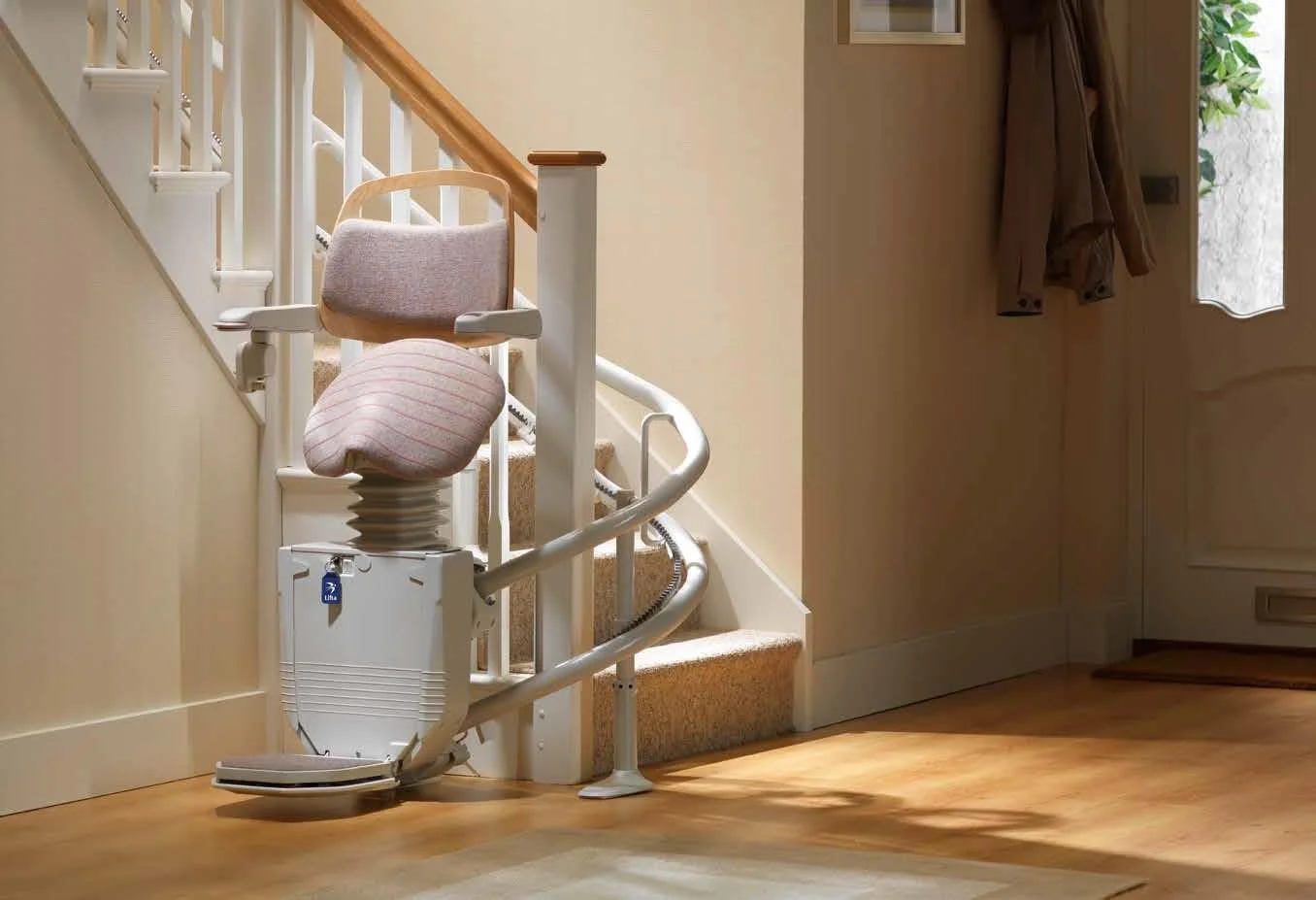
For a straight indoor staircase, a straight-rail lift is usually the simplest fit. Split-level homes often have short flights between levels, which can take a short straight rail, though a landing that turns may call for a curved rail built to that staircase. In low-rise buildings, a shared stairwell needs permission from whoever owns the building before anything gets mounted.
Colorado County covers 964 square miles of level to rolling land, with elevations from about 150 to 425 feet. On rolling lots, a house can sit higher at the front or back than the yard, so the hardest climb is sometimes outside, not inside.
Annual rainfall averages about 41 inches. If an outdoor lift is the answer for entry steps, it needs to be a model rated for outdoor use, with a cover for the seat and controls. Where a wheelchair user cannot transfer to a seat, a platform lift is the option to ask about instead of a chair-style lift.
About 11,549 people live in the county, and 17.7% are 65 or older. Roughly 75.9% of residents own their homes, which matters because owners can usually install a lift without asking a landlord.
That is a large share, so it is worth checking VA benefits early, while knowing that not every VA home benefit pays for a stair lift.
No program in the list below names stair lifts as a covered item, and the VA HISA grant specifically excludes stair glides. Some programs fund home accessibility work more broadly, so a stair lift request may be possible with medical documentation or an approved plan.
For veterans, start with the Colorado County Veterans Service Office in Columbus at (979) 733-0903; help there is free and appointments are encouraged. For adults 60 and older, the Area Agency on Aging of the Houston-Galveston Area Council can be reached at (800) 437-7396. Homeowners outside Columbus, Eagle Lake and Weimar should also check their address against the USDA rural eligibility map for Section 504 repair loans and grants.
A Texas Medicaid waiver benefit with a $7,500 lifetime limit per member, plus $300 a year for repairs after that. Ramps, grab bars and door widening are named as covered; stair lifts are not listed either way, so a request needs medical-necessity justification through the member's service plan.
A one-time state grant of up to $22,500 for households with a person with a documented disability and income at or below 80% of Area Median Family Income. Ramps, handrails and bathroom safety upgrades are named, stair lifts are not listed; call (512) 936-7799 to confirm availability for a Colorado County address.
Loans up to $40,000 at 1% fixed interest and grants up to $10,000 for very-low-income homeowners 62 or older in eligible rural areas, combined up to $50,000. Interior lift devices are not named, but funds can go toward disability accessibility reviewed case by case by USDA field staff.
A VA benefit of up to $6,800 or $2,000 lifetime, depending on disability status, for medically necessary home improvements. The VA explicitly excludes stair glides, so it does not pay for a stair lift.
Grants of up to $126,526 (SAH) or $25,350 (SHA) for FY2026 for veterans with qualifying severe service-connected disabilities. Stair lifts are not listed and would depend on the VA-approved adaptation plan; call (979) 733-0903 for help applying.
Serves adults 60 and older and their caregivers in Colorado County with information and assistance, Medicare counseling and ombudsman services. It does not list a home-modification benefit, but can point you to options at (800) 437-7396.
A nonprofit independent living center in Sugar Land serving Colorado County residents of any age with a documented disability. Stair lifts are not listed as a covered item; call (281) 980-2219 to ask what help is available.
The county office at 305 Radio Lane, Room 106, Columbus, helps veterans and dependents apply for VA benefits such as HISA, SAH and SHA at no cost. It does not fund modifications itself; call (979) 733-0903 to set up an appointment.
Older adults
3555 Timmons Ln., Suite 120, Houston, 77027
Veterans
305 Radio Lane, Room 106, Columbus, 78934
Not through the HISA grant, which excludes stair glides. The SAH and SHA grants do not list stair lifts, but a lift could be considered within a VA-approved adaptation plan for veterans with severe service-connected disabilities. The Colorado County Veterans Service Office at (979) 733-0903 can help with the application.
The Area Agency on Aging serves people 60 and older, but the Fort Bend Center for Independent Living serves Colorado County residents with a documented disability of any age at (281) 980-2219. The Amy Young Barrier Removal Program and STAR+PLUS also have no age requirement in their listed eligibility.
Possibly. Much of the county outside Columbus, Eagle Lake and Weimar is rural, and the Section 504 program offers 1% loans to very-low-income owner-occupants, plus grants up to $10,000 for homeowners 62 or older who cannot repay a loan. Check your exact address on the USDA eligibility map first.
For entry steps, an outdoor-rated stair lift can work for someone who can sit and transfer. With about 41 inches of rain a year, the lift should have weather protection. If the person uses a wheelchair and cannot transfer, a platform lift is usually the better choice.
STAR+PLUS HCBS minor home modifications do not list stair lifts as covered or excluded, and elevators are excluded. A stair lift request would need to be justified as medically necessary through the member's individual service plan, within the $7,500 lifetime limit.
Tell us about the stairs in your home and we will explain which lift fits, what it costs and how installation works.
