Washington County covers 563 square miles of South County, and 41% of that is water. Its 20 towns and villages run from Watch Hill and Misquamicut on the Atlantic shore to Hope Valley, Exeter and Wyoming inland, with New Shoreham out on Block Island.
The homes here are just as varied. A historic multi-story house near Narragansett Pier, a mid-century split-level in North Kingstown and a farmhouse in Richmond each have a different staircase, and that staircase is often the one thing standing between an owner and the upstairs bedroom. This page walks through what that means for a stair lift and where to look for help paying for one.
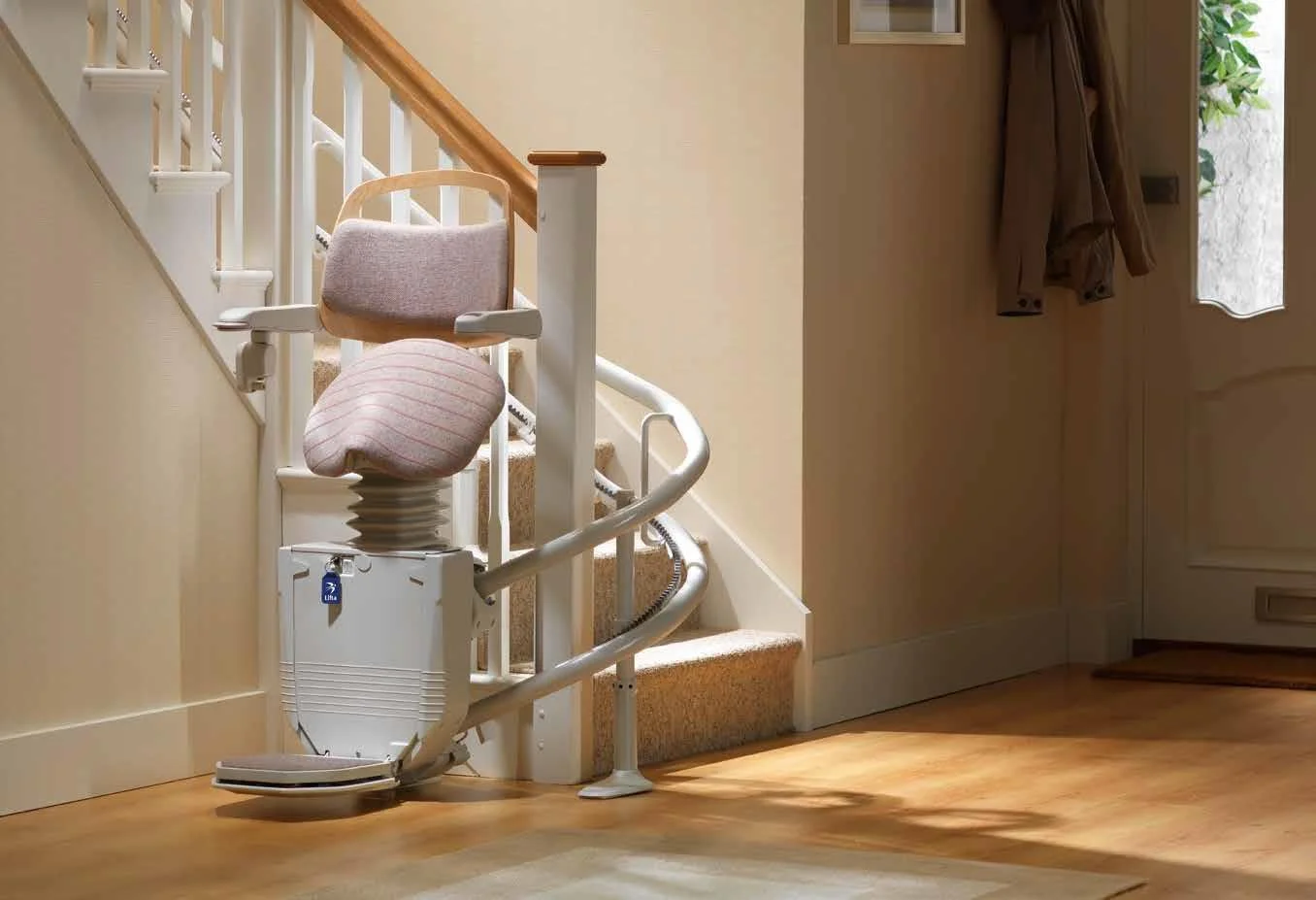
Most housing in the county is owner-occupied single-family homes, typical of New England towns. When the staircase is one straight flight with no landing turns, a straight stair lift is usually the simplest and quickest install.
Historic multi-story coastal homes are a different story. Older stairs often turn at a landing, wind, or narrow near the top, and those usually call for a curved rail built to the exact shape of the stairs.
Mid-century split-levels bring their own puzzle: several short flights instead of one long one. Depending on which levels the person needs, that can mean one lift on the most important flight or separate lifts on more than one.
Rural farmhouses can have steep, tight back stairs alongside a main staircase. Part of our visit is deciding which set is the better candidate for a rail.
The land runs from flat shoreline to gently rolling hills, topping out around 560 feet near the Black Plain neighborhood of Exeter. Inland homes on sloped lots often have exterior steps from the driveway or deck, where an outdoor stair lift built for weather exposure can make sense.
Along the shore in places like Charlestown, Quonochontaug and Weekapaug, many homes sit up off the ground with steps to the entry. Those entries are worth measuring for an outdoor lift, or for a vertical platform lift when a wheelchair is involved.
Walk-up apartments, townhouses and low-rise buildings show up in the county too. In those, the stairs may be shared, so the owner or association usually has to approve any installation before work starts.
As of the 2020 Census, the county's median age was 46.9, and 22.7% of residents were 65 or older. That is an older profile than many places, and it shows in how many families are thinking about the stairs now rather than later.
In 2020, 74.6% of the county's 65,694 housing units were owner-occupied. Owners can generally install a stair lift without a landlord's sign-off, which keeps the decision in the family's hands.
Another 20.2% of units were vacant, many of them seasonal or vacation homes along the coast and on Block Island. If a summer house is becoming a year-round home, the stairs are worth looking at before the move.
Only one program on our list names lift installations outright: RIHousing Access Independence II, a loan for households that include a person with a developmental disability. The others may help, but they do not list stair lifts by name, so coverage has to be confirmed with the agency first.
For people on Medicaid or near nursing-home level of care, start with Rhode Island Medicaid HCBS, PACE Rhode Island, or the @HOME / At Home Cost Share Program through the Office of Healthy Aging at (401) 462-3000. Rural homeowners with very low income can ask about USDA Section 504 repair loans and grants, and veterans with severe service-connected disabilities can ask the VA about housing grants.
Rhode Island also has statewide options worth asking about: the RI Medicaid Global Consumer Choice Compact Waiver, Environmental Modifications, the RI Livable Home Modification Grant, the OSCIL / ATAP Assistive Technology Program, and VA Benefits for Veterans (HISA + Prosthetics). Details for the main programs are below.
VA Providence Healthcare System, at 830 Chalkstone Ave in Providence, is the VA medical facility serving Washington County.
For state-level help with benefits, the Rhode Island Office of Veterans Services is at 560 Jefferson Boulevard, Suite 206, Warwick, and can be reached at (401) 921-2119.
Medicaid services that help older adults who meet financial and nursing-home level-of-care criteria stay at home, delivered through an individual care plan. The source does not list stair lifts or home modifications, so confirm with EOHHS / The POINT at (401) 462-4444.
A Medicaid/Medicare-funded care package covering medical care, therapy and home-care coordination for older adults at nursing-home level of care in a PACE service area. The source does not say whether stair lifts are included; ask the PACE team at (401) 490-6566.
An income-based cost-share that helps older Rhode Islanders afford in-home care when they do not qualify for Medicaid LTSS. The source does not mention stair lifts or home modifications; call the Office of Healthy Aging at (401) 462-3000 to ask.
Loans of up to $50,000 for families and caregivers of people with developmental disabilities to modify their homes, and installation of lifts is named as an eligible use. Eligibility depends on a developmental disability in the household, not age alone.
Loans up to $40,000 at 1% fixed interest for very-low-income rural homeowners, and grants up to $10,000 for owners 62 and older who cannot repay a loan. Stair lifts are not listed by name, and the home must be in an eligible rural area; call (800) 414-1226.
Grants for veterans with specific severe service-connected disabilities, up to $126,526 for SAH and $25,350 for SHA (FY2026), to buy, build or adapt a home. The VA source mentions ramps and wider doorways but not stair lifts; call (800) 827-1000.
Older adults
57 Howard Avenue, 3rd Floor, Cranston, 02920
Veterans
560 Jefferson Boulevard, Suite 206, Warwick, 02886
The Medicaid HCBS and LTSS information we reviewed does not list stair lifts by name. Coverage would have to be worked out in an individual care plan, so call EOHHS / The POINT at (401) 462-4444 before you buy.
RIHousing Access Independence II names installation of lifts as an eligible use, with loans of up to $50,000. It is limited to households caring for someone with a developmental disability.
The @HOME / At Home Cost Share Program through the Office of Healthy Aging is built for older adults who need in-home care but do not qualify for Medicaid LTSS. It does not list stair lifts, so ask directly at (401) 462-3000.
USDA Section 504 grants require the owner to be 62 or older. Repair loans up to $40,000 at 1% interest do not carry that age rule, but the household must have very low income and live in an eligible rural area.
It depends on the address. Washington County has both eligible rural inland towns and denser coastal and village areas, so the property has to be checked against USDA's rural map. Their number is (800) 414-1226.
Often, yes. Split-levels have several short flights, so we look at which levels matter most and whether one lift or more than one is the right fit.
Tell us about the stairs in your home and we will explain which lift fits, what it costs and how installation works.
