Philadelphia earned the nickname 'City of Homes' in the nineteenth century because row houses were everywhere and so many people owned them. That history still shapes daily life. Row houses, townhouses, semi-detached homes, walk-up apartments and low-rise buildings make up much of the county, and most of them put the bedroom and bathroom up a flight of stairs.
The narrowest of these homes are the 'bandbox' or 'Trinity' houses, typically no larger than about sixteen feet on any side, with one room per floor and enclosed winding stairs. If a parent or you are trying to stay in a house like that, the staircase is usually the first thing to plan around. This page covers which kind of lift fits Philadelphia homes and where the money can come from.
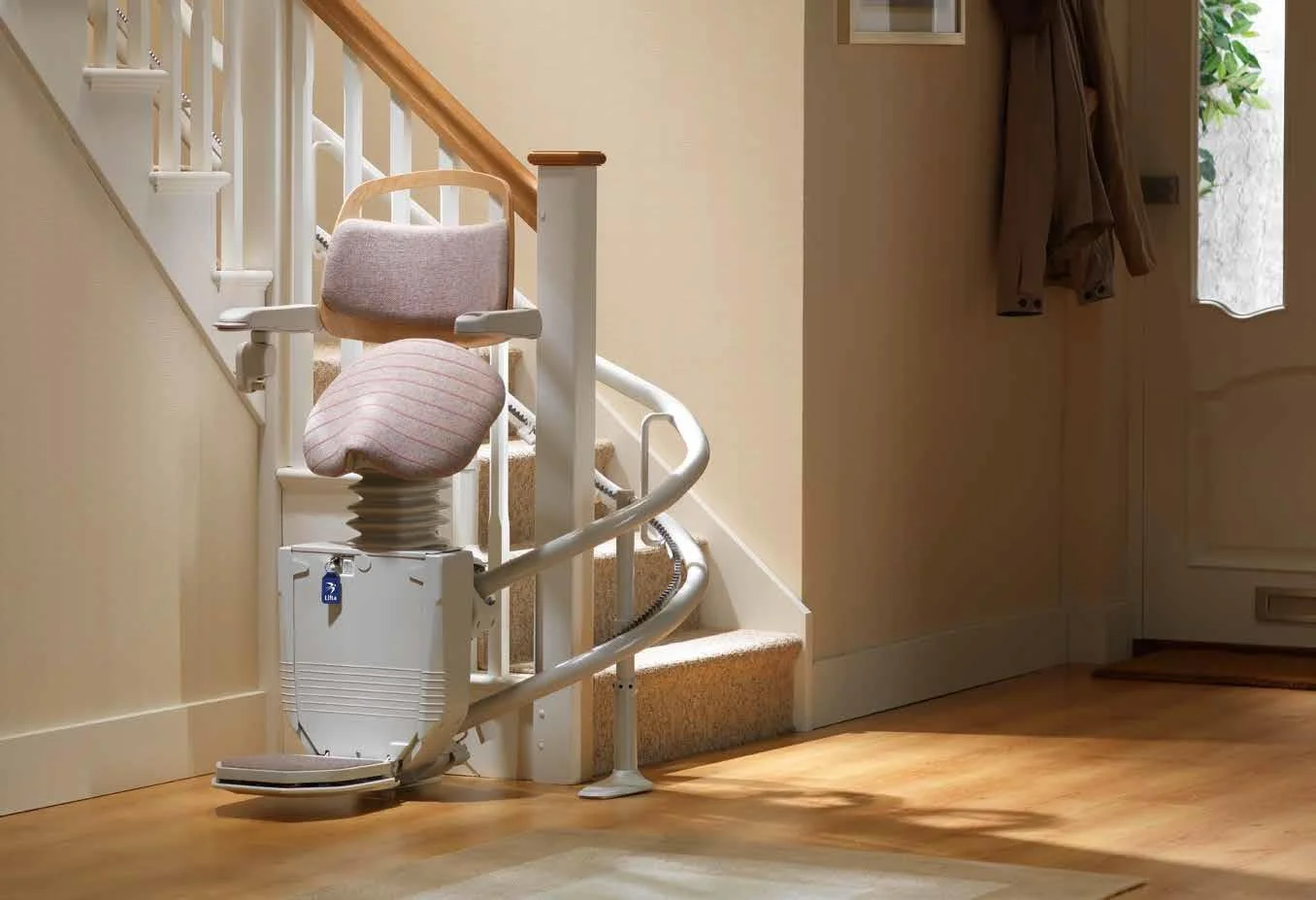
Many Philadelphia row houses and townhouses have a single straight flight between floors. A straight-rail lift is usually the simpler and lower-cost fit for those, since the rail runs one direction along the wall.
Trinity and bandbox houses are a different job. Their stairs wind tightly inside an enclosed space, so a curved rail built to the shape of that staircase is often the only option. In homes with two or three stories, expect us to look at each flight separately, because each one may need its own lift.
Center City and the southern parts of the region sit on flat, gently sloped ground, so most homes there start at street level with a few front steps. The northwest of the city rises onto hillier Piedmont ground, near where the Schuylkill River has cut a steep valley on its way to Fairmount.
In those older northwest hillside neighborhoods, the stairs inside are only part of the picture. Sloped approaches and split-level entries can mean outdoor steps too. An outdoor-rated stair lift or a platform lift may be worth considering for the entry, so getting into the house is as manageable as getting upstairs.
About 14.4% of Philadelphia County residents are 65 or older, and 52.3% of all households own their home. Among seniors, ownership runs higher: about 69% of Philadelphia seniors are homeowners.
Owning a paid-off house does not mean the budget is easy. More than a third of residents age 65 and older live at or below the federal poverty line, and repair costs weigh on fixed incomes. That is why the funding programs below matter so much in this county.
The usual first call is the Philadelphia Corp for Aging (PCA) at (215) 765-9040, at 642 N. Broad St., Philadelphia 19130. PCA is the county Area Agency on Aging and the local entry point for OPTIONS and CHC assessments.
Two programs here list stair lifts directly: the Community HealthChoices waiver for people who qualify for Medicaid and need a nursing-facility level of care, and Liberty Home Solutions for people with disabilities. Inglis House also covers stair lifts, but only for homeowners 62 and older in five ZIP codes. For others, OPTIONS and SHARP fund home modifications without naming stair lifts, so ask PCA during your assessment.
The Philadelphia Office of Veterans Affairs is in City Hall Room 127, Philadelphia 19107, and can be reached at (215) 686-3256.
Veterans with qualifying service-connected disabilities may be eligible for VA Specially Adapted Housing or Special Housing Adaptation grants. The VA source does not mention stair lifts specifically, so confirm with the VA at (800) 827-1000 before planning around one.
A Medicaid waiver for Pennsylvania residents 21 and older who meet nursing-facility level of care, and it covers stair lifts on a case-by-case basis with prior authorization through your managed care organization. Call (833) 735-4416.
State-funded in-home services for Pennsylvanians 60 and older with no income requirement, though a sliding co-payment may apply; home modifications are listed, but stair lifts are not mentioned by name. Call (717) 783-1550 or start through PCA locally.
The county's Area Agency on Aging handles intake and assessment and connects residents to OPTIONS, CHC enrollment and SHARP; whether it funds stair lifts directly is not stated. Call (215) 765-9040.
Minor repairs and safety modifications for Philadelphia homeowners 60 and older, free at or below 200% of the federal poverty level with cost-sharing above that; stair lifts are not mentioned in the source. Call (215) 765-9040.
A nonprofit home-modification provider for people with disabilities in the Philadelphia region that covers stair lifts, paid through Medicaid waivers, CDBG/HOME grants, other grants or private pay. Call (267) 765-1530.
Home repair and accessibility modifications, including stair lifts, for homeowners 62 and older in ZIP codes 19104, 19121, 19131, 19132 and 19139 only. Call (412) 885-6794.
Federal grants for veterans with qualifying service-connected disabilities, up to $126,526 for SAH and $25,350 for SHA in FY2026; stair lifts are not mentioned in the source. Call (800) 827-1000.
Older adults
642 N. Broad St., Philadelphia, 19130
Veterans
City Hall Room 127, Philadelphia, 19107
Usually not. Trinity and bandbox houses have tight, enclosed winding stairs, which often call for a curved rail built to fit that staircase instead of a straight unit.
Yes, possibly. The CHC waiver starts at age 21 for people who meet its Medicaid and nursing-facility level of care rules, and Liberty Home Solutions serves people with disabilities in the Philadelphia region. Both list stair lifts as covered.
According to the source, OPTIONS has no income requirement for people 60 and older. A sliding co-payment based on income may apply, and PCA handles the local assessment.
SHARP focuses on minor repairs and safety modifications, and its source does not mention stair lifts. It is free for qualifying homeowners at or below 200% of the federal poverty level, so ask PCA at (215) 765-9040 what it can cover for your home.
Inglis House limits its home modification program to homeowners 62 and older in 19104, 19121, 19131, 19132 and 19139. Call (412) 885-6794 to check.
The Philadelphia Office of Veterans Affairs in City Hall Room 127 can help at (215) 686-3256. For SAH or SHA grants, contact the VA at (800) 827-1000.
Tell us about the stairs in your home and we will explain which lift fits, what it costs and how installation works.
