Allentown's brick rowhouses were built tall and narrow, and their staircases were built steep. Many of these homes date to the late 19th and early 20th centuries. The bedrooms and the only full bath are often upstairs, so a hard staircase can decide whether someone stays in the house.
The rest of Lehigh County has its own version of the problem. From Emmaus and Macungie to Slatington, Coplay and Coopersburg, the county's 40 towns hold mostly older, multistory homes on rolling ground. This page covers what that means for a stair lift and which programs in Lehigh County may help pay for one.
The typical Lehigh Valley home was built around 1970, about 54 years old compared with a national median near 43. Roughly 61% of homes in the valley were built before 1980, and about 25.5% were built before 1940. New single-floor, step-free construction is scarce, so moving to a ranch house is not always a realistic option.
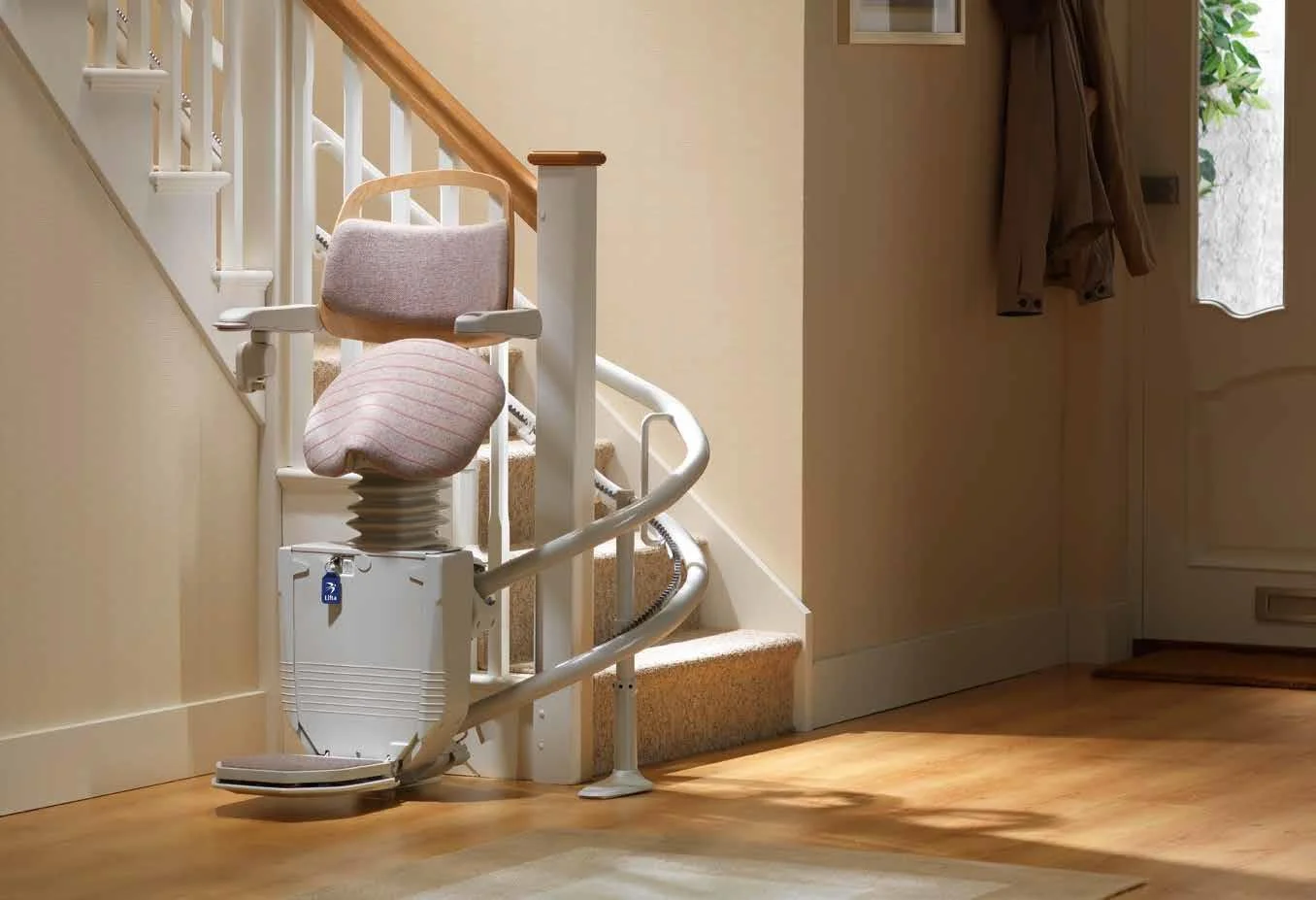
In an Allentown rowhouse, a straight stair lift is usually the first thing we measure for. If the staircase turns at a landing or winds near the top, a curved lift built to that staircase is the answer. In either case the lift lets an owner keep using the second-floor bedrooms and bath.
Across the county you will also find single-family homes, detached houses, townhouses and walk-up apartments. Each staircase is different, so we measure width, rise and any turns before recommending a model.
Lehigh County sits in the Lehigh Valley, framed by Blue Mountain to the north and South Mountain to the south. The ground rolls from the valley floor along the Lehigh River up into hillside neighborhoods and older borough hillsides.
Sloped lots and split-level homes often mean steps outside as well as inside. A porch or entry stair can be as much of a barrier as the one to the bedroom. For those spots we look at an outdoor stair lift or a platform lift, depending on the steps and how the person gets around.
Lehigh County has a population of 420,098. About 16.9% of residents are 65 or older, and 67.0% of homes are owner-occupied. That means many longtime owners want to stay put in houses with stairs.
Lehigh County Veterans Affairs is at 17 South 7th Street, Room 230, Allentown 18101, and can be reached at (610) 782-3295. The Lehigh County AAA, at 17 S. 7th St., Allentown 18101, answers aging services questions at (610) 782-3034.
A stair lift can cost $3,000 to $15,000, which is a lot for an owner on a fixed income. Several programs in Lehigh County may help, and they are listed below.
Three of them say stair lifts or lifting devices can be covered: the Community HealthChoices waiver, the OBRA and Independence waivers, and the Whole-Home Repairs Program. Others cover home modifications in general without naming stair lifts, so ask directly. The VA HISA grant does not cover stair lifts, though it can fund other changes like ramps and bathroom access.
A Medicaid waiver for adults 21 and older who are dually eligible for Medicare and Medicaid or meet a nursing-facility level of care, and it does cover stair lifts based on assessed medical need. Call (833) 735-4416.
Medicaid waivers through the Office of Long-Term Living for people with physical disabilities (Independence Waiver, ages 18 to 59, or OBRA Waiver, 18 and older), with environmental adaptations that cover stair lifts case by case. Call (833) 735-4416.
Reimburses home modifications up to a $2,000 lifetime grant when the care receiver is 60 or older (or under 60 with a dementia diagnosis) and has a regular caregiver; the source does not mention stair lifts specifically. Call (610) 782-3200.
State-funded in-home services for Pennsylvania residents 60 and older who are not eligible for Medicaid long-term services, with a possible sliding-scale co-payment; the source does not mention stair lifts. Call (717) 783-1550.
A nonprofit serving people of any age with disabilities in Lehigh and Northampton counties, offering information, referral, adaptations, assistive technology and waiver supports coordination; whether it pays for stair lifts is unknown. Call (610) 770-9781.
Grants of up to $50,000 per owner-occupied home for households at or below 80% of area median income, and lifting devices are an eligible item. Enrollment windows open and close, so call (484) 821-2203 to check for a reopening or waitlist.
A VA benefit of up to $6,800 for service-connected or up to $2,000 for non-service-connected veterans for permanent structural changes like ramps and bathroom access; it does not cover stair lifts. Call (877) 222-8387.
Grants for veterans with qualifying severe service-connected disabilities who own or will own the home, with SAH up to $126,526 and SHA up to $25,350 for FY2026; the source does not mention stair lifts. Call (877) 827-3702.
Older adults
17 S. 7th St., Allentown, 18101
Veterans
17 South 7th Street, Room 230, Allentown, 18101
Often it is the most practical option for these homes. A straight lift works on a straight run, and a curved lift is built for stairs that turn. We measure the staircase first to confirm the fit.
Yes, in some cases. The Caregiver Support Program accepts care receivers under 60 who have a dementia diagnosis, and the Independence Waiver serves Medicaid-eligible people ages 18 to 59 with physical disabilities. LVCIL serves people of any age with disabilities.
The HISA grant does not cover stair lifts. The SAH and SHA grants do not mention them on the source, so ask at (877) 827-3702 or contact Lehigh County Veterans Affairs at (610) 782-3295.
Enrollment windows are intermittent and have closed after high demand. Call the Community Action Committee of the Lehigh Valley at (484) 821-2203 to ask about reopening or a waitlist.
Yes. Hillside and split-level homes in Lehigh County often have porch or entry steps, and an outdoor stair lift or a platform lift can address those.
The Lehigh County AAA at (610) 782-3034 is a good starting point for OPTIONS and caregiver support. For Medicaid waivers, call (833) 735-4416.
Tell us about the stairs in your home and we will explain which lift fits, what it costs and how installation works.
