Lane County runs from the Pacific Ocean at Florence, along the Siuslaw River, across the Willamette Valley through Eugene and Springfield, and up the McKenzie River corridor toward Oakridge. It is one of only two Oregon counties that reach from the coast to the Cascade Range, and the homes change as the land does.
In the Eugene-Springfield core you find townhouses, walk-up apartments and low-rise buildings. Out in the hillier coastal and foothill communities, multi-level and hillside construction is common. This page walks through what those homes mean for a stair lift and where Lane County residents can look for help paying for one.
Lane County covers 4,722 square miles. About 82% of residents live in urban areas and 18% in rural areas, according to the 2020 Census. That split shows up in the staircases we see.
Hillside lots in places like Florence, Dunes City, Mapleton, Oakridge and Westfir often mean homes built into a slope, with stairs between levels and sometimes steps up from the driveway to the front door. In-town neighborhoods of Eugene, Springfield, Santa Clara and River Road tend toward more conventional layouts, though plenty of those homes still have a full flight to the bedrooms.
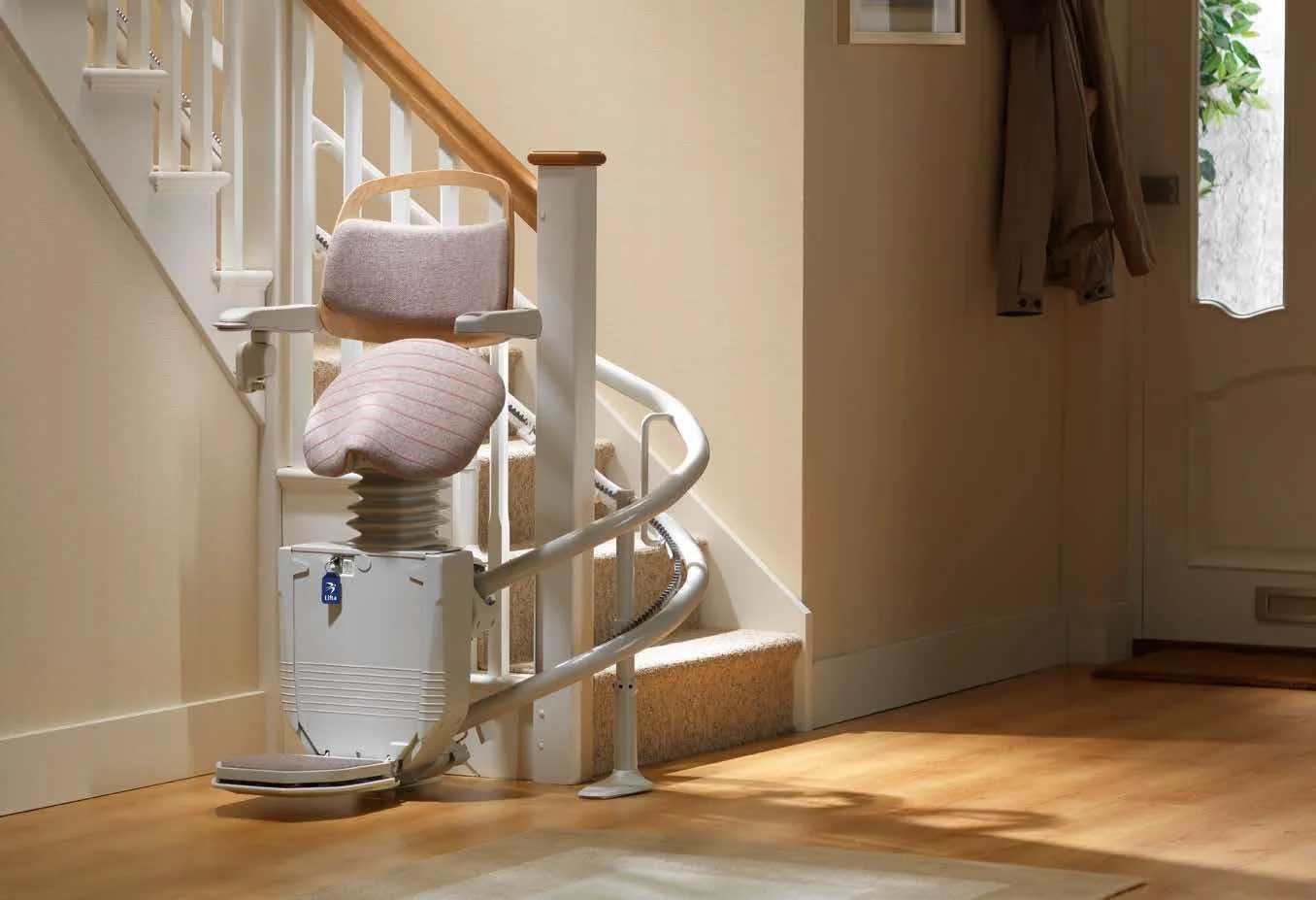
A single-family home with one straight flight is usually the simplest job. A straight stair lift runs on a rail fastened to the stair treads, not the wall, so it fits most standard staircases.
Split-level homes are a different story. Short runs with a landing or a turn often call for a curved lift with a custom-bent rail, or two straight lifts if the layout allows it. Townhouses frequently have narrow stairs, so we measure width and clearance at the top and bottom before recommending a model.
Where the climb starts outside, as with steps up a hillside to the entry, an outdoor-rated lift built to handle the weather is worth considering. For someone who uses a wheelchair and cannot transfer to a seat, a platform lift may be the better fit. Walk-up apartments and low-rise buildings involve shared stairways, so the building owner usually needs to be part of the conversation.
Lane County is home to 309,626 people spread across 22 towns, from Junction City and Coburg in the north to Cottage Grove and Creswell in the south. Many calls come from adult children in Eugene helping a parent stay in a house out in Veneta, Lowell, Dexter or Marcola.
If that includes someone in your family, the veterans programs below are worth a look, though they have limits on what they pay for.
The most direct state help is the Oregon K Plan home modification benefit, which offers up to $5,000 toward necessary home modifications for seniors and people with physical disabilities already eligible for Oregon Medicaid. The source describes home modifications in general rather than naming stair lifts, so ask specifically when you call.
If you are not sure where you qualify, start with the Aging & Disability Resource Connection of Lane County. It is free, open regardless of income, and screens residents for Oregon Project Independence - Medicaid and other in-home benefits. Lane Council of Governments - Senior & Disability Services also has an office at 1015 Willamette Street in Eugene, (541) 682-4038.
Veterans can contact the Lane County Veterans Services Program at 151 W. 7th Ave, Suite 460 in Eugene, (541) 682-4191. Rural homeowners with very low incomes may want to check USDA Section 504 repair loans and grants. Each program is summarized below.
A case-managed Oregon Medicaid program for residents age 60+, or under 60 with Alzheimer's disease or a related dementia, who need help with daily activities; the current source does not list stair lifts or home modifications as covered. Ask Lane County Senior and Disability Services at (541) 682-3353.
A free information and referral hub for older adults, people with disabilities and caregivers, regardless of income; it is not a funding source and stair lifts are not listed, but it screens residents for OPI-M, Medicaid waivers and home-modification benefits. Call (541) 682-3353.
Provides up to $5,000 toward necessary home modifications for seniors and people with physical disabilities already eligible for Oregon Medicaid, which can include a stair lift. Call (503) 945-5600.
A VA grant of up to $6,800 or $2,000 lifetime, depending on disability status, for permanent structural changes to a veteran's primary residence; the source explicitly excludes stair glides and porch lifts. Because rules can vary by facility, confirm current local HISA policy with Roseburg VA Health Care System.
Federal grants for veterans with qualifying severe service-connected disabilities, with FY2026 maximums of $126,526 for SAH, $25,350 for SHA, and $50,961 or $9,100 for TRA; the source does not list stair lifts among covered modifications. Apply through VA.gov or your local VA facility.
Loans up to $40,000 at a fixed 1% interest rate over 20 years, and grants up to $10,000 for homeowners age 62+, for very-low-income owners in USDA-eligible rural areas; stair lifts are not listed, as the program describes general repair and hazard removal. Eligibility depends on your address, so check the USDA rural eligibility map.
A free Center for Independent Living for Lane County residents with disabilities, offering information and referral, skills training, peer counseling and advocacy; it does not fund stair lifts or home modifications directly. Call (541) 607-7020.
Older adults
1015 Willamette Street, Eugene, 97401
Veterans
151 W. 7th Ave, Suite 460, Eugene, 97401
Sometimes. If each run is straight, a straight lift on the main flight may be enough. Split-levels with landings or turns usually need a curved rail, so we measure the stairs in person before recommending anything.
Oregon Project Independence - Medicaid serves people under 60 who have a diagnosis of Alzheimer's disease or a related dementia and need help with daily activities. The Oregon K Plan home modification benefit covers people with physical disabilities who are already on Oregon Medicaid, with no age limit stated. Call the ADRC of Lane County at (541) 682-3353 to be screened.
The HISA grant source explicitly excludes stair glides, since HISA pays for permanent structural changes. The Specially Adapted Housing grants do not list stair lifts either. Talk with the Lane County Veterans Services Program at (541) 682-4191 and confirm current rules with Roseburg VA Health Care System.
Possibly. USDA Section 504 serves very-low-income homeowners in eligible rural areas, with grants limited to people age 62+. The program describes general repairs rather than stair lifts, and eligibility must be checked address by address on USDA's rural eligibility map.
Start with the Aging & Disability Resource Connection of Lane County at (541) 682-3353. It is free, open regardless of income, and can point you toward OPI-M, the K Plan and other in-home benefits.
Yes, outdoor-rated lifts are made for exterior steps. On a hillside home we look at the length of the run, any turns and where the lift will park, and a platform lift may make more sense for a wheelchair user.
Tell us about the stairs in your home and we will explain which lift fits, what it costs and how installation works.
