Along Wooster Street in Bowling Green, many of the oldest and largest homes in Wood County still stand from the oil-boom years, a few blocks from downtown storefronts and the Neoclassical post office built in 1913. Out past the city, the county's 617 square miles run from the Maumee River on the northwest border through small towns like Pemberville, Grand Rapids, North Baltimore and Custar, with farmland in between.
That mix matters when someone in the family starts having trouble with stairs. About 30.1% of residents live in rural areas, where older farmhouses often put every bedroom on the second floor. In town, historic homes and newer split-levels each bring their own stair layouts. This page walks through what those homes mean for a stair lift and which programs may help cover the cost.
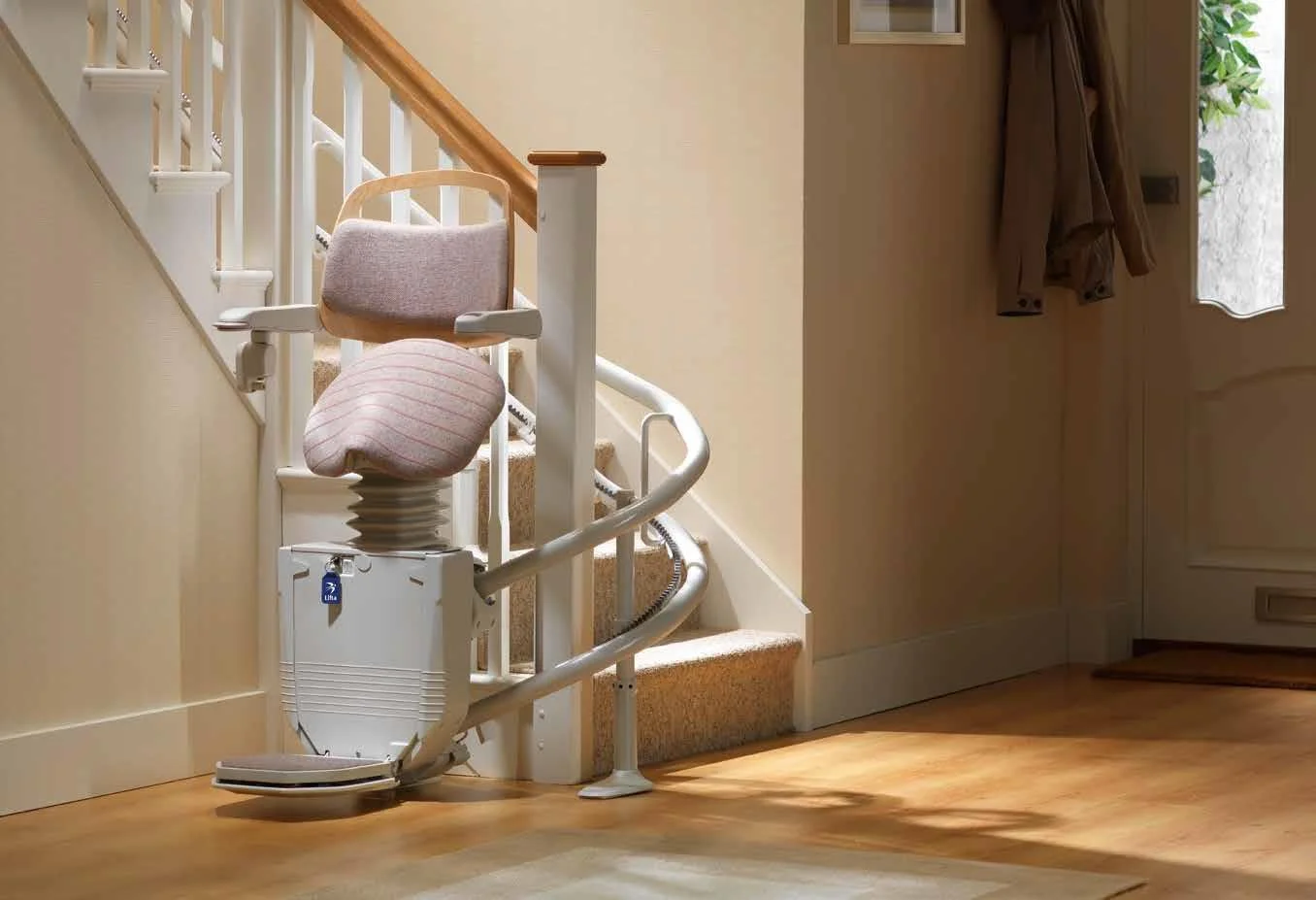
The historic houses near downtown Bowling Green and the farmhouses scattered across the rural parts of the county share one thing: they were built with a full staircase to the sleeping level. Moving the bedroom downstairs is often not practical, so a lift on the existing staircase is the usual answer.
Many of these staircases are straight, which keeps a lift simpler to fit. Older homes, though, sometimes have a landing, a turn near the top or a narrow stairway. Those call for a curved rail built to the stairs, so we measure every step before recommending anything.
Split-level homes are common in towns like Perrysburg, Rossford and Northwood. Each flight is short, but there may be two or three of them. Sometimes one lift on the flight to the bedrooms solves most of the problem, and the other half-flights can be handled with railings.
Townhouses usually have one straight flight, which is a good fit for a standard straight lift. In walk-up apartments, the stairs are often shared space, so talk with the building owner before planning anything on a common stairway.
Plenty of single-family and detached houses in the county have steps up to the front or back door, and older farmhouses often have a raised porch. An outdoor stair lift is built to handle Ohio weather and gets someone from the driveway to the door without a ramp taking over the yard.
For a person who uses a wheelchair, a seated lift is not enough. A vertical platform lift at the porch or garage entry can carry the chair itself, and it is worth asking about during the home visit.
Wood County has a population of 87,625, and 14.0% of residents are 65 or older. With 25 towns spread from the Toledo suburbs to small farm communities, many families are planning ahead for a parent who wants to stay in the house they know.
If that includes your family, the Wood County Veterans Service Office at 1940 East Gypsy Lane Road in Bowling Green, (419) 354-9147, can help sort out which VA benefits apply.
Only a few programs name stair lifts directly. The Ability Center's Home Accessibility Program lists them as a covered modification, and Ohio's PASSPORT and Home Care waivers cover home modifications based on assessed need. Other programs cover home repairs or modifications in general without saying whether a lift qualifies, so call and ask.
Where you live in the county makes a difference. Bowling Green residents have a city repair program, while everyone else in Wood County applies through the county program. The Area Office on Aging of NW Ohio at 2155 Arlington Ave. in Toledo, (419) 382-0624, is a good first call for anyone 60 or older. Details on each program are listed below.
An Ohio Medicaid waiver for residents 65 and older (or physically disabled at 60-64 at enrollment) who need nursing facility level of care, and home modifications are a covered service based on assessed need. Call (866) 243-5678.
This waiver pays for care in a Medicaid-certified assisted living residence rather than at home, and stair lifts or home modifications are not listed among its services. Call (866) 243-5678.
A Medicaid waiver for Ohioans with physical disabilities and unstable medical conditions who would otherwise need nursing-facility care, with a Home Modification Service capped at $10,000 per calendar year (a March 2026 proposal would raise it to $15,000). Stair lifts are covered through that home modification category.
A state-funded program for minor home repairs and modifications for adults 60 and older in Wood and nine other counties; stair lifts are not specifically listed. Call (419) 382-0624 and ask for the Wood County application.
A grant program serving Wood County and other northwest Ohio counties that explicitly covers stair lifts, after income verification and a staff home visit. Call (419) 885-5733.
A VA grant of up to $6,800 or $2,000 over a lifetime for home structural changes, but it specifically excludes stair glides and porch lifts.
VA grants for veterans with qualifying severe service-connected disabilities, with caps of up to $126,526 for SAH and $25,350 for SHA in FY2026; stair lifts are not listed as covered or excluded.
Loans up to $40,000 and grants up to $10,000 for very-low-income homeowners in USDA-eligible rural areas, with grants limited to those 62 and older; stair lifts are not specifically listed. Confirm current amounts with USDA before applying.
A CDBG-funded repair program for very low-, low- and moderate-income households inside Bowling Green city limits; stair lift coverage is not listed. Call (419) 354-6203.
The county's home repair program for residents outside Bowling Green, and the source does not list which repairs are covered. Call (567) 331-2679 to apply.
Older adults
2155 Arlington Ave., Toledo, 43609
Veterans
1940 East Gypsy Lane Road, Bowling Green, 43402
Yes. PASSPORT accepts physically disabled Ohioans age 60-64 at enrollment, and the Area Office on Aging Home Repair Program starts at age 60. The Ability Center's Home Accessibility Program and the Ohio Home Care Waiver do not use a 65 cutoff in their listed eligibility.
Residents outside Bowling Green city limits apply through the Wood County Home Repair Program at (567) 331-2679. The city program at (419) 354-6203 is for Bowling Green residents only.
The HISA grant specifically excludes stair glides. The SAH, SHA and TRA grants do not say either way, so call the Wood County Veterans Service Office at (419) 354-9147 to check.
The Ability Center's Home Accessibility Program explicitly lists stair lifts. You can reach them at (419) 885-5733 to start an application and set up the home visit.
It may be if the home is in a USDA-eligible rural area and your income is at or below 50% of the county median. Grants of up to $10,000 are limited to owners 62 and older who cannot repay a loan, and stair lifts are not specifically listed.
No. It pays for living in a Medicaid-certified assisted living residence. For in-home changes, look at PASSPORT or the Ohio Home Care Waiver instead.
Tell us about the stairs in your home and we will explain which lift fits, what it costs and how installation works.
