In Bryan, a few blocks from the Williams County Courthouse, many houses are older two-story Midwest farmhouses and foursquares. The bedrooms are upstairs, and there is often just one full bath. That layout is a daily climb for anyone who wants to keep living in a long-held family home.
The same pattern shows up across the county's 10 towns, from Montpelier and Edgerton to West Unity, Pioneer, Stryker, Edon, Lake Seneca, Kunkle and Nettle Lake. About 19.7% of the county's 21,014 residents are 65 or older. This page covers which kind of stair lift tends to fit local homes and which programs may help with the cost.
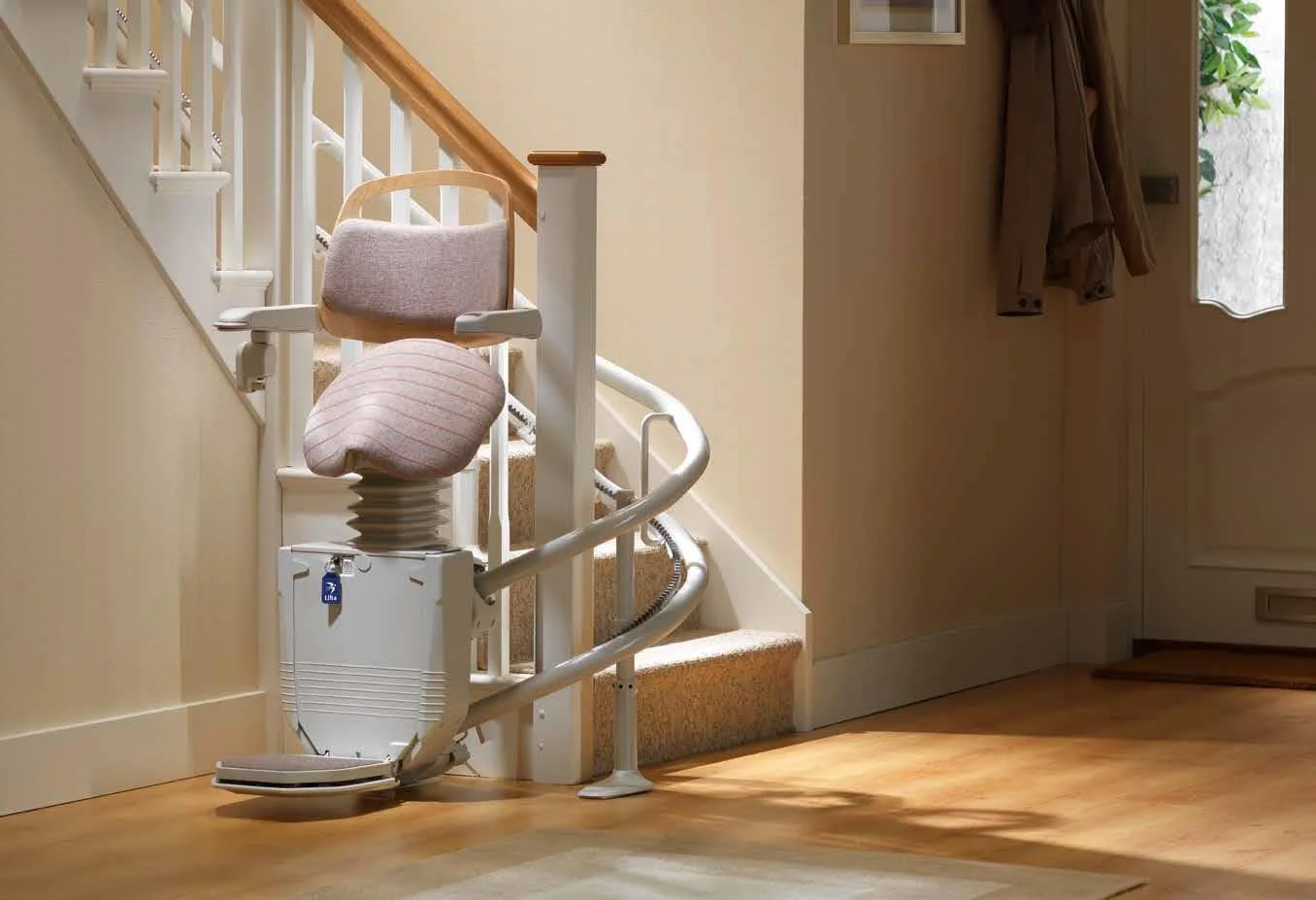
The classic two-story farmhouse or foursquare usually has one main staircase between the living space and the bedrooms. If that staircase runs straight from bottom to top, a straight stair lift is usually the simplest fit. The rail mounts to the stair treads, not the wall, so older plaster walls are left alone.
Some older homes have a landing partway up or a turn at the top. Those stairs need a curved rail built to the exact shape of the staircase. We measure every staircase in person before quoting, because a curved rail is made for one set of stairs only.
With a single full bath upstairs in many of these homes, the stairs are not optional. A lift lets the upstairs bedroom and bathroom stay usable instead of moving a bed into the dining room.
Ranch-style homes put the main living space on one floor, so the stairs that matter are often the ones down to the basement laundry or the steps at the entry door. Basement stairs can take an indoor lift, and entry steps may call for an outdoor model built for weather.
Split-level homes have short flights between levels. Each flight may need its own lift, or a curved rail if the flights connect. Where a wheelchair is part of daily life, a platform lift can be the better choice than a seat.
Walk-up apartments share their stairs with other tenants. In that case, the building owner has to approve any installation before work can start.
Williams County covers about 423 square miles in the far northwest corner of Ohio, bordering Michigan and Indiana. Per the 2020 census, 75.1% of residents lived in rural areas, spread across flat farmland.
That spread means travel times for installers, home health workers and other contractors can run longer than in a metro area. It helps to call early, especially if a hospital discharge or a planned move home is coming up. Having the stairs measured ahead of time keeps the install date from slipping.
Two Ohio Medicaid waivers, PASSPORT and the Ohio Home Care Waiver, list stair lifts as an approved home modification for people who qualify. PASSPORT is for adults 60 and older, while the Home Care Waiver is open to Medicaid recipients of any age who meet the level-of-care rules.
Several local agencies help with home repairs, accessibility or referrals, though their published materials do not name stair lifts. They are still worth a call: the Williams County Department of Aging, NOCAC, the CHIP program and the Ability Center of Greater Toledo.
The VA HISA benefit does not cover stair lifts, since it pays only for permanent structural changes. The SAH and SHA grants do not mention stair lifts either way, and the Williams County Veterans Service Commission can help sort out which applies. Each program is listed below.
An Ohio Medicaid waiver for people 60 and older who meet financial rules and a nursing-facility level of care, and stair lifts are listed as an approved modification. Case management runs through the Area Office on Aging of Northwestern Ohio, and the Williams County Department of Job and Family Services generally handles Medicaid applications.
An Ohio Medicaid waiver for recipients of any age who meet nursing-facility or hospital level-of-care criteria and choose care at home. Stair lifts are listed as a covered modification, approved case by case in the service plan.
The area agency on aging serving Williams County and nine other Northwest Ohio counties, offering home care, caregiver support, housing help and more for people 60+ and adults with disabilities. Stair lifts are not mentioned in its materials; call (800) 472-7277.
A levy-funded county agency in Bryan for residents 60 and older that offers information and referral, including on PASSPORT, and bath aids and walkers through a partnership with the Ability Center. Stair lifts are not named; call (419) 633-4317.
A community action program that provides repairs free of charge to eligible low-income homeowners, with Williams County in NOCAC's core service area. Stair lifts are not named specifically; call (419) 784-5136.
A housing rehabilitation program for income-qualified homeowners in Williams County and the City of Bryan that lists accessibility needs as an eligible improvement. Stair lifts are not named specifically; call (419) 784-3882.
A federal grant of up to $126,526 (FY2026) for veterans with qualifying service-connected disabilities who own or will own the home. The VA does not say whether stair lifts are covered; call (800) 827-1000.
A federal grant of up to $25,350 (FY2026) for veterans with qualifying disabilities such as loss of use of both hands. Stair lifts are not mentioned; call (800) 827-1000.
A VA benefit of up to $6,800 or $2,000 lifetime for permanent structural changes prescribed by a VA physician. It does not cover stair lifts, which the VA treats as removable equipment.
A county office in Bryan offering case-by-case emergency financial assistance and help applying for VA grants such as HISA, SAH and SHA. Stair lift funding is not mentioned; call (419) 636-8812.
A nonprofit serving people of all ages with disabilities in 13 Northwest Ohio counties, with a satellite office in Bryan, providing items like grab bars, railings and ramps. Stair lifts are not named either way; call (419) 885-5733.
Older adults
2155 Arlington Ave., Toledo, 43609
Veterans
1425 E High Street, Suite 106, Bryan, 43506
It can, through a waiver. PASSPORT and the Ohio Home Care Waiver both list stair lifts as an approved modification for people who meet their financial and level-of-care rules. There is no published dollar cap; coverage depends on an assessment of need.
Yes, possibly. The Ohio Home Care Waiver is open to Medicaid recipients of any age who meet its care criteria, and the Ability Center of Greater Toledo serves people of all ages with disabilities at (419) 885-5733.
No. HISA covers only permanent structural changes and excludes stair glides and porch lifts. The Williams County Veterans Service Office at 1425 E High Street, Suite 106 in Bryan, (419) 636-8812, can help check the SAH or SHA grants instead.
Start with NOCAC's Emergency Home Repair / Handicap Modification Program at (419) 784-5136 and the CHIP program at (419) 784-3882. Both serve income-qualified homeowners in Williams County, though neither names stair lifts specifically.
The Williams County Department of Aging is at 1425 E High Street, Suite 102 in Bryan, (419) 633-4317, for residents 60 and older. The regional Area Office on Aging of NW Ohio is in Toledo at 2155 Arlington Ave., (419) 382-0624.
It can. The county is mostly rural and spread out, so installer travel times can be longer than in a city. Calling early and getting the stairs measured ahead of time helps keep the schedule on track.
Tell us about the stairs in your home and we will explain which lift fits, what it costs and how installation works.
