From the subdivisions of Beavercreek and Bellbrook to the older streets of Xenia, Fairborn and Yellow Springs, much of Greene County was built during the mid-to-late 20th-century suburban boom. That means a lot of two-story colonials, ranch-style houses and split-levels, each with its own kind of staircase.
The county covers about 416 square miles of the Miami Valley, mostly flat to gently rolling. Roughly 77.6% is classified as urbanized and 22.4% as rural, so a visit might take us to a townhouse near Wright-Patterson AFB one day and a farmhouse outside Bowersville or Jamestown the next. This page walks through what your stairs mean for a lift and where to look for help paying for one.
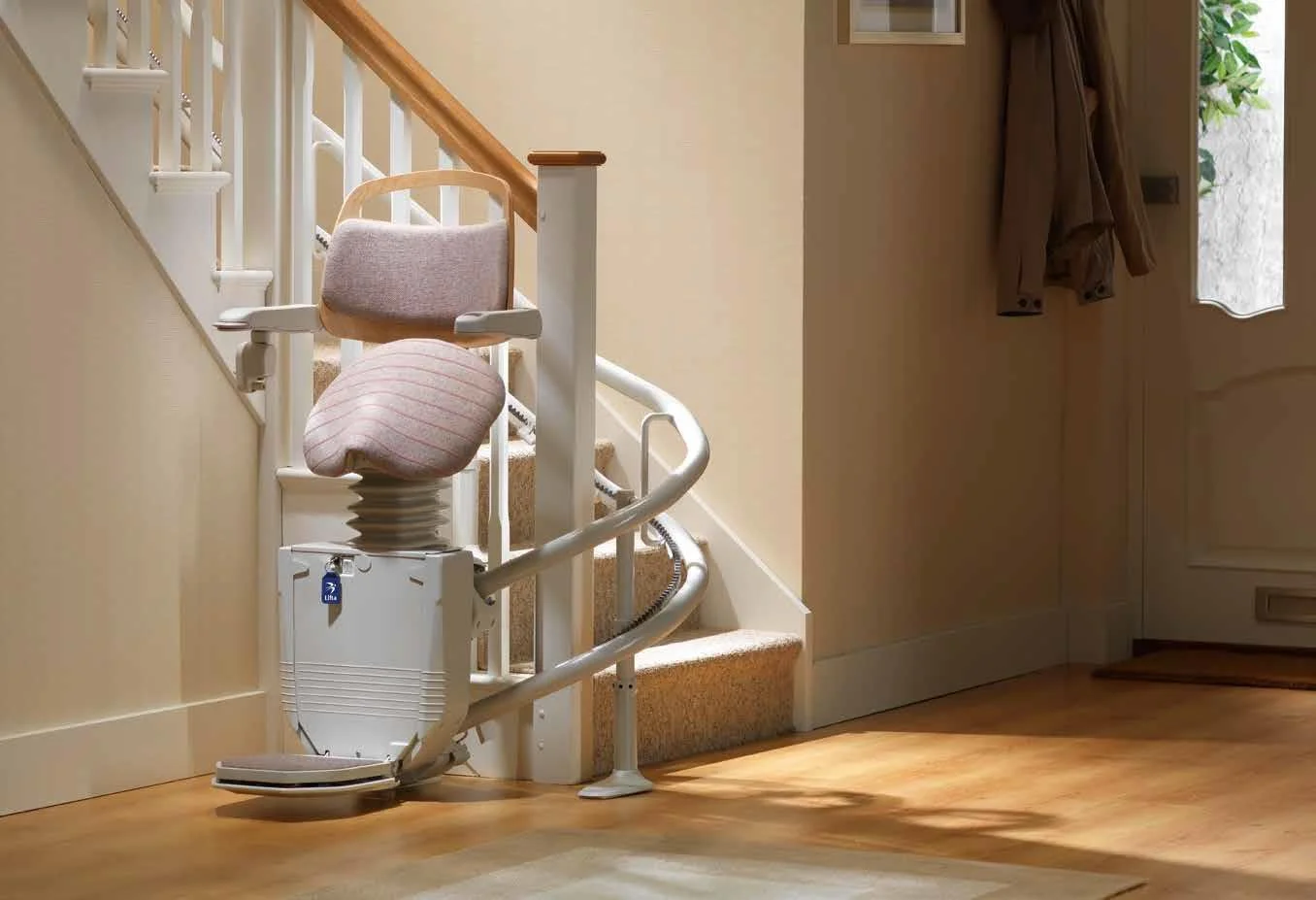
Two-story colonials usually have one straight run of stairs from the front hall to the bedrooms. A straight stair lift is the simplest fit there, and it is often the quickest install.
Split-level homes are different. You may have a short flight up to the bedrooms and another short flight down to the family room, sometimes with a turn. Depending on which levels you need, that can mean one straight lift, two separate lifts, or a curved rail that follows the turn.
Townhouses tend to have narrower stairwells, so we measure the width carefully and look at folding rails and seats. In walk-up apartments, the building owner usually has to approve anything mounted to a shared or interior staircase, so it helps to ask before we schedule.
Ranch-style houses are common across the county and often keep the main living space on one floor. The stairs that cause trouble are frequently the ones outside: the steps to the front porch, the back deck or the garage door.
For those spots, an outdoor-rated stair lift or a vertical platform lift can make sense. Greene County's mostly flat to gently rolling ground usually leaves room near the entry for a platform, though sloped yards and rural lots around places like Cedarville or Spring Valley need a closer look at footing and approach.
Of the 71,336 housing units counted in 2020, about 66.4% are owner-occupied, so many people looking at lifts are staying in a house they already own.
Ownership matters because several programs below, including the VA housing grants, require that the veteran own or will own the home. If a parent rents, the landlord's permission comes first.
No program on this page says outright that it pays for stair lifts, and one, the VA HISA grant, says it does not. Still, several are worth a call, because a caseworker can tell you what your situation qualifies for.
For residents 60 and older, start with the Greene County Council on Aging Partners in Care Program at (937) 376-5486 and the Area Agency on Aging PSA 2 at (937) 341-3000 or (937) 223-4357. Veterans can reach the Greene County Veterans Service Office at 571 Ledbetter Rd in Xenia, (937) 562-6020, to ask about the VA grants.
Statewide, it can also be worth asking about the Ohio Home Care Waiver and Ohio HOME Choice (Money Follows the Person). Each program is summarized below.
A Medicaid waiver for people age 60 and older who need a nursing-facility level of care but choose to stay at home, run locally by the Area Agency on Aging PSA2. The source does not mention stair lifts or home modifications; call (937) 223-4357 to ask.
A Medicaid option that helps with daily living in a participating assisted living facility with 24-hour on-site staff, coordinated through the same PSA2 agency. The source does not mention stair lifts or home modifications; the number is (937) 223-4357.
A levy-funded county program for Greene County residents 60 and older living in their own or a family member's home, with a sliding-scale co-pay based on income, assets and monthly medical expenses. It names adaptive equipment such as grab bars and bath benches but does not mention stair lifts; call (937) 376-5486.
A federal grant of up to $126,526 (FY2026 maximum) for veterans and service members with qualifying service-connected disabilities who own or will own the home. The source lists ramps and doorway widening as examples but does not name stair lifts.
A federal grant of up to $25,350 (FY2026 maximum) for veterans and service members with qualifying service-connected disabilities who own or will own the home, or a family member's home. Stair lifts are not specifically named among covered adaptations.
A VA medical benefit with a lifetime maximum of $6,800 for service-connected disabilities (or non-service-connected disabilities rated at least 50% service-connected) and $2,000 for other eligible disabilities. It explicitly does not cover stair glides or porch lifts; call (800) 698-2411.
A nonprofit Center for Independent Living serving people with disabilities in a nine-county area that includes Greene County. Its site does not mention stair lifts or home modification help; call (937) 341-5202.
Older adults
40 W. Second Street, Suite 400, Dayton, 45402
Veterans
571 Ledbetter Rd, Xenia, 45385
The aging programs here, including Partners in Care and PASSPORT, start at age 60. For a younger person with a disability, the Access Center for Independent Living serves Greene County and can be reached at (937) 341-5202.
The HISA grant explicitly excludes stair glides and porch lifts. The SAH and SHA grants do not name stair lifts either way, so a veteran should ask the Greene County Veterans Service Office at (937) 562-6020 what applies.
The PASSPORT source page does not list stair lifts or home modifications. Call the Area Agency on Aging at (937) 223-4357 and ask a caseworker directly.
It depends on which levels you need to reach. If only one short flight matters, one straight lift may do; if you need both the upper and lower flights, it may take two lifts or a curved rail.
No. The county and regional programs listed here cover Greene County as a whole, from Xenia and Fairborn to Jamestown and Bowersville.
The Greene County Veterans Service Office is at 571 Ledbetter Rd, Xenia, OH 45385. The phone is (937) 562-6020.
Tell us about the stairs in your home and we will explain which lift fits, what it costs and how installation works.
