In the City of Schenectady's Stockade Historic District, Dutch merchants and fur traders settled in 1661, and more than 40 structures there are over 200 years old. The National Park Service describes the area near Ferry, Front, and Green streets as densely built, mostly with small two-story attached houses. In homes like these, the bedrooms and bathroom are usually up a full flight of interior stairs.
Beyond the Stockade, Schenectady County's 11 towns run from Schenectady, Rotterdam, Niskayuna, Glenville, and Scotia out to Duanesburg, Princetown, Delanson, Mariaville Lake, and Duane Lake. The county covers 209 square miles on both sides of the Mohawk River. This page walks through how local homes and terrain shape the choice of a stair lift, and which programs may help with the cost.
The Stockade became New York's first local historic district in 1962 and was listed on the National Register of Historic Places in 1973. Many of its homes are attached two-story houses, so the daily routine depends on one interior staircase.
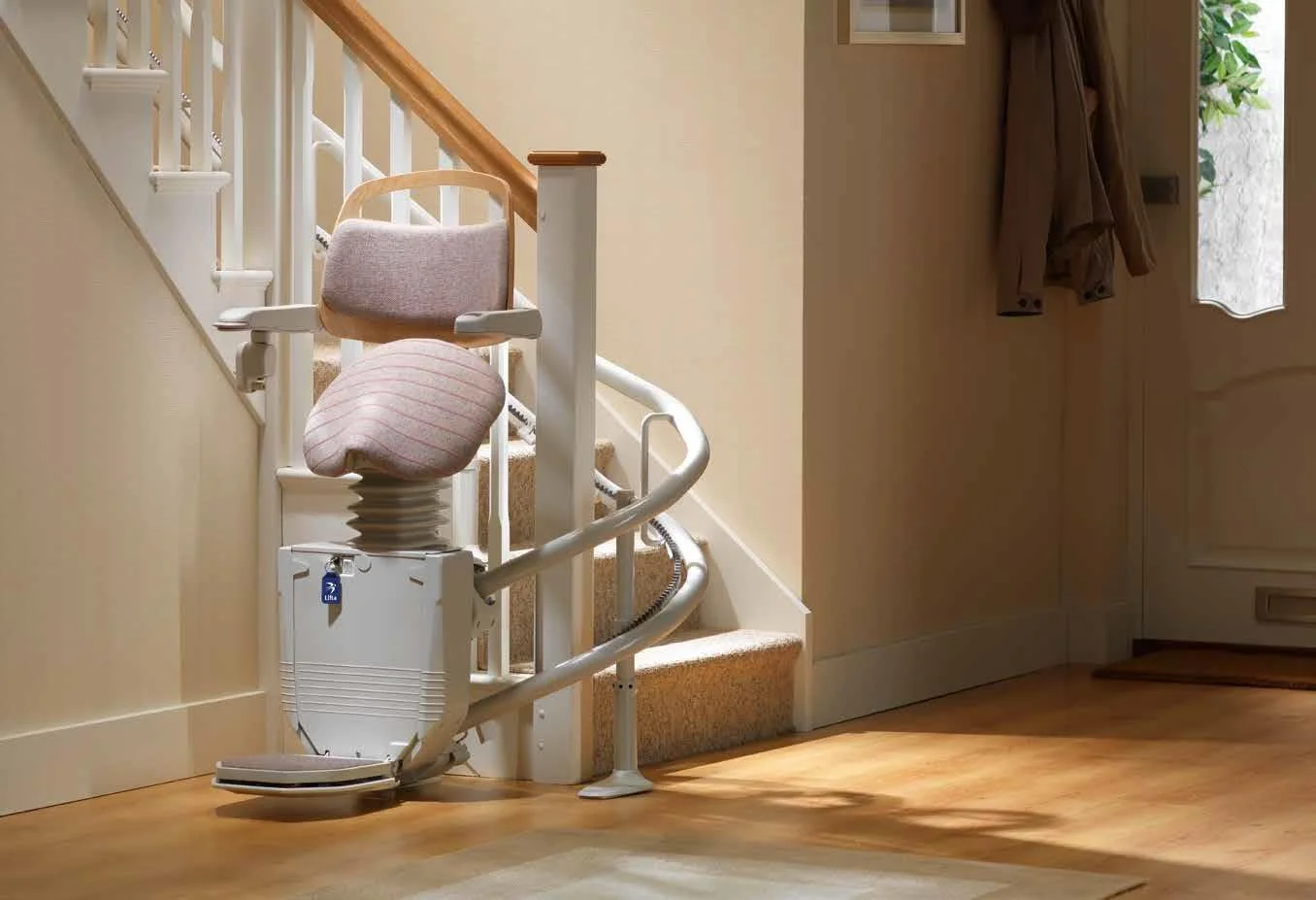
A straight staircase with no turns can take a straight-rail stair lift, the simplest type to fit. If the stairs turn, wind, or stop at a landing, the rail has to be curved and built to match that staircase. We measure first, because older homes rarely follow one standard layout.
The same questions come up in the county's other housing: single-family homes, detached houses, townhouses, and row houses. A good look at the staircase tells you which kind of lift makes sense before any money is spent.
The Mohawk River splits the county, and that river geography brings hills and grade changes to parts of it. A house on a slope often has steps at the entry as well as stairs inside.
Snow and ice are a regular part of winter here, which makes exterior steps and walkways harder for older residents. An outdoor stair lift, built for weather exposure, can cover a set of entry steps. For someone who uses a wheelchair, a platform lift may fit the entry better than a seat-style lift.
Of the county's 179,931 residents, 18.0% are 65 or older, and 64.6% are homeowners. Owning the home matters, because several of the grant programs below are for owner-occupants only.
Renters are not left out entirely. The NYS Access to Home Program serves renters as well as homeowners. Walk-up apartments raise their own questions, so it is worth talking with the property owner early.
The Schenectady County Veterans Service Agency at 797 Broadway, Schenectady, can be reached at (518) 377-2423.
Most help here comes through grants for accessibility or home repair. These programs do not name stair lifts specifically, so ask each one directly whether your project qualifies. The VA HISA benefit, by contrast, specifically excludes stair glides.
Two local calls cover most of the ground. Schenectady County Senior Services at 107 Nott Terrace, Suite 305, (518) 382-8481 ext. 1, is the NY Connects entry point for screening, including EISEP. Better Community Neighborhoods Inc. (BCNI) at 816 Union Street, (518) 372-7616, takes applications for Access to Home, RESTORE, and Access to Home for Heroes.
Income limits are set as a share of area median income. Under the 2010 estimates cited, the county median household income was $53,399, which puts many homeowners within reach of these programs. Statewide, you can also ask about New York Medicaid Home Modifications (NHTD Waiver & MLTC).
Very low-income owner-occupants in USDA-designated rural areas can get a 1% loan, and homeowners 62+ who cannot repay a loan can get a grant of up to $7,500 to remove hazards or make the home accessible to a household member with a disability. Stair lifts are not listed by name, and each address must be checked for rural eligibility.
HISA pays for medically prescribed home improvements for eligible veterans, but VA rules list stair glides as outside its scope. A veteran needing a stair lift should ask the VA Prosthetic and Sensory Aids Service, (202) 461-0389, about its specific purpose funds.
These grants help veterans with qualifying service-connected disabilities buy, build, or modify a permanent home, with FY2026 caps of up to $126,526 for SAH and $25,350 for SHA. The VA does not list stair lifts among covered adaptations.
This county office is the local entry point for long-term-care information, referral, and screening for programs such as EISEP and Access to Home. It does not list stair lifts by name; call (518) 382-8481 ext. 1.
EISEP serves people 60 or older who need help with daily activities, and its ancillary services may include home repairs or assistive devices, though stair lifts are not listed by name. It runs through the county senior services office, and the state line is (800) 342-9871.
Access to Home can cover up to 100% of accessibility adaptations, to a maximum of $25,000 per household, for renters or homeowners with a permanent disability at or below 80% of area median income (120% for veterans with a service-related disability), with no age limit. Stair lifts are not named specifically; the state office is at (518) 474-2057, and local applications go through BCNI.
BCNI handles Access to Home, RESTORE for seniors 60+, and Access to Home for Heroes for owner-occupants in Schenectady County, funding items such as ramps, lifts, and handrails, though stair lifts are not named. Call (518) 372-7616.
Older adults
107 Nott Terrace Suite 305, Schenectady, 12308
Veterans
797 Broadway, Schenectady, 12305
Yes, possibly. The NYS Access to Home Program has no age restriction, and BCNI takes applications from homeowners of any age. RESTORE and EISEP are for people 60 and older.
Not through HISA, which lists stair glides as outside its scope. The VA directs that kind of equipment to the Prosthetic Service's specific purpose funds, so ask the Prosthetic and Sensory Aids Service at (202) 461-0389. Locally, the Schenectady County Veterans Service Agency is at (518) 377-2423.
Much of the county outside the City of Schenectady is likely to fall in a USDA rural area, but every address has to be checked at eligibility.sc.egov.usda.gov. The program is for very low-income owner-occupants, and the grant portion is for homeowners 62 and older.
For a broad screening, call Schenectady County Senior Services at (518) 382-8481 ext. 1. If you own your home and want to apply for Access to Home, RESTORE, or Access to Home for Heroes, call BCNI at (518) 372-7616.
For BCNI's programs, yes: you must own and live in the home and be current on your mortgage, property taxes, and insurance. The state's Access to Home Program itself is open to renters as well as homeowners.
Generally not, but conditions apply. Access to Home places a 3-year use restriction on the home, BCNI grants are secured by a lien until the residency period ends, and USDA grants must be repaid if the home is sold within 3 years.
Tell us about the stairs in your home and we will explain which lift fits, what it costs and how installation works.
