Washoe County homes sit at very different heights. Reno's valley floor is at roughly 4,400-4,500 feet, while hillside neighborhoods like Arrowcreek, Somersett and Galena Forest climb toward 6,000 feet in the Sierra Nevada foothills. Many of those houses were graded into the slope, so the garage, entry or lower rooms end up on a different level from the kitchen and bedrooms.
Across the county's 14 towns, from Reno and Sparks to Incline Village, Verdi and Nixon, that adds up to a lot of interior stairs. This page explains how local home styles affect which stair lift makes sense, and which Washoe County and Nevada programs may help with the cost.
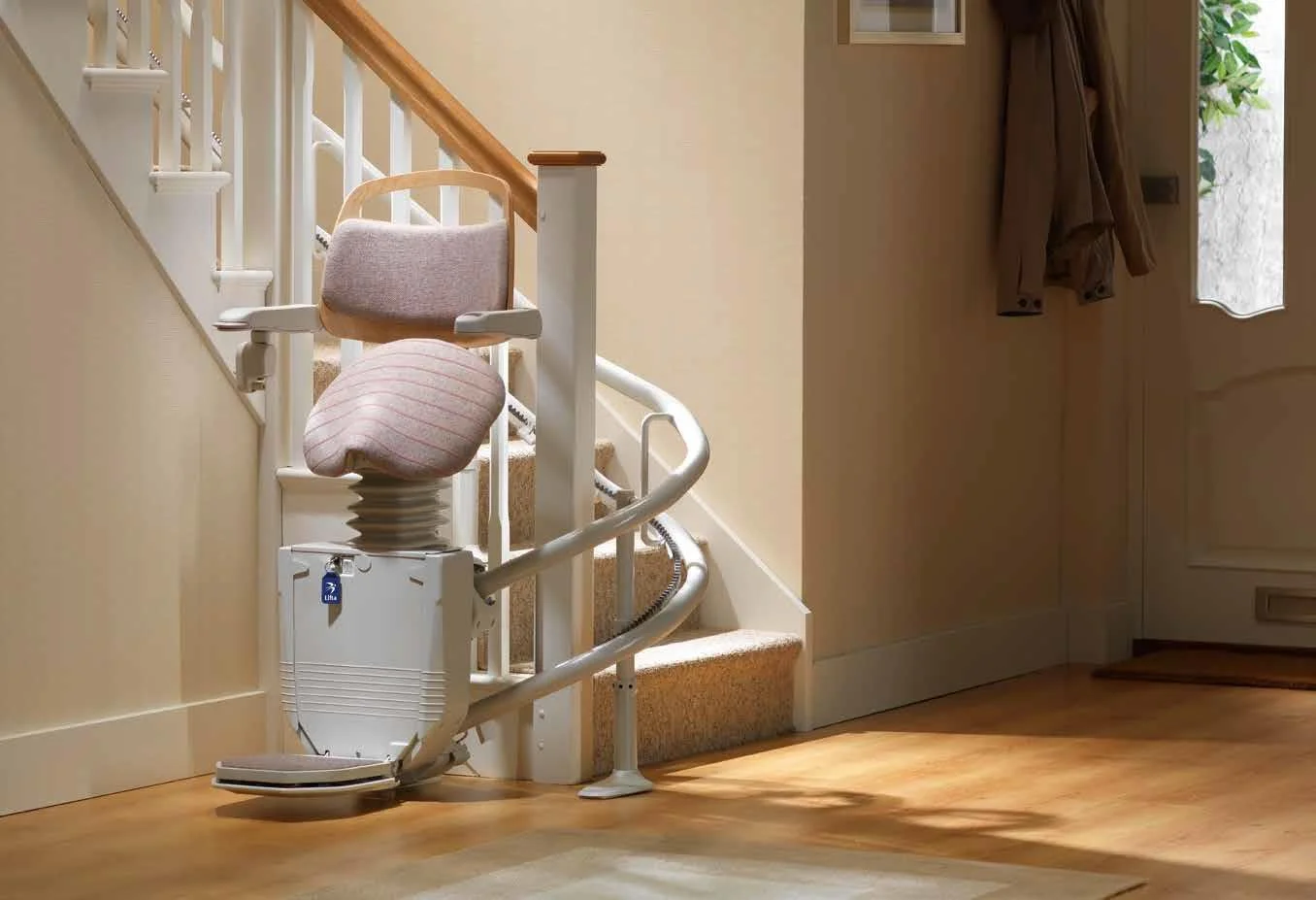
The valley floor around Reno and Sparks is full of dense mid-century tract neighborhoods. Up the western and southern edges, newer master-planned developments such as Somersett, Arrowcreek, Caughlin Ranch and Galena Forest were built on sloped ground, and split-level and multi-level layouts are a recognized local housing category.
A split-level often has a short, straight flight between levels. That is usually the simplest case for a straight stair lift on a single rail. A multi-level home with landings or turns may need a curved rail, or a separate lift on each flight.
Washoe County also has plenty of townhouses, walk-up apartments and low-rise buildings. Townhouse stairs are often narrow and straight, which a slim straight lift can handle while leaving room for others to walk past when the seat is folded.
In a walk-up apartment or shared low-rise stairwell, the stairs usually belong to the building, not the resident. Talk with the owner or association before planning any lift there. With 57.3% of county households owning their homes, many residents can make the decision themselves, but renters need permission first.
Elevation changes the weather fast here. Valley-floor areas may see light snow or rain while higher foothill communities get more snow, stronger winds and colder temperatures, which makes exterior steps and entries riskier for older residents.
If the problem is the steps from the driveway or garage to the front door, an outdoor stair lift or a vertical platform lift may be worth a look. Indoors, a lift on the main staircase keeps someone from carrying laundry or groceries up and down during the icy months.
For many families, the question is whether a parent can keep living in a home with stairs between the garage, the bedrooms and the kitchen.
A good first step is to note which flight causes trouble, how many steps it has and whether it turns. That tells an installer quickly whether a straight or curved rail is needed.
The program that most clearly applies is the Nevada Assistive Technology for Independent Living Program (AT/IL), run locally by CARE Chest of Sierra Nevada. Its source states that funding can be used for home modifications when other sources such as Medicaid, Medicare or insurance do not cover them.
Several city and federal repair programs serve homeowners in Reno, Sparks and the rural parts of the county, though their sources do not mention stair lifts by name. Veterans should know that the VA HISA grant excludes stair glides. The program list below gives the details and phone numbers.
A state last-resort funding program for people with disabilities of all ages, administered in Northern Nevada by CARE Chest of Sierra Nevada, that can pay for home modifications when other funding is not available. Stair lifts fall under its covered home modifications; call (775) 829-2273 Ext 108 or toll-free (866) 206-5242.
A statewide low-interest loan program for assistive technology purchases, with lower rates and often longer terms than a typical bank loan, plus micro-loans for lower-cost items. Its source does not mention stair lifts; call (775) 829-2273.
A HUD-funded grant program for City of Reno homeowners age 62 and older with income at or below 80% of Area Median Income, expected to help roughly 110-150 older adults. Stair lifts are not mentioned in its source; call Rebuilding Together Northern Nevada at (775) 395-9808.
Sparks homeowners who have owned and lived in their home at least one year, with income at or below 80% of Area Median Income, may get an Emergency Repair Grant up to $10,000 or a Deferred Payment Loan up to $25,000. Stair lifts are not named in its source.
Offers 1% loans up to $20,000 and grants up to $7,500 for homeowners age 62 and older with very low income in USDA-eligible rural areas, which may include outlying places like Verdi, Sun Valley or Spanish Springs but not most of Reno and Sparks. Stair lifts are not mentioned; call (775) 887-1222.
A lifetime VA grant of up to $6,800 or $2,000 for medically necessary structural changes such as entrance access or permanent ramps. It does not cover stair lifts, since stair glides are explicitly excluded; call (775) 786-7200.
Grants of up to $126,526 (SAH) or $25,349 (SHA) for veterans with specific severe service-connected disabilities to build, buy or adapt a home. Official VA sources reviewed do not list stair lifts; call (800) 827-1000.
The county's information, referral and case-management division for seniors and families looking for independent-living resources. It does not fund stair lifts directly, but it is a good place to start; call (775) 328-2575.
A Medicaid home and community-based waiver for Nevadans 65 and older who need nursing-facility level of care, with 2026 limits of $2,982 a month in income and $2,000 in assets for a single applicant. Stair lifts are not listed among its services; call (775) 687-4210.
A state program for people 65 and older at risk of nursing-home placement that pays for in-home services like personal care, homemaker help and respite. Home modifications and stair lifts are not part of its service list; call (775) 687-4210.
Older adults
1155 E. 9th St., Reno, 89512
Veterans
5460 Reno Corporate Dr, Suite 131, Reno, 89511
No. The VA's own fact sheet says HISA excludes removable equipment such as stair glides and porch lifts. Veterans can ask the Nevada Department of Veterans Services Veterans Service Officer - Reno at (775) 321-4880 about other options.
Yes, the Older Adults Home Modification Program serves City of Reno homeowners age 62 and older with income at or below 80% of Area Median Income. Its source does not mention stair lifts, so ask Rebuilding Together Northern Nevada at (775) 395-9808 what it covers.
Possibly. Outlying and unincorporated areas such as Sun Valley, Spanish Springs and Verdi may count as rural for USDA Section 504, but eligibility is checked address by address. Call the Carson City USDA Rural Development office at (775) 887-1222.
The Nevada Assistive Technology for Independent Living Program (AT/IL) is the one whose source covers home modifications. It is a last-resort fund, so it helps when other sources fall short. Call CARE Chest of Sierra Nevada at (775) 829-2273 Ext 108.
Washoe County Senior Services at 1155 E. 9th St., Reno 89512, phone (775) 328-2575, offers information, referral and case management for seniors and their families.
Not always. The short straight flights common in split-level homes often take a straight rail. Multi-level homes with turns or landings may need a curved rail or more than one lift.
Tell us about the stairs in your home and we will explain which lift fits, what it costs and how installation works.
