From the adobe streets around the Santa Fe plaza to Edgewood, Eldorado at Santa Fe, Chimayo, Tesuque and Glorieta, Santa Fe County spreads across 1,911 square miles and 41 towns. The land runs from the Rio Grande and its tributaries up to Santa Fe Baldy at 12,621 feet, and the homes are just as varied as the ground they sit on.
This page walks through what that mix of houses means for a stair lift, which type tends to fit which home, and where county residents can look for help paying for one. If you are weighing a lift for yourself or for a parent, the goal is to give you enough to start a clear conversation.
Santa Fe is known for Pueblo Revival and Territorial Revival architecture, much of it protected under city design guidelines. The historic core was laid out around a central plaza after the city's founding in 1610, which gives it a long-standing low-rise adobe character.
Outside the historic district, the county's housing includes single-family homes, detached houses, townhouses, split-level homes and low-rise buildings. Each of these can come with its own kind of stairs, so the right lift depends on the house in front of us, not the style on the street.
A straight stair lift fits a single run of steps with no turns, which is common in many townhouses and two-story detached houses. It is usually the simplest to install because the rail follows one line.
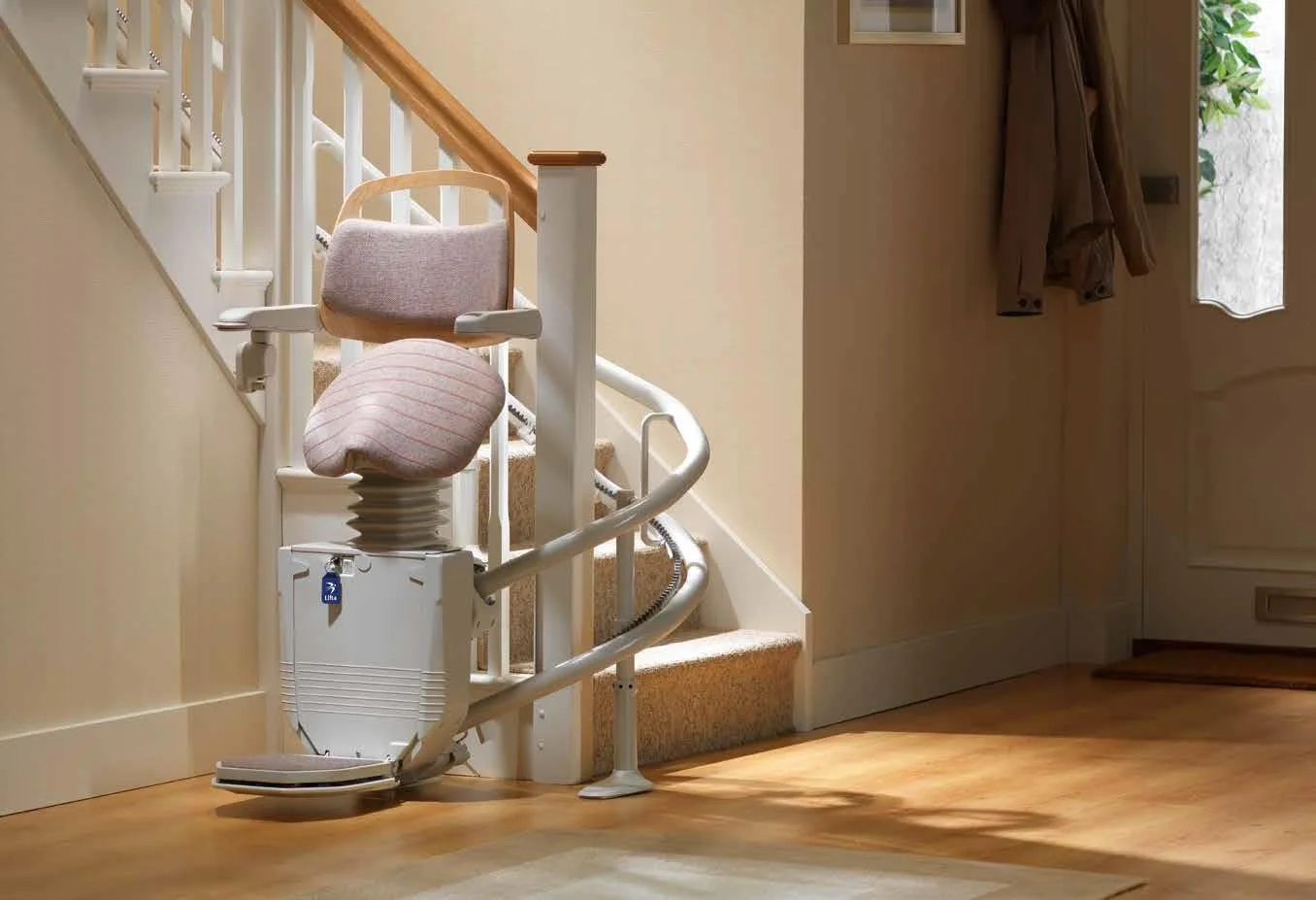
A curved lift is built for stairs that turn, wrap or stop at a landing. Split-level homes often have short flights between levels, and a curved rail or a lift for each flight may be needed. Where the problem is steps up to a porch or entry, an outdoor lift or a platform lift can be the better choice, and a platform lift also works for someone who needs to stay in a wheelchair.
About 26.8% of the county's 137,786 residents are 65 or older. According to the 2020 census, 68.9% of occupied housing units are owner-occupied, so most older residents own the home they would modify rather than rent it.
Owning the home matters because a stair lift is attached to the stairs, and several grant programs require the applicant or a family member to own the property.
Several state and federal programs list home modifications or accessibility changes, though most do not name stair lifts by name and none publish a fixed amount except the VA grants. The list below explains each one and who to call.
For a local starting point, the Non-Metro AAA (Region I) is at 2550 Cerrillos Rd., Santa Fe 87505, phone (505) 827-7640. Veterans can visit the Santa Fe Field Office of the New Mexico Department of Veterans Services at 407 Galisteo St., Room 134, Santa Fe 87501, phone (505) 218-3125.
Statewide, residents can also ask about Access Loan New Mexico (NM Technology Assistance Program), the Mi Via Self-Directed Waiver and the Turquoise Care Community Benefit, which are listed for environmental modifications.
Home repairs and accessibility modifications for low-to-moderate income homeowners, applied for through a regional nonprofit provider such as Central New Mexico Housing Corporation or Southwestern Regional Housing & Community Development Corp. Stair lifts are listed as covered; call (505) 843-6880 for details.
Options counseling and help navigating Medicaid home and community-based waivers for seniors and adults with disabilities. The source does not mention stair lifts; call (800) 432-2080 to ask about home-modification coverage and a Santa Fe County caseworker.
Home and vehicular modification for New Mexico residents whose disability is a barrier to work and who have an approved Individualized Plan for Employment. Stair lifts are listed as covered for qualifying cases; call (800) 224-7005 or (505) 954-8500.
A federal grant of up to $126,526 for a permanent home (FY2026) for veterans with qualifying service-connected disabilities who own or plan to own the home. Stair lifts are listed as covered; the VA line is (800) 827-1000.
A federal grant of up to $25,350 for a permanent home (FY2026) for a different set of qualifying service-connected disabilities, where the applicant or a family member owns the home. Stair lifts are listed as covered; call (800) 827-1000.
Disability support and advocacy for people of any age in nine northern New Mexico counties, with a Santa Fe office at 1205 Parkway Dr., Suite A. The source does not mention stair lifts, so treat it as a referral point; call (505) 471-1001.
Older adults
2550 Cerrillos Rd., Santa Fe, 87505
Veterans
407 Galisteo St., Room 134, Santa Fe, 87501
It depends on the staircase itself, not the architecture. Many historic homes in Santa Fe are low-rise, so we look at whether there are interior steps, entry steps or both, and then choose between a straight, curved, outdoor or platform lift.
Often, yes. Split-level homes have short flights between levels, so a curved rail or a separate lift for each flight may be the practical answer.
The Housing New Mexico (MFA) Home Rehabilitation and Weatherization Program offers accessibility modifications for low-to-moderate income homeowners. You apply through a regional nonprofit provider, and the main number is (505) 843-6880.
The VA Specially Adapted Housing grant goes up to $126,526 and the Special Home Adaptation grant up to $25,350 for a permanent home in FY2026, for qualifying service-connected disabilities. The Santa Fe Field Office at 407 Galisteo St. can help, phone (505) 218-3125.
The Non-Metro AAA (Region I) at (505) 827-7640 is the local aging office. The ALTSD Aging and Disability Resource Center at (800) 432-2080 can also explain Medicaid waiver options.
Tell us about the stairs in your home and we will explain which lift fits, what it costs and how installation works.
