Sullivan County stretches across 552 square miles of western New Hampshire along the Connecticut River, from Claremont and the county seat of Newport out to small towns like Acworth, Goshen, Lempster and Langdon. Mount Sunapee, Lovewell Mountain and Lake Sunapee shape the landscape, and 78.1% of residents live in rural areas. Around here, most people live in a house they own, and many of those houses have stairs that get harder to climb every year.
About 24% of the county's 21,958 housing units were built in 1939 or earlier. Those older New England houses often have narrow, steep staircases with winder turns, which matters a great deal when you are choosing a stair lift. This page walks through what the local housing means for the type of lift you need and which programs may help cover the cost.
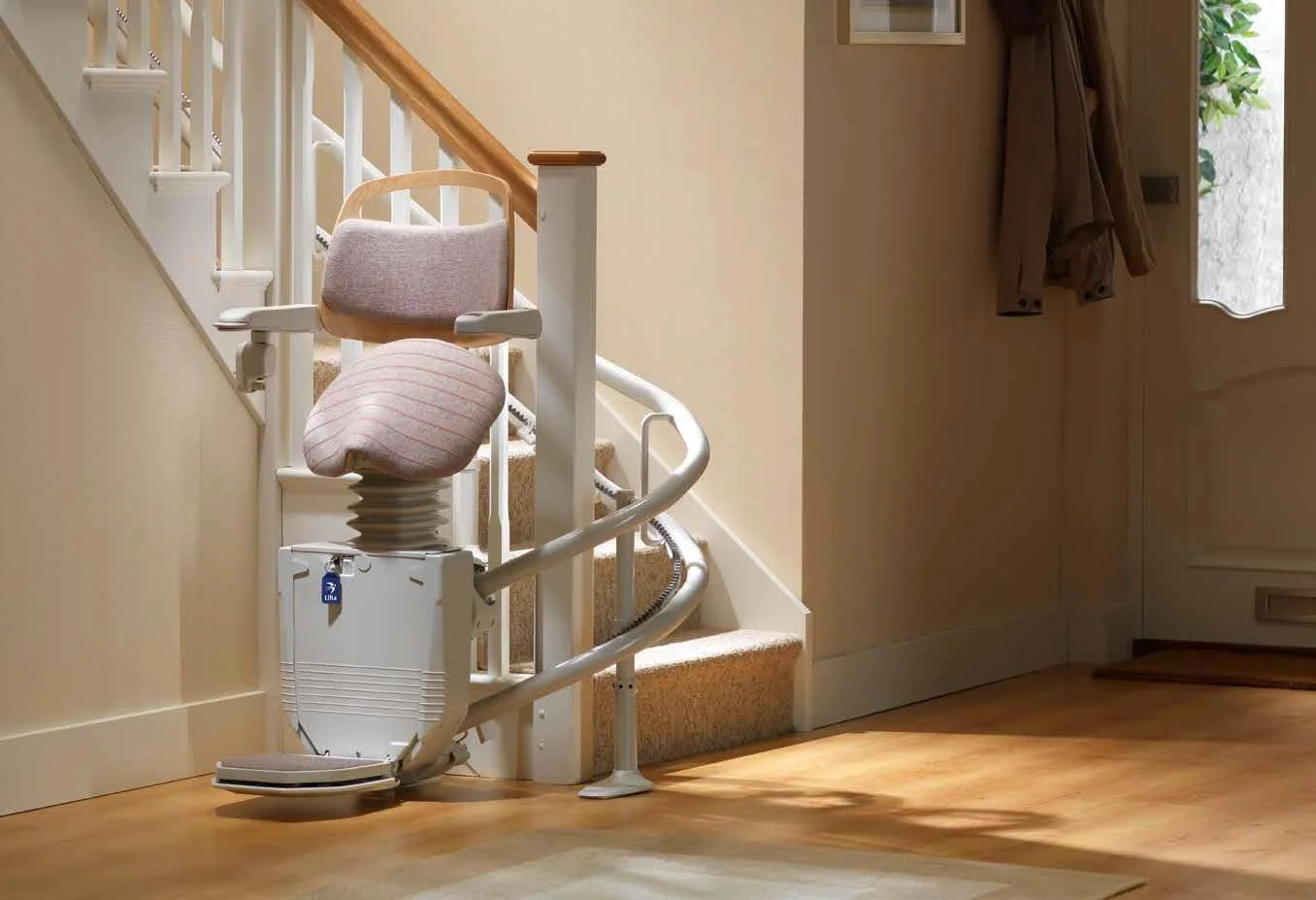
Sullivan County has 5,198 homes built in 1939 or earlier, plus another 987 from the 1940s. Stairs in these houses tend to be narrow and steep, and many turn partway up with pie-shaped winder steps. A straight rail cannot follow that turn, so these homes usually need a curved stair lift with a rail built to the exact shape of the staircase.
Narrow stairs also raise a practical question: will someone else still be able to walk up past the lift? We measure width, the pitch of the stairs and the space at the top and bottom landings before recommending a model. On a tight old staircase, a folding seat and footrest make a real difference.
The county's two biggest building waves came in the 1970s, with 3,882 units, and the 1980s, with 3,520. Many houses from those decades have a single straight run of stairs, which is the simplest and usually quickest install. Only 1,045 units have been built since 2010, so very few homes here were designed with single-level or accessible layouts.
Split-level homes are different. They often have two or more short flights, and each one may need its own lift, or one lift may need a rail that handles a landing. Townhouses can work much like a single-family house, while walk-up apartments usually need the building owner's approval first.
The county also has 1,699 mobile homes. For these and other homes where the hard part is getting from the yard to the front door, an outdoor-rated stair lift or a platform lift for a wheelchair user may be the better answer than anything indoors.
Detached single-family houses make up 16,230 units, roughly 74% of the county's housing. Buildings with 20 or more apartments hold just 1,205 units. That means moving to a flat apartment is not an easy option in most Sullivan County towns.
Owner-occupancy is high too: 12,531 of the county's 16,618 occupied units are owned by the people living in them, and 75.3% of residents are homeowners. With 23.1% of residents age 65 or older, a lot of families are weighing the same question: adapt the house or leave it. For many, a stair lift is what lets a parent keep using the bedroom and bathroom upstairs.
The most direct funding route for people who qualify is the NH Choices for Independence (CFI) Medicaid HCBS Waiver, which can cover approved home modifications as part of a care plan. Granite State Independent Living also lists stair lifts among the services in its Home Access Modification Program and helps households find funding sources.
If you don't know where to begin, start with ServiceLink Aging and Disability Resource Center of Sullivan County at 224 Elm St. in Claremont. Staff there can connect you to CFI enrollment, GSIL and other local sources. Rural homeowners with very low income may also want to ask the USDA Rural Development office about its Section 504 Home Repair Program.
Be aware that the VA HISA grant explicitly excludes stair glides, so it will not pay for a stair lift. The VA SAH and SHA grants can be used to change a permanent home for veterans with certain severe service-connected disabilities, but the VA source does not name stair lifts, so confirm before counting on them.
A statewide Medicaid waiver run by NH DHHS for people 65 and older, or 18 to 64 with a qualifying disability, who meet nursing facility level of care; it covers approved home modifications for safety and accessibility, the category stair lifts fall under. Apply through NH Easy or a district DHHS office, and expect up to 3 months of processing plus a possible waitlist; call (866) 634-9412.
New Hampshire's statewide Center for Independent Living, based in Concord, lists stair lifts among its home access services and serves Sullivan County with no strict age limit stated. Call (603) 228-9680 to be connected to the office covering Sullivan County.
The county's first stop for older adults, adults with disabilities and caregivers, offering information, referral, options counseling and Medicare counseling at 224 Elm St., Claremont. Its listing does not mention stair lifts or home modifications directly, but staff can connect you to CFI, GSIL and other funding; call (603) 542-5177.
Offers loans up to $40,000 and grants up to $10,000 for very-low-income homeowners in eligible rural areas, with grants limited to those 62 or older who cannot repay a loan. The program does not list stair lifts, so confirm with the Concord office at (603) 223-6035.
A VA grant for medically necessary home improvements, up to $6,800 lifetime for service-connected or 50%+ rated veterans and up to $2,000 for non-service-connected. The VA explicitly excludes stair glides, so it does not cover stair lifts; call (603) 624-4366 with questions.
Grants for veterans with specific severe service-connected disabilities to buy, build or change a permanent home, with SAH up to $126,526 and SHA up to $25,350 for FY2026. The VA source gives ramps and wider doorways as examples but does not mention stair lifts; call (603) 624-4366 to ask.
Older adults
129 Pleasant Street, Concord, 03301
Veterans
224 Elm Street, Claremont, 03743
Usually, yes. Stairs with winder turns need a curved stair lift with a custom rail made to follow the staircase. We check the stair width and landing space first, and folding parts help keep the stairs usable for others.
The CFI Medicaid waiver covers adults 18 to 64 with a qualifying disability who meet nursing facility level of care. Granite State Independent Living states no strict age limit and serves people with disabilities of all ages; call (603) 228-9680.
For 2026, a single applicant can have income up to $2,982 a month and assets up to $2,500. When both spouses apply, the limits are $5,964 a month and $5,000 in assets, and home equity is exempt up to $752,000.
Not through the HISA grant, which explicitly excludes stair glides. SAH and SHA grants do not name stair lifts, so call (603) 624-4366 to ask. Locally, the NH Veterans Services Sullivan County Family Assistance Center is at 224 Elm Street in Claremont, (603) 542-5177.
Most of Sullivan County outside larger population centers falls in USDA-eligible rural areas, but eligibility depends on the exact address. Very-low-income homeowners 62 or older who cannot repay a loan may qualify for a grant up to $10,000; confirm stair lift coverage at (603) 223-6035.
Call ServiceLink Aging and Disability Resource Center of Sullivan County at (603) 542-5177, at 224 Elm St. in Claremont. They can help with CFI enrollment and point you to GSIL and other sources while you get a stair lift assessment.
Tell us about the stairs in your home and we will explain which lift fits, what it costs and how installation works.
