Belknap County wraps around the southwestern part of Lake Winnipesaukee, with Squam Lake and Lake Winnisquam close by and the Belknap Mountains rising along the eastern shore. From Laconia and Gilford to Meredith, Alton and Center Harbor, a lot of homes here sit on slopes or near the water, and many were built before anyone thought about accessibility standards.
That combination of hills and older houses means stairs are often the first thing that stops someone from living comfortably at home. This page walks through what the county's homes mean for choosing a stair lift, and which programs and offices can help with the cost.
The county covers 470 square miles, and 68.2 of those are water. Homes built along the shorelines and up the hillsides often have steep or narrow staircases, and some have steps outside just to reach the front door.
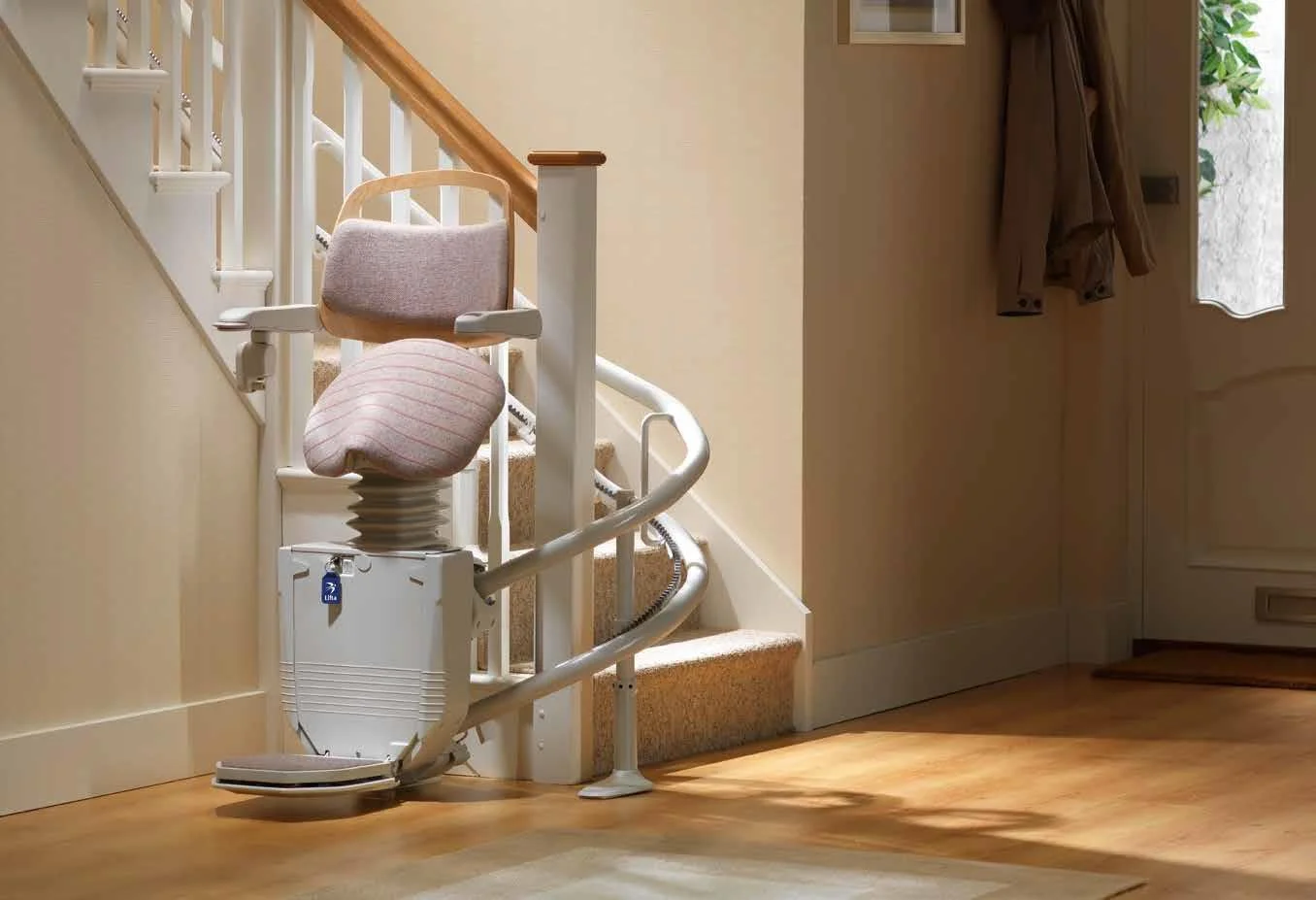
A straight stair lift works well when the staircase runs in one line from bottom to top. Where a staircase turns at a landing or curves, a curved rail is built to follow that exact shape. For exterior steps on a sloped lot, an outdoor lift built to handle New Hampshire weather is the option to look at.
Housing in Belknap County includes single-family homes, detached houses, split-level homes, walk-up apartments and low-rise buildings. Split-levels are a common challenge because they have several short flights instead of one long one. Each flight may need its own lift, or a rail that runs around the turns.
The Lakes Region also has a substantial share of seasonal lake camps and second homes. If a family plans to spend summers at a camp, it is worth measuring those stairs too, not just the main house. When someone uses a wheelchair and cannot transfer to a seat, a platform lift may be the better fit.
About 23.5 percent of the county's 67,469 residents are 65 or older, and 77.4 percent of households own their homes. Owners decide on their own modifications, so there is no landlord to ask before a lift goes in.
That is worth knowing because the VA has its own grants, though the rules on stair lifts differ by program, as explained below.
Granite State Independent Living is the one program listed here that clearly names stair lifts in its home access services. Its staff look at the home and help find funding, which may include the CFI waiver, the VA or other grants.
The CFI Medicaid waiver pays for home modifications for safety and accessibility, but its materials name ramps, grab bars and doorway widening rather than stair lifts, so ask directly. USDA Section 504 repair loans and grants may help very-low-income homeowners in eligible rural areas. For veterans, the VA HISA grant excludes stair glides, while SAH and SHA grants cover adaptations for severe service-connected disabilities without naming stair lifts.
A good first call is ServiceLink at (603) 528-2145 in Laconia, which helps residents of Belknap and Carroll Counties sort out these options. Statewide, the Bureau of Elderly & Adult Services in Concord can be reached at (603) 271-9203. New Hampshire also has property tax relief for elderly and disabled homeowners, which can free up some of the household budget.
A Medicaid waiver for residents 65 and older, or 18 to 64 with a qualifying disability, who meet nursing facility level of care; it funds home modifications per the care plan, but the source does not mention stair lifts specifically. Call (866) 634-9412 or screen through NH Easy or the ADRC.
A statewide nonprofit independent living program that lists stair lifts among its home access services and helps identify funding for the project. Call (603) 228-9680 to confirm eligibility.
Fixed 1 percent loans and grants, combined up to $50,000, for very-low-income homeowners in eligible rural areas; grants require the applicant to be 62 or older, and stair lifts are not mentioned in the source. Call (603) 223-6035 and verify your address on the USDA eligibility site.
A lifetime VA grant of up to $6,800 or $2,000 for medically necessary alterations, depending on disability status. The VA explicitly excludes stair glides, so it does not cover a stair lift.
VA grants of up to $126,526 (SAH) or $25,350 (SHA) for FY2026 for veterans with specific severe service-connected disabilities to buy, build or adapt a home. The source mentions ramps and doorway widening but does not name stair lifts.
A free information, referral and options counseling service for older adults, people with disabilities, caregivers and veterans in Belknap and Carroll Counties; it is not a modification fund and does not mention stair lifts. Call (603) 528-2145.
Older adults
129 Pleasant Street, Concord, 03301
Veterans
67 Water Street; Suite 105, Laconia, 03246
The CFI waiver covers home modifications for safety and accessibility, such as ramps, grab bars and doorway widening, approved through the person's care plan. Stair lifts are not named on the source page, so coverage is not confirmed. Call (866) 634-9412 or ServiceLink at (603) 528-2145 to ask.
The HISA grant does not; the VA lists stair glides as excluded equipment. SAH and SHA grants fund adaptations for veterans with specific severe service-connected disabilities, but stair lifts are not named, so ask the VA about your situation. The Belknap County ADRC at 67 Water Street, Suite 105, in Laconia can be reached at (603) 528-6945.
Granite State Independent Living's Home Access Modification Program lists stair lifts among its services and serves the whole state, including Belknap County. Call (603) 228-9680.
USDA Section 504 grants require the applicant to be 62 or older, unable to repay a loan, and at or below 50 percent of area median income. Grants have a lifetime cap of $10,000. Most of the county outside Laconia's denser areas may qualify, but check your address with USDA at (603) 223-6035.
Yes, but split-levels have several short flights, so you may need a lift for each flight or a curved rail that follows the turns. A home visit to measure each staircase is the way to know for sure.
ServiceLink, run by Partnership for Public Health, is the local access point for Belknap and Carroll Counties at (603) 528-2145. They can point you to waiver enrollment, caregiver support and funding for home modifications.
Tell us about the stairs in your home and we will explain which lift fits, what it costs and how installation works.
