Eddy County is North Dakota's smallest county by land area, and its two towns, New Rockford and Sheyenne, sit among semi-arid hills with the Sheyenne River running east through the upper part of the county. Much of the housing here is older small-town and farmhouse construction, built when the county held far more people than it does now.
Those older homes often mean a flight to a second floor or a set of steps up to a raised entry. This page walks through how local homes and terrain shape the right stair lift choice, and which North Dakota and federal programs can help cover the cost.
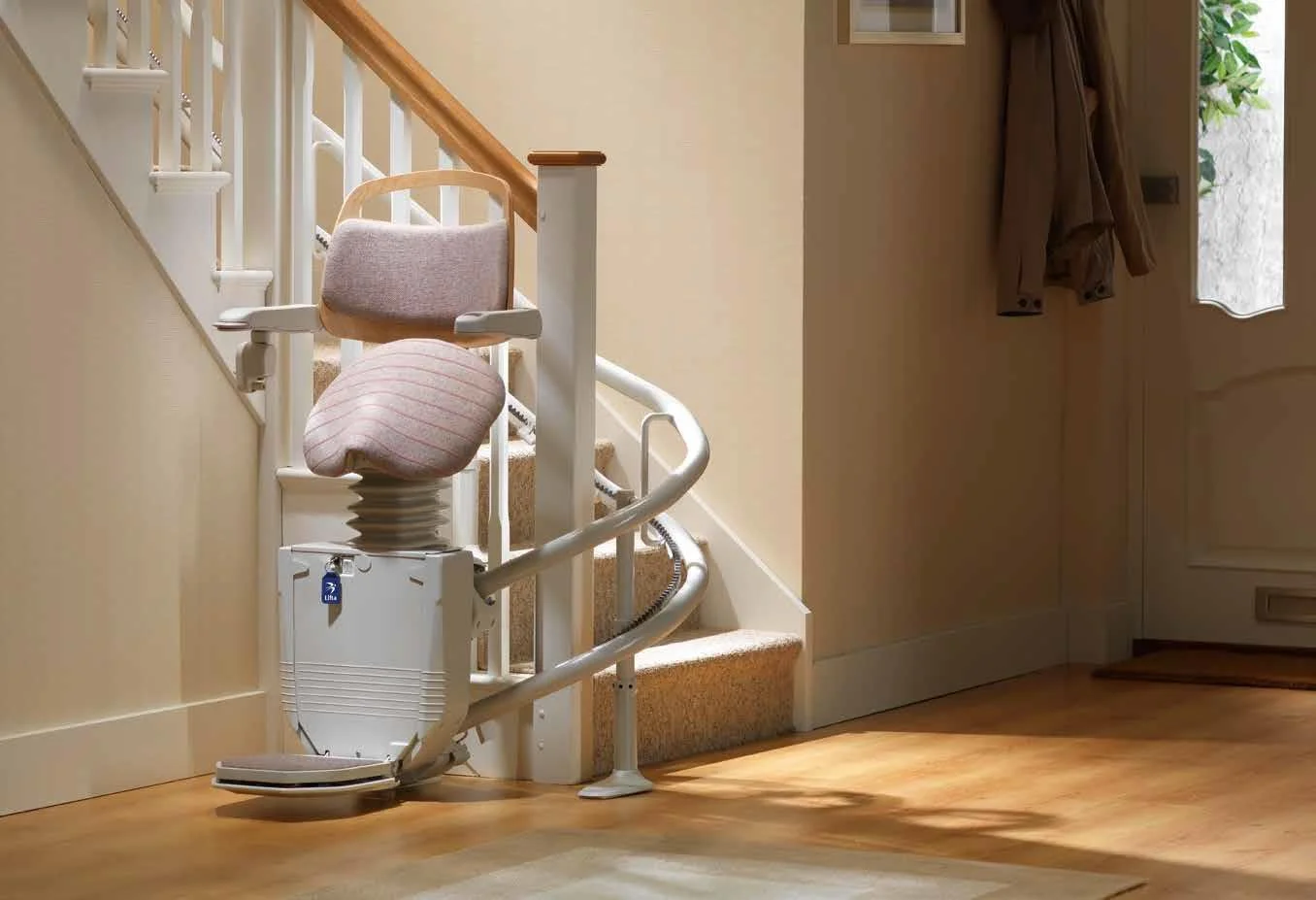
Eddy County had 1,240 housing units as of the 2020 census. Most are single-family homes and detached houses, with a mix of ranch-style homes, split-level homes and older farmhouses.
In a two-story farmhouse, the main question is whether the staircase runs straight from bottom to top. A straight stair lift is the simplest install and usually fits a plain run with no landing. If the stairs turn at a landing or wind around a corner, a curved rail built to that staircase is the usual answer.
Split-level homes are a different puzzle. They tend to have several short flights instead of one long one, so it helps to decide which levels really need to be reached every day before choosing equipment.
Even a ranch-style home with everything on one floor can have steps up to the front or back door. When the trouble starts at the entry, an outdoor stair lift built for exposure to the weather is one option. For a wheelchair user, a platform lift that carries the chair itself may make more sense than a seat.
Stairs that lead onto a porch or deck should be measured with the whole path in mind, from the driveway to inside the door. A lift that gets someone up the steps but leaves them facing a narrow threshold has not solved the problem.
Eddy County covers 630.24 square miles of land with only about 3.7 people per square mile. That means long drives to services and fewer nearby contractors and medical-equipment suppliers.
Close to a third of residents, 30.7%, are 65 or older, so many households here are thinking about stairs at the same time. Getting measurements done and funding applications started early avoids waiting until a fall or a hospital discharge forces a rushed decision.
Most help for home changes in North Dakota runs through a category called Environmental Modification. The Medicaid waiver, SPED and Ex-SPED all include it. Stair lifts are not named on their own, so a case manager decides whether a specific install fits your plan of care.
The local starting point is the Central Prairie Human Service Zone office in New Rockford at (701) 947-5314. The zone serves Eddy, Foster and Wells counties, and its host office in Fessenden can be reached at (701) 547-3694.
The Eddy County Veterans Service Office at 22 9th Street S in New Rockford, (701) 302-8087, can help sort out which VA benefits apply. Low-income rural homeowners can also ask about USDA repair loans and grants, listed below.
This state Medicaid waiver covers Environmental Modification, the home-adaptation benefit a case manager may approve a stair lift under if it is part of the plan of care. Applicants must be Medicaid eligible, 18 or older and meet nursing-facility level of care; call (855) 462-5465.
A state-funded program that does not require Medicaid and includes Environmental Modification, with a cap of $3,537.00 per month toward authorized services and a sliding fee scale. Liquid assets must be under $50,000; call (701) 547-3694.
A Medicaid-linked program for people on SSI or with income at or below the SSI level, also including Environmental Modification, with a $3,537.00 monthly cap and no service fee. A case manager decides on a stair lift case by case; call (701) 547-3694.
The local intake and case-management office in New Rockford where residents apply for Medicaid, SPED, Ex-SPED and waiver services; it is not a grant and does not itself list stair lift coverage. Call (701) 947-5314 or the zone support line at 1-866-614-6005.
A statewide referral line that connects callers to in-home service programs and helps identify funding sources; it does not fund modifications and does not list stair lift coverage. Call (855) 462-5465.
Very-low-income rural homeowners can borrow up to $40,000 at 1% interest, and those 62 or older who cannot repay a loan may get grants up to $10,000 for health and safety hazards; stair lifts are not specifically listed. Call (701) 530-2037.
This VA grant pays for ramps, accessible bathrooms and similar structural work, but it explicitly excludes stair glides, so it does not cover a stair lift. Call (800) 698-2411.
For veterans with qualifying service-connected disabilities, this grant provides up to $126,526 for FY2026 to buy, build or change a permanent home; stair lifts are not specifically listed. Call (800) 698-2411.
This grant offers up to $25,350 for FY2026 to adapt a permanent home for veterans with certain service-connected disabilities; stair lifts are not specifically listed. Call (800) 698-2411.
Older adults
600 E Boulevard Ave, Dept 325, Bismarck, 58505
Veterans
22 9th Street S, New Rockford, 58356
Start with the Central Prairie Human Service Zone office in New Rockford at (701) 947-5314. A case manager there assesses eligibility for Medicaid waiver, SPED and Ex-SPED services and decides whether a stair lift qualifies as an Environmental Modification.
No. SPED does not require Medicaid enrollment. Liquid assets must be under $50,000, and income is figured on a sliding fee scale, so there may be a cost share.
Yes, the Medicaid waiver accepts people 18 or older. If the applicant is under 65, the disability must meet Social Security criteria or be confirmed by the state review team.
The HISA grant explicitly excludes stair glides, so it will not. The SAH and SHA grants fund home adaptations for qualifying service-connected disabilities but do not name stair lifts, so the VA decides case by case. The Eddy County Veterans Service Office at (701) 302-8087 can help with the application.
USDA Section 504 grants are limited to very-low-income homeowners 62 or older who cannot repay a loan, and they target health and safety hazards. Stair lifts are not specifically listed, so ask the USDA office at (701) 530-2037 about your situation.
Split-level homes usually have several short flights, so the answer depends on which levels you need to reach. A straight lift fits a single plain run, while stairs that turn need a curved rail, and some homes need more than one lift.
Tell us about the stairs in your home and we will explain which lift fits, what it costs and how installation works.
