Burleigh County stretches across 1,632.694 square miles of central North Dakota, with the Missouri River along its western and southern edge. Most of its 78,657 residents live in and around Bismarck, the county seat and state capital, with Lincoln and Wing rounding out the county's three towns.
Detached single-family homes make up most of the housing here, and 67.3% of households own their home. That matters for a stair lift, because owners can usually decide on an install without waiting on anyone else. This page walks through which lift suits which kind of local home and where to look for help paying for one.
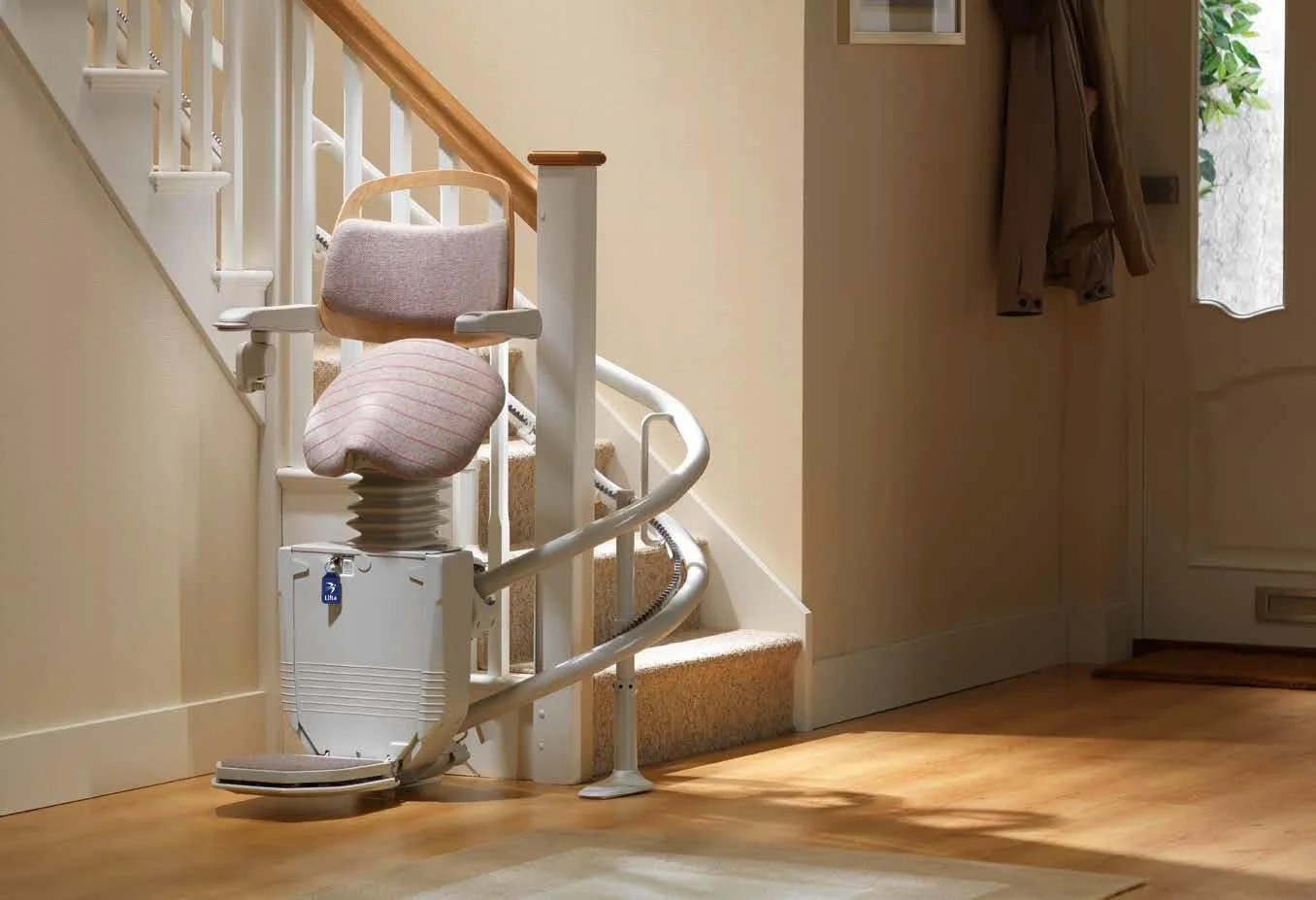
A detached house with one straight flight to the bedrooms is the simplest job. A straight rail mounts to the stair treads, not the wall, so there is no structural work and the stairs stay usable for everyone else.
Split-level homes are different. They often have two or three short flights between levels, and each flight may need its own straight lift, or one curved rail if the person needs to ride past a landing without transferring. We measure every run before recommending either.
Townhouses tend to have narrow stairways, so we check the folded width of the seat and footrest against the stair width before anything else. A slim straight lift fits most of these stairs.
Walk-up apartments are mostly rented, so the building owner has to approve any rail. For a home with steps up to the front or back door, an outdoor-rated lift or a vertical platform lift can be the better answer, especially if a wheelchair is involved.
Many of the calls we get come from adult children in Bismarck arranging a lift so a parent can stay in the house they own.
With a median household income of $88,701, a lot of families here pay privately. Even so, it is worth checking the programs below first, since some can help with home accessibility changes for people who qualify.
No program in our records names stair lifts as a covered item, and the VA HISA grant specifically excludes stair glides. Several programs do fund environmental modifications in general, so the honest answer is to ask and get a written decision.
The best first call is the Aging and Disability Resource-LINK at (855) 462-5465. Its main office is right in Bismarck at 1237 W. Divide Ave, Suite 6, and it screens people for the Medicaid HCBS waiver and SPED programs. Veterans should start with the Burleigh County Veterans Service Office at 221 N 5th St, Bismarck, (701) 222-6698.
A Medicaid waiver for recipients 65+ or 18+ with a physical disability who meet nursing-facility level of care; Environmental Modification and Specialized Equipment need prior approval, and requests over $500 need a written professional recommendation. Stair lifts are not named in the policy manual; call (855) 462-5465.
The state's single point of entry for information, referral and screening for the HCBS Waiver, SPED and ExSPED, with its main office in Bismarck. It does not fund stair lifts or home modifications itself; call (855) 462-5465.
A state-funded program for people 65+ or 18+ with a functional impairment, with liquid assets up to $50,000 and an aggregate monthly cap of $4,029 ($6,796 with Adult Foster Care). Environmental Modification is an ExSPED service, but stair lifts are not named; call (855) 462-5465.
Loans up to $40,000 at 1% and grants up to $10,000 for very-low-income homeowners 62+ in eligible rural areas, to remove health and safety hazards. Stair lifts are not listed, and central Bismarck may not count as rural; call (701) 530-2037.
A lifetime grant of up to $6,800 or $2,000 for medically needed home alterations for enrolled veterans. VA policy excludes stair glides and porch lifts, so it will not pay for a stair lift; call (800) 698-2411.
Grants of up to $126,526 (SAH) or $25,350 (SHA) for veterans with qualifying service-connected disabilities; the VA lists ramps and widened doorways as examples but does not name stair lifts. Call (800) 698-2411.
Up to $4,000 per calendar year for North Dakota veterans, spouses or unremarried widows and widowers who meet income and asset limits, including a special medical or non-medical needs category. Stair lifts are not named; call (701) 222-6698.
A county office at 221 N 5th St in Bismarck that helps veterans and survivors file for VA and state benefits. It does not fund home modifications directly; call (701) 222-6698.
A Bismarck-based nonprofit offering information and referral, peer support and advocacy for people with disabilities. No stair lift funding is listed, but it can point you to other programs; call (701) 222-3636 or TTY 1-800-489-5013.
Older adults
600 E Boulevard Ave, Dept 325, Bismarck, 58505
Veterans
221 N 5th St, Bismarck, 58501
Not through the HISA grant, which excludes stair glides. SAH and SHA grants do not name stair lifts, and the state Hardship Assistance Grant does not either, so ask the Burleigh County Veterans Service Office at (701) 222-6698 to review your case.
Yes, possibly. The Medicaid HCBS waiver and SPED both accept adults 18 and older with a qualifying disability or functional impairment. The Aging and Disability Resource-LINK at (855) 462-5465 can screen you.
Usually. Each short flight can get its own straight lift, or a curved rail can carry the rider past a landing. We measure every run during the home visit before recommending one.
It depends on your address. Central Bismarck may not qualify as rural, while surrounding parts of the county often do, and grants are for homeowners 62 or older. Call (701) 530-2037 to check.
Start with the Aging and Disability Resource-LINK at (855) 462-5465, which handles HCBS waiver and SPED screening. You can also reach the Aging Services Division at (701) 328-8910, 600 E Boulevard Ave, Dept 325, Bismarck.
Tell us about the stairs in your home and we will explain which lift fits, what it costs and how installation works.
