From the riverside streets of Columbus to the ranch roads around Absarokee, Park City and Rapelje, most homes in Stillwater County are older single-family houses owned by the people living in them. Many were built for working families on farm and ranch land, not for someone who now finds the basement stairs or the porch steps hard to manage.
This page walks through how those homes tend to be laid out, which kind of stair lift usually fits, and where local residents can turn for help paying for one. If you are helping a parent stay in the house they have lived in for decades, start here.
Stillwater County is entirely rural. As of the 2020 Census, 0.0% of residents lived in urban areas, and the owner-occupancy rate among occupied housing units was 81.0%. That points to a lot of older, owner-occupied houses rather than newer suburban builds.
In a straightforward single-family home with one straight flight, a straight stair lift is usually the simplest fit. It mounts to the stair treads, not the wall, so it works well in older houses where walls may not be ideal for anchoring.
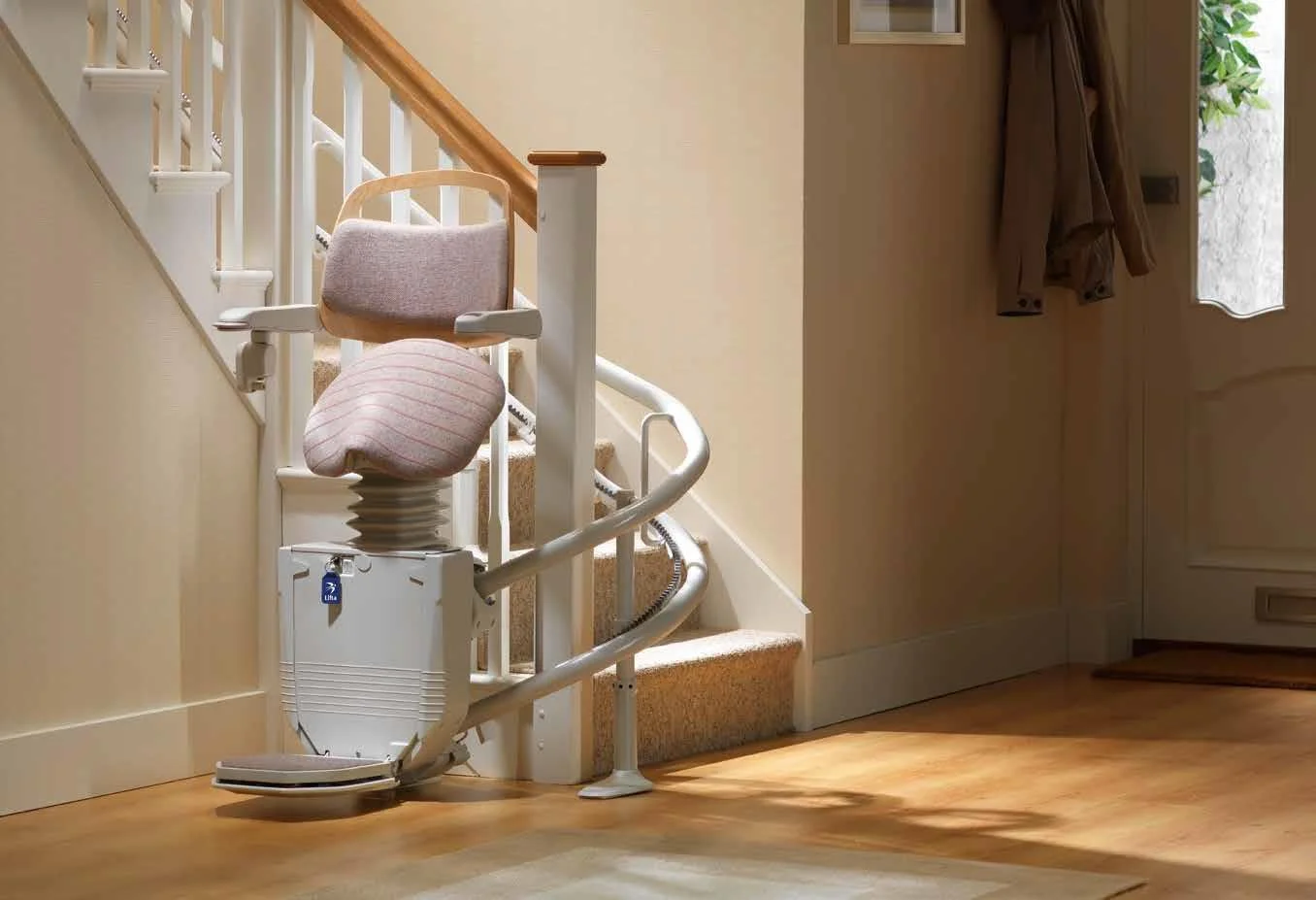
Split-level homes are a different job. Short flights between levels, or a landing that turns, often call for a curved rail or two separate straight lifts. We measure every run before suggesting either one.
On outlying farm and ranch properties, the hardest steps are sometimes outside: the porch, the back entry by the mudroom, or a stoop that sits well above grade. An outdoor stair lift built for weather exposure can handle those, and a platform lift can be the better answer for someone using a wheelchair.
Terrain plays a part too. The county runs from about 3,400 feet near Park City up to over 12,000 feet near Granite Peak in the Beartooth Mountains, with the Stillwater and Yellowstone River valleys and northern coulees in between. Homes on sloped lots often have longer or uneven entry steps, so we look at the outside approach as carefully as the inside stairs.
Not everyone lives on acreage. Some residents are in townhouses, walk-up apartments or low-rise buildings in town, where the stairs may be shared or narrower.
A shared stairway usually needs permission from the owner or building manager before any lift goes in. A folding rail and a seat that swivels and folds out of the way help keep the stairs clear for neighbors.
The 2020 Census put the county's median age at 48.6, with 24.4% of residents age 65 or older.
Columbus sits along Interstate 90 about 40 miles west of Billings, which is the nearest metro area for specialized medical and mobility-equipment services. Families often find it easier to have an installer come to the house than to arrange repeated trips into Billings.
No program on this page states plainly that it pays for stair lifts, so it helps to know where each one stands before you call. The VA HISA grant explicitly excludes stair glides. The Big Sky Waiver, VA housing grants and LIFTT do not mention stair lifts either way, so ask them directly.
A good first call is the Area II Agency on Aging ADRC at (406) 323-1320, or your local senior center: Columbus (406) 322-8605, Park City (406) 638-4513, Absarokee (406) 328-4869, or Rapelje/Stockman Cafe (406) 663-2231. The Area II - Adult Resource Alliance of Yellowstone County office is at 1505 Avenue D, Billings, 59102, phone (406) 259-5212.
Other statewide options worth asking about include the Montana Assistive Technology Loan (MATL), Reverse Annuity Mortgage (RAM), Community First Choice Services (CFCS), and the Property Tax Assistance Program (PTAP) & Elderly Homeowner/Renter Credit. Veterans can reach the Montana Veterans Affairs Division - Billings Veterans Service Office at (406) 248-8579.
A Montana Medicaid waiver for people who meet nursing-facility level of care, with services that include Environmental Adaptations; stair lifts are not named on the official page and there is currently a waiting list. Call (800) 219-7035 for a referral.
Information, referral and options counseling for adults age 60 and older and people with disabilities over 18 in the Area II region, which includes Stillwater County; it does not mention stair lifts and is not a cash grant. Call (406) 323-1320.
A VA grant for medically necessary home alterations, up to $6,800 or $2,000 lifetime depending on disability status; it explicitly does not pay for stair glides, porch lifts or portable ramps. Call (406) 447-7586.
VA grants for veterans with qualifying severe service-connected disabilities, with SAH up to $126,526 and SHA up to $25,350 for FY2026; stair lifts are not specifically listed. Call (877) 827-3702.
A nonprofit serving people with disabilities in 18 Montana counties including Stillwater, offering information on home modifications such as ramps and grab bars and connections to loan programs; stair lifts are not mentioned. Call (406) 259-5181.
Older adults
1505 Avenue D, Billings, 59102
Veterans
1500 University Dr, College of Education Rm 114, Billings, 59102
The Big Sky Waiver lists Environmental Adaptations among its services, but its official page does not name stair lifts. It also has an active waiting list. Call (800) 219-7035 and ask whether a stair lift can be included in an individualized service plan.
No. The VA states that HISA will not pay for removable equipment such as stair glides, porch lifts or portable ramps. Veterans with severe service-connected disabilities can ask about SAH or SHA grants at (877) 827-3702, or talk with the Billings Veterans Service Office at (406) 248-8579.
Yes, through some channels. The Area II ADRC serves people with disabilities over the age of 18, and LIFTT serves people with disabilities in its 18-county area, which includes Stillwater County.
Not usually. Split-level homes often need either a curved lift that follows the turns or separate straight lifts for each short flight. A home visit to measure each run settles which one fits.
Yes. Outdoor stair lifts are built for weather exposure, and a platform lift may suit someone who uses a wheelchair. We look at the slope and the height of the entry before recommending one.
The Columbus senior center at (406) 322-8605 or the Area II ADRC at (406) 323-1320 can point you to programs. Then call us to schedule a home visit so you know which lift your stairs need.
Tell us about the stairs in your home and we will explain which lift fits, what it costs and how installation works.
