Prairie County covers about 1,737 square miles of rolling grassland and badlands, with roughly 0.6 people per square mile. Terry is the county seat and holds most of the county's homes, Fallon is the other town, and the rest of the houses sit on ranches and farms spread across the prairie.
Out here, a trip to services in Glendive or Miles City is a long drive. For many older residents, staying in the house they already own is the practical plan, and that often comes down to one thing: getting safely up and down the stairs.
The 2020 Census counted 671 housing units in Prairie County, and most occupied homes are owner-occupied. Many are older single-story wood-frame houses from the early-to-mid 20th century homesteading era, along with ranch-style homes, split-level homes, detached houses and a few walk-up apartments.
Those older homes were not built with aging in place in mind. A single-story house can still have a steep flight down to the basement, where the laundry, freezer or furnace sits. Other homes have a second story with the only full bathroom or bedroom upstairs.
A straight basement or second-story stair with no turns usually takes a straight stair lift. The rail mounts to the stair treads, not the wall, so plaster or older wood-frame walls are not a problem.
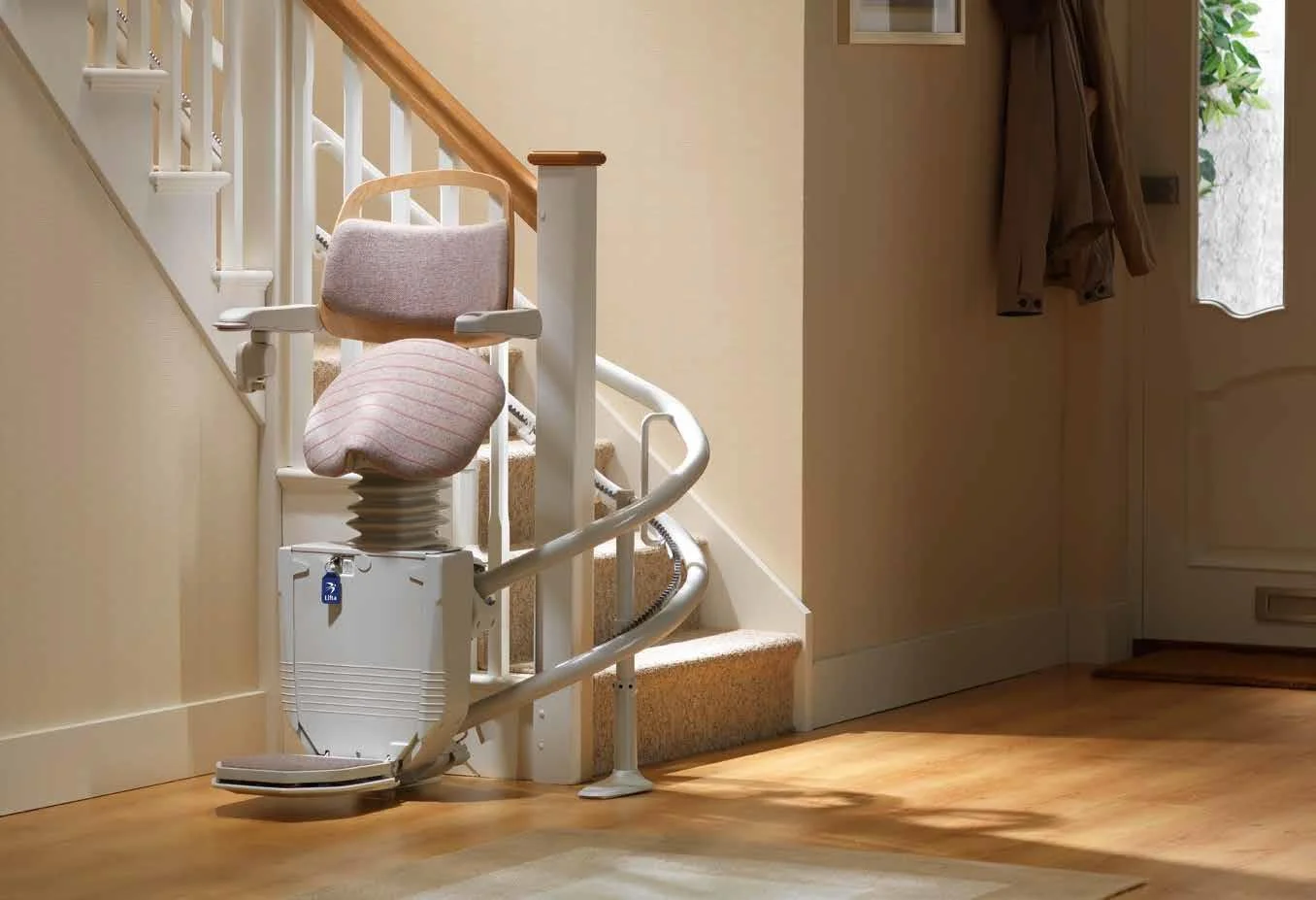
Split-level homes and stairs with a landing or a turn need a curved lift, which uses a rail bent to fit that exact staircase. Short runs of steps at a porch or side door can be handled with an outdoor lift built for weather, and a vertical platform lift is the option when someone uses a wheelchair and cannot transfer to a seat.
For a ranch house far from town, we plan the visit so measurements, rail choice and wiring questions are settled in one trip.
Prairie County has one of the oldest populations in Montana, with a 2020 median age of 52.8. Farming and ranching are the largest line of work, and many homeowners are aging on fixed, farm- or ranch-dependent incomes.
If that includes someone in your family, the VA grants listed below are worth a call, though not all of them pay for a stair lift.
Median household income in the county is $51,250 and the poverty rate is 20.6%, so cost matters. The USDA Section 504 program is built for rural areas like Terry and Prairie County, offering loans up to $40,000 at 1% and grants up to $10,000 for homeowners age 62 and older who cannot repay a loan. Its source does not name stair lifts, so ask directly.
The Big Sky Waiver lists environmental adaptations as a covered service, but approval for a stair lift is case by case, the income limit for a single applicant is $994 a month, and there is a waiting list. Prairie County residents apply through their county Office of Public Assistance.
The VA HISA grant specifically excludes stair glides. Other statewide options to ask about include the Montana Assistive Technology Loan (MATL), the Reverse Annuity Mortgage (RAM), Community First Choice Services (CFCS), and the Property Tax Assistance Program (PTAP) & Elderly Homeowner/Renter Credit.
A Montana Medicaid program for people who meet nursing-facility level of care; it lists environmental adaptations but does not name stair lifts, so coverage is decided case by case, and there is a waiting list. Call (800) 219-7035 or apply through the county Office of Public Assistance.
Serves Prairie County residents age 60 and older across a 17-county region from its Glendive office at 2030 N. Merrill Ave.; its listed services do not mention stair lifts or home modifications. Call (406) 377-3564 for help finding resources.
A nonprofit serving Montanans of any age with disabilities in an 18-county region that includes Prairie County, offering referral, advocacy and independent living skills; stair lift funding is not listed. Call (406) 948-8500.
Loans up to $40,000 at 1% fixed interest and grants up to $10,000 lifetime for very-low-income homeowners age 62 and older in eligible rural areas such as Prairie County; the source mentions accessibility improvements but does not list stair lifts.
A lifetime benefit of $6,800 or $2,000 for medically needed home changes, but the VA explicitly excludes stair glides and porch lifts, so it will not pay for a stair lift. Call (800) 827-1000 with questions.
Up to $126,526 for FY2026 for veterans with severe service-connected mobility disabilities who own or will own the home; stair lifts are not mentioned. Call (800) 827-1000.
Up to $25,350 for FY2026 for veterans with certain qualifying disabilities where the veteran or a family member owns the home; stair lifts are not itemized. Call (800) 827-1000.
Older adults
2030 N. Merrill Ave., Glendive, 59330
Veterans
104 2nd St S, Ste 200, Great Falls, 59401
Usually, yes. Many Prairie County homes are older wood-frame houses with a straight flight to the basement, which is the most common fit for a straight stair lift mounted to the treads.
Split-level stairs often have a landing or turn, which calls for a curved rail made for that staircase. Short straight runs between levels can sometimes take a straight lift, which we confirm when we measure.
The USDA Section 504 program offers grants up to $10,000 lifetime for homeowners 62 and older in rural areas like Prairie County who cannot repay a loan. The source does not list stair lifts, so ask whether your project qualifies.
The VA HISA grant specifically excludes stair glides. The SAH and SHA grants do not mention stair lifts, so call (800) 827-1000 or the Great Falls Service Office at (406) 452-2265 to ask about your situation.
The Big Sky Waiver lists environmental adaptations, which may or may not include a stair lift on case-by-case approval. The single-applicant income limit is $994 a month, there is a waiting list, and you apply through your county Office of Public Assistance.
Area I - Action for Eastern Montana in Glendive serves residents 60 and older and can be reached at (406) 377-3564. For a disability of any age, LIFTT at (406) 948-8500 also serves Prairie County.
Tell us about the stairs in your home and we will explain which lift fits, what it costs and how installation works.
