Judith Basin County stretches across roughly 1,870 square miles of central Montana, from the county seat of Stanford out to places like Hobson and Geyser, with part of the Lewis and Clark National Forest inside its borders. Homes here sit far apart, and many are ranch properties where the nearest neighbor may be miles down the road.
That distance shapes how a stair lift project works in this county. Installers for accessibility equipment are not based locally and travel in from larger hub cities, so it pays to plan the measurement visit, the order and the install carefully. This page walks through which lift fits the homes we see here and where to look for help paying for one.
The 2020 census counted 1,248 housing units in Judith Basin County, and most occupied homes, 77.6%, are lived in by their owners. The pattern is dispersed single-family homes and ranch-style houses, with some split-level homes and a few low-rise buildings rather than dense in-town apartments.
A ranch-style house often keeps everything on one floor, but the basement stairs or the steps up to the front door can still become a problem. A straight stair lift handles a basement run with no turns, which is usually the simplest and quickest kind to install.
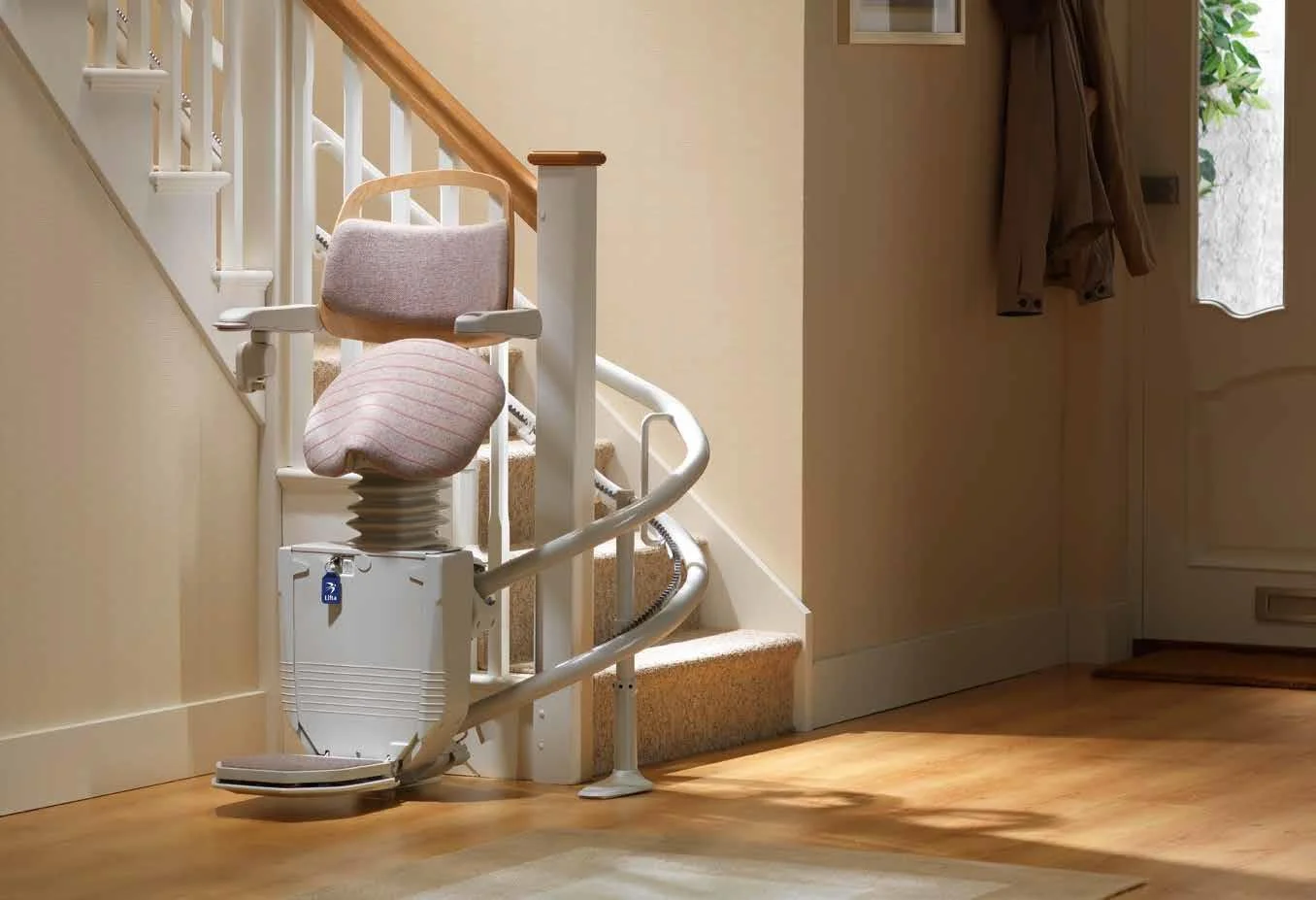
Split-level homes are different. They tend to have short flights broken up by landings, so a lift may need to follow a turn, which calls for a curved rail built to the exact shape of your stairs.
On a rural property, the hardest steps are sometimes outside: the porch, the back entry or the way down to a garage. Outdoor stair lifts are built with weather covers for exactly that spot.
If the person using the lift relies on a wheelchair, a seat on a rail will not solve the problem. A platform lift carries the chair itself and is worth discussing during the home visit, along with whether a ramp would work better at your entry.
Because installers come in from larger cities, a single well-prepared visit saves a lot of time. Have the stairs clear, know where the nearest outlet is, and write down the questions the person who will use the lift has about getting on and off.
Curved lifts are custom made after measuring, so the install happens on a second trip. Straight lifts can often be ordered with fewer steps between the first visit and the finished job.
Of the county's roughly 1,605 adults, 539 are seniors, about a third of the adult population. The median age is 46.2 years, so many families here are already thinking about how a parent or spouse will keep living at home.
If someone in your household served, the VA programs below are worth a call before you buy anything.
No program on this page names stair lifts as a covered item, and the VA HISA grant specifically excludes stair glides. Several programs do fund home modifications or accessibility repairs, so the honest next step is to call and ask how your situation fits.
For a referral starting point, the Area II Agency on Aging / ADRC covers an 11-county central Montana area at (406) 323-1320. The Area VIII - Cascade County AAA at 1601 2nd Ave N. in Great Falls is also listed for aging services at (406) 454-6990.
Montana also runs statewide programs you can ask about, including the Montana Assistive Technology Loan (MATL), the Reverse Annuity Mortgage (RAM), Community First Choice Services (CFCS), and the Property Tax Assistance Program (PTAP) & Elderly Homeowner/Renter Credit.
A Montana Medicaid waiver for people who need a nursing facility level of care but can live at home, with home modifications approved case by case through a care plan; stair lifts are not named in the source. Call (800) 219-7035.
An information, assistance and referral hub for seniors and adults with disabilities in central Montana; home modification programs are not listed, so call (406) 323-1320 to ask about stair lift referrals.
Rural Development offers repair loans up to $40,000 at 1% interest and grants up to $10,000 lifetime for owners age 62+ in eligible rural areas. Listed repairs include ramps, grab bars and walk-in tubs; stair lifts are not specifically named.
A VA benefit of $6,800 or $2,000 lifetime for medically needed structural home changes. The VA lists stair glides among the equipment HISA does not cover, so it will not pay for a stair lift.
A grant of up to $126,526 for veterans with certain severe service-connected disabilities to build, buy or adapt a home. The source gives ramps and wider doorways as examples and does not name stair lifts.
A grant of up to $25,350 to adapt a home for veterans with qualifying disabilities such as loss of use of both hands. Stair lifts are not specifically named as a covered adaptation.
A community action agency serving Judith Basin and five other central Montana counties with home weatherization and Section 8 rent assistance; neither service mentions stair lifts or home modifications. Call (406) 535-7488.
A block grant that local governments use to fix critical health and safety problems in owner-occupied homes, including an inspection for ADA improvements; stair lifts are not specifically named. Call (406) 841-2700.
A center for independent living that covers Judith Basin County with information, referral, advocacy and skills training. It does not fund stair lifts directly but can point you to funding; call (406) 452-9834.
Older adults
1601 2nd Ave N., Great Falls, 59401
Veterans
232 1st St W, Havre, 59501
Yes, but installers for accessibility equipment are not based in the county and travel in from larger hub cities. Planning the measuring visit and install together helps keep the number of trips down.
The Montana Big Sky Waiver covers home modifications case by case through a care plan, though stair lifts are not named in its list. Applicants need a nursing facility level of care, with a 2026 income limit of $994 a month and a $2,000 asset limit for a single person. Call (800) 219-7035 to ask.
No. The VA lists stair glides among the items HISA does not cover. Veterans with severe service-connected disabilities can ask about the SAH or SHA grants, or contact the Montana Veterans Affairs Division - Havre Field Office at (406) 265-4225.
The USDA Section 504 program offers grants up to $10,000 lifetime for owners age 62+ who cannot repay a loan, and Judith Basin County is rural and generally USDA eligible. Stair lifts are not specifically named, so ask whether your project qualifies.
Split-level homes often have short flights with landings, which usually means a curved lift built to your stairs. If each flight is straight and separate, two straight lifts may be an option to discuss at the home visit.
The Area II Agency on Aging / ADRC at (406) 323-1320 and North Central Independent Living Services at (406) 452-9834 both offer information and referral and can point you toward funding.
Tell us about the stairs in your home and we will explain which lift fits, what it costs and how installation works.
