Hill County stretches across about 2,916 square miles of the Hi-Line, from Havre and Havre North out to Rudyard, Beaver Creek, Sangrey, Azure, St. Pierre and Parker School. In Havre you find tall Queen Anne/Colonial Revival houses on the old residential streets. Out on the farm and ranch roads you find working homes where the nearest service visit can mean a long drive on U.S. Routes 2 and 87.
That range matters when someone in the family starts struggling with the stairs. A Craftsman bungalow with a half-story upstairs needs a different lift than a split-level home or a basement stairway in a ranch house. This page walks through the homes we see in Hill County, what kind of stair lift tends to fit each one, and the programs worth calling before you pay out of pocket.
Much of Havre's historic housing sits in the Havre Residential Historic District, built up between 1895 and the 1940s. The early houses for the town's well-off families were large, multi-story Queen Anne/Colonial Revival and Neo-Colonial residences. Those homes often still have their original interior stairways, which is where most stair lift questions in town start.
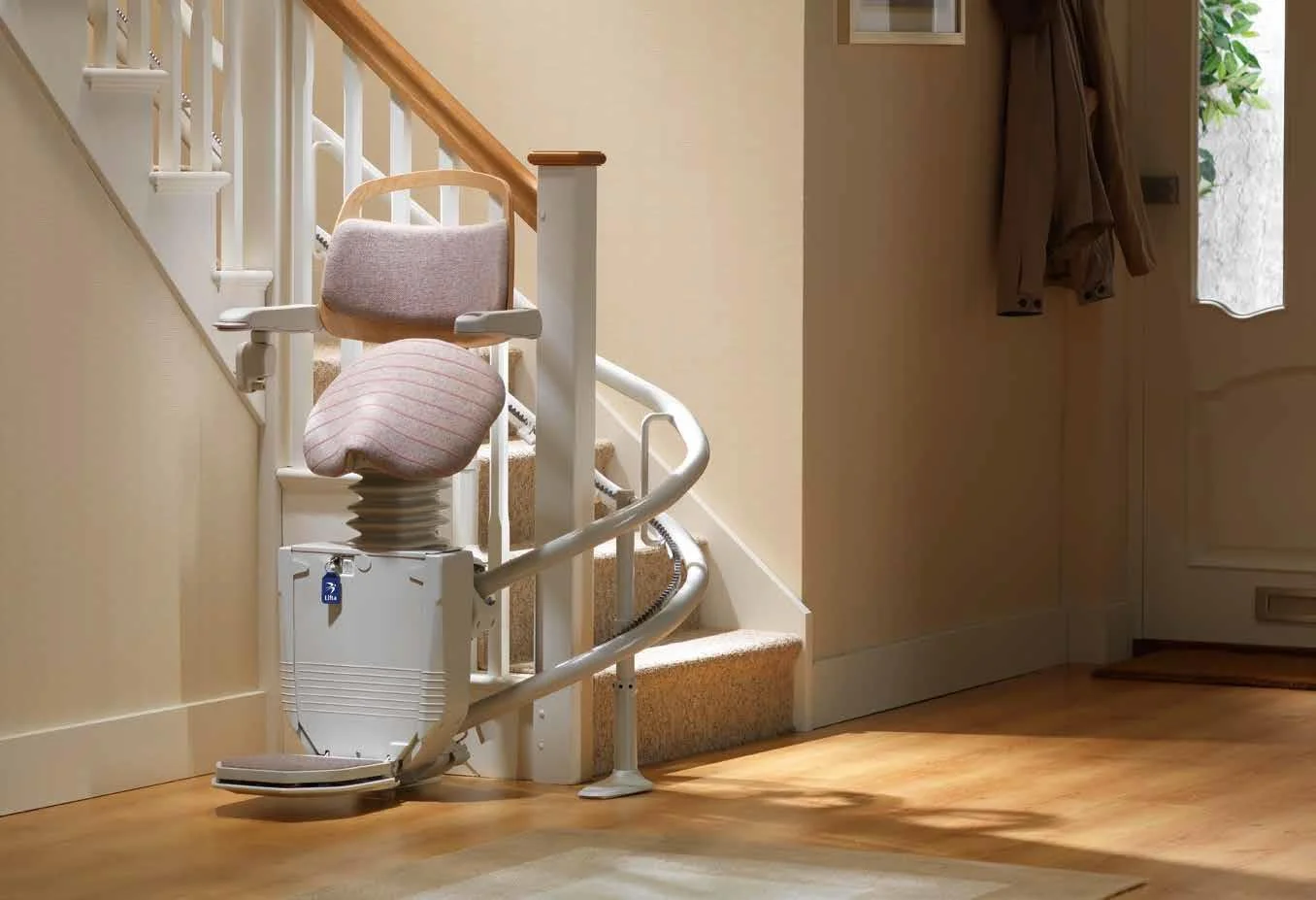
A straight staircase with no turns usually takes a straight rail, the simplest and quickest install. Older stairs that turn at a landing or wind near the top need a curved rail built to that exact staircase. We measure every step before quoting, because original woodwork and uneven treads in a century-old house rarely match a standard layout.
By 1907 the Craftsman bungalow had become the favorite for Havre's middle class, usually one or one-and-a-half stories. The Home Builders Investment Company put up more than 100 homes between 1913 and 1917, and later Great Depression houses used simpler designs and lower-cost materials. In a one-and-a-half-story bungalow, the upstairs flight is often steep and narrow, so we check width and the wall or tread structure before recommending a rail.
Beyond the historic core, Hill County has plenty of single-family homes, detached houses, ranch-style homes and split-level homes. A ranch-style home may have everything on one floor except the basement, and a straight lift down to the laundry or storage room is a common request. Split-level homes have short flights between levels, and some families put a lift on just the flight that matters most.
Front steps and back entry steps are a separate problem from indoor stairs. An outdoor stair lift is built for weather, and for a wheelchair user a vertical platform lift at the entry may make more sense than a seat. We will tell you which one fits the steps you actually have.
If your parent rents, especially in a walk-up apartment, the landlord needs to approve any rail. A stair lift mounts to the stair treads rather than the walls, and it can be removed later, which often makes that conversation easier.
About 39.8% of Hill County residents live in rural, dispersed farm and ranch settlement, and the rest live mostly in and around Havre. Distance cuts into access to aging, medical and home-modification services for people outside town. For a family in Rudyard or out past Beaver Creek, that means planning ahead rather than waiting for a fall to force the decision.
We try to handle the measurement, quote and install in as few trips as possible. Having the stairs clear, knowing which side your parent prefers to hold, and having the decision-makers present for the first visit all help. Ask us how service visits work for your location before you buy, so there are no surprises later.
Many of those calls come from adult children helping a parent stay in the house they have owned for decades.
About 63.6% of residents own their homes. Owning makes a stair lift simpler, since there is no landlord to ask and the lift can stay as long as it is needed.
No program in the list below names stair lifts as a covered item, so go in with clear expectations. The Montana Big Sky Waiver covers home modifications such as wheelchair ramps, grab bars and widening of doorways, and stair lifts are not mentioned. The VA HISA grant specifically excludes stair glides, though it can help with permanent changes like ramps and roll-in showers.
The USDA Section 504 program offers rural repair loans and grants that must address health or safety hazards, and the local Rural Development office decides eligible items case by case. The Hill County Council on Aging in Havre is the best first call to ask what in-home services exist locally. Statewide, it is also worth asking about the Montana Assistive Technology Loan (MATL), the Reverse Annuity Mortgage (RAM), Community First Choice Services (CFCS) and the Property Tax Assistance Program (PTAP) & Elderly Homeowner/Renter Credit.
Veterans can talk through options with the Montana Veteran Affairs Division - Havre Service Office at 232 1st St. W, Havre, (406) 265-4225.
A statewide Medicaid waiver for elderly and physically disabled Montanans who need a nursing-facility level of care but want to stay home, with a 2026 income limit of $994/month and asset limit of $2,000 for a single applicant. Named home modifications are wheelchair ramps, grab bars and widening of doorways; stair lifts are not listed. Call (888) 706-1535, and expect processing to take 3+ months with a possible waitlist.
The local senior-services contact for older adults living in Hill County, based at 2 West 2nd Street in Havre. The source does not list a stair lift or home-modification program, so call (406) 265-5464 and ask what in-home services they offer.
Loans up to $20,000 at 1% interest over 20 years, and grants up to $7,500 for very-low-income rural homeowners 62 or older who cannot repay a loan, with combined help up to $27,500. Grants must remove a health or safety hazard; stair lifts are not listed, and the local Rural Development office decides eligible items case by case.
A VA grant of up to $6,800 lifetime for a service-connected disability, or $2,000 for other non-service-connected disabilities, for medically necessary structural changes like ramps and roll-in showers. It does not cover stair lifts, since stair glides are explicitly excluded. Call (800) 827-1000.
Energy-efficiency repairs such as insulation, air sealing and furnace work for income-eligible homeowners and renters in Blaine, Hill and Liberty counties. It does not cover stair lifts; the listed number is 265-6743.
Older adults
2 West 2nd Street, Havre, 59501
Veterans
232 1st St. W, Havre, 59501
The Montana Big Sky Waiver covers home modifications such as wheelchair ramps, grab bars and widening of doorways, but stair lifts are not named. Call (888) 706-1535 to ask directly, and know that you must apply through Montana Medicaid first and enrollment is capped at about 2,783 people per year.
The HISA grant does not, because stair glides are on its list of excluded equipment. The Montana Veteran Affairs Division - Havre Service Office at (406) 265-4225 can help you look at other VA benefits.
Usually, yes. Straight stairs take a straight rail, while stairs that turn at a landing need a custom curved rail, and we measure each step before quoting.
The USDA Section 504 program offers grants up to $7,500 to very-low-income rural homeowners 62 or older who cannot repay a loan. The grant must remove a health or safety hazard, and the local Rural Development office decides case by case whether a stair lift qualifies.
Start with the Hill County Council on Aging at (406) 265-5464, at 2 West 2nd Street in Havre. They can tell you which local in-home services exist and what to ask the state programs.
Only with the landlord's approval. Because a stair lift mounts to the stair treads and can be removed, many landlords are open to it.
Tell us about the stairs in your home and we will explain which lift fits, what it costs and how installation works.
