Great Falls sits where the Missouri River and the Sun River meet. Its neighborhoods hold some of the oldest houses of any larger city in Montana: 66% of owner-occupied homes were built before 1980, compared with 52% in Billings and 32% in Bozeman. Many of those houses have stairs to an upper floor or a basement and were built with no thought of accessibility.
Outside the city, the county runs from Black Eagle and Gibson Flats out to Belt, Cascade, Simms, Ulm, Vaughn, Sun Prairie and Malmstrom AFB. This page covers how the homes in these 10 towns usually work with a stair lift, and which local and state programs are worth calling when it comes time to pay.
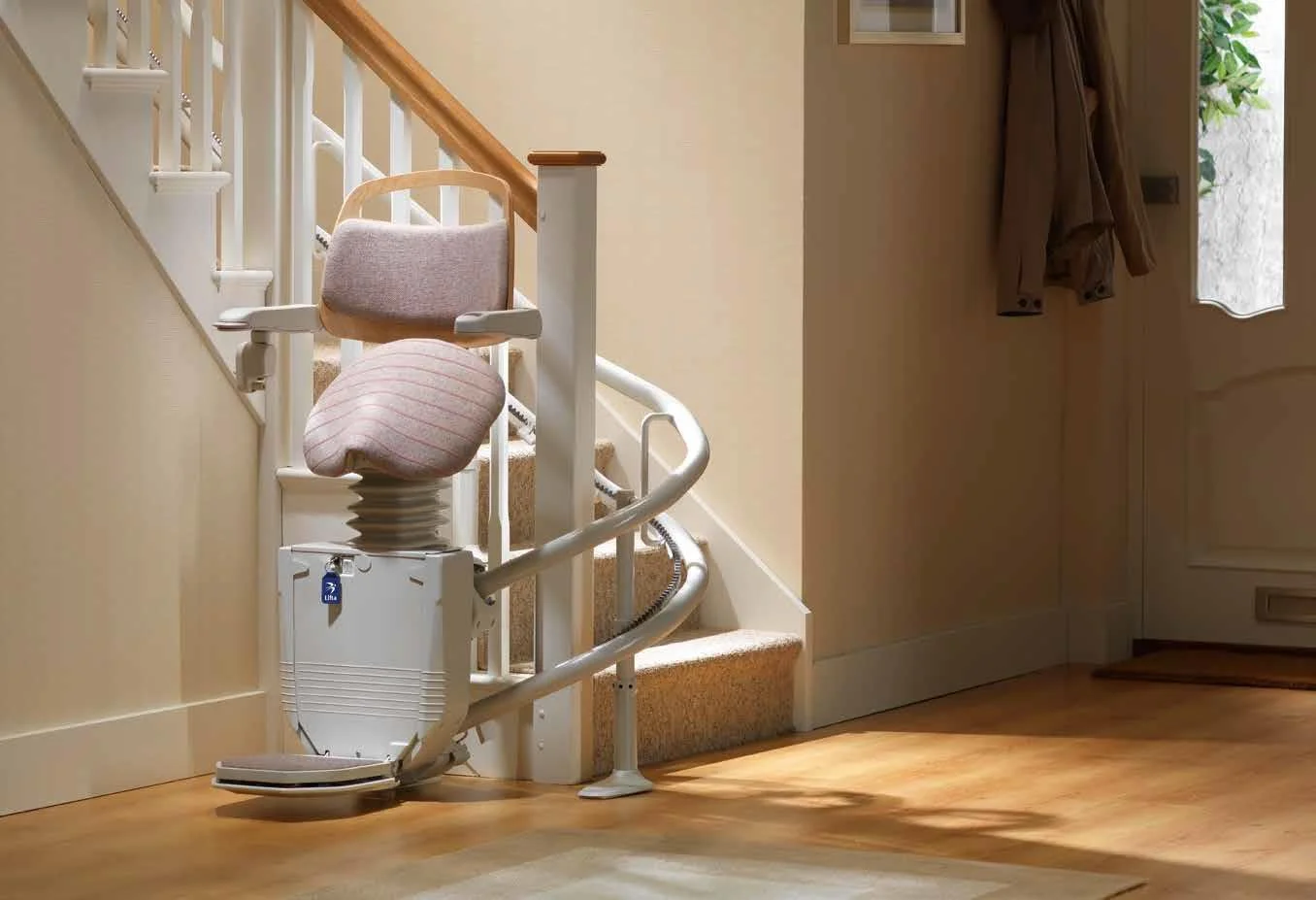
Homes built before 1980 often have a narrow straight run to the second floor and a steeper set of steps down to the basement. A straight stair lift handles most of these. The rail mounts to the stair treads, not the wall, so plaster walls in an older house are not a problem.
The basement stairs are the ones to look at closely. If they turn at the bottom or have a landing partway down, a curved rail is usually the answer. We measure both staircases on the same visit so you know what each one needs.
Split-level homes are common in parts of the county, and they bring short flights of a few steps each. Sometimes one short straight lift on the flight used most is enough. Other times a curved rail that follows the stairs through several levels makes more sense.
Single-family and detached houses give the most freedom, since the owner decides. In walk-up apartments and low-rise buildings, the stairway may be shared, so the building owner has to agree before anything is installed. For some entries, a platform lift fits better than a seat lift.
The county covers about 2,698 square miles, from Rocky Mountain foothills and the Little Belt and Highwood Mountains down to rolling high plains. Homes on sloped lots in places like Belt or Cascade often have a long run of steps from the driveway to the door.
An outdoor stair lift is built with weather-resistant parts and a covered seat for exactly these steps. If a wheelchair is involved, an outdoor platform lift may be the better choice. We check the footing, the angle and the length of the run before recommending one.
About 20.2% of county residents are 65 or older, and 65.8% of households own their home. New housing is hard to come by: the Great Falls area needs an estimated 630 new units per year over the next decade, and roughly 90% of buildable land requires geotechnical soil testing because of expansive soils.
That pushes up the cost of building new, and expected in-migration tied to the Sentinel missile program adds more demand. For many homeowners, adding a stair lift to the house they already own is the practical path.
No program on this page names stair lifts as a covered item, and the VA HISA grant specifically excludes stair glides. That does not mean there is no help. Some programs fund environmental adaptations or accessibility repairs in general, and the right phone call can tell you whether your situation fits.
A good first call is Area VIII - Cascade County AAA at (406) 454-6990, 1601 2nd Ave N., Great Falls 59401. Veterans can reach the Great Falls Service Office, Montana Veteran Affairs Division, at (406) 452-2265, 104 2nd St S, Ste 200. Statewide, also ask about the Montana Assistive Technology Loan (MATL), the Reverse Annuity Mortgage (RAM), Community First Choice Services (CFCS), and the Property Tax Assistance Program (PTAP) & Elderly Homeowner/Renter Credit.
A state Medicaid waiver for people who meet nursing facility level of care; it lists environmental adaptations as an example service, but stair lifts are not named and there is currently a waiting list. Call (800) 219-7035.
Very low income owners at eligible rural addresses can borrow up to $40,000 at 1% for 20 years, and owners 62 or older may get a grant up to $10,000 for accessibility or safety, combined up to $50,000; stair lifts are not named in the source, and central Great Falls addresses may not count as rural. Call (406) 585-2580 to prequalify.
A lifetime VA benefit of $6,800 or $2,000 depending on disability status, for medically justified changes such as entrances, roll-in showers and permanent ramps. It does not cover stair glides; call (406) 442-6410.
Zero-interest loans of $5,000 to $25,000 for low-to-moderate income owners inside Great Falls city limits whose home has a code deficiency or a system expected to fail within two years; stair lifts are not named as an eligible use. Call (406) 455-8471.
The local hub for adults 60 and older and adults 18 and older with disabilities, offering meals, transportation, respite, homemaker help and Medicare counseling; it does not list a stair lift grant, but it is the right place for options counseling. Call (406) 454-6990.
A Center for Independent Living offering referral, advocacy, peer support and skills training for people with disabilities of any age; it does not document stair lift funding, so treat it as a referral point. Call (406) 452-9834.
Older adults
1601 2nd Ave N., Great Falls, 59401
Veterans
104 2nd St S, Ste 200, Great Falls, 59401
No. The VA lists stair glides among the items HISA excludes. HISA can help with entrance access, roll-in showers, sink and counter access, and permanent ramps, and the Great Falls Service Office at (406) 452-2265 can talk through other VA benefits.
The aging services side of Area VIII serves adults 60 and older, but its ADRC referral line also serves adults 18 and older with disabilities. NCILS works with people with disabilities of any age at (406) 452-9834.
No. The City of Great Falls Housing Rehabilitation Loan Program only covers property inside city limits. Rural addresses in the county may fit the USDA Section 504 program instead, which you can check by calling (406) 585-2580.
Not always. If one short flight is the problem, a straight lift on that flight may do the job. If you need to travel through several levels, a curved rail that follows the stairs is usually the answer, and we decide that after measuring.
Usually yes. Basement stairs in pre-1980 homes are often steep or turn at the bottom, which can mean a curved rail. Headroom and the landing at the bottom are what we check first.
Start with Area VIII - Cascade County AAA at (406) 454-6990. They can explain local options and point you to statewide programs like the Big Sky Waiver, which has a waiting list, so it helps to ask early.
Tell us about the stairs in your home and we will explain which lift fits, what it costs and how installation works.
