Winona's river-town core sits right up against the bluffs, and many of its older multi-story houses still have their original stairways. Those stairs were built long before anyone planned for a chair rail along the wall, so fitting a lift often means working with narrow treads, tight turns and landings that were never squared up.
Outside the county seat, the picture changes. Goodview, St. Charles, Lewiston, Stockton, Rollingstone, Altura, Dakota, Dresbach and Utica mix newer single-story construction with farmhouses and split-level homes spread across rolling driftless-area hills. This page walks through what that housing and terrain mean for a stair lift, and which local and state programs are worth a phone call when it comes time to pay.
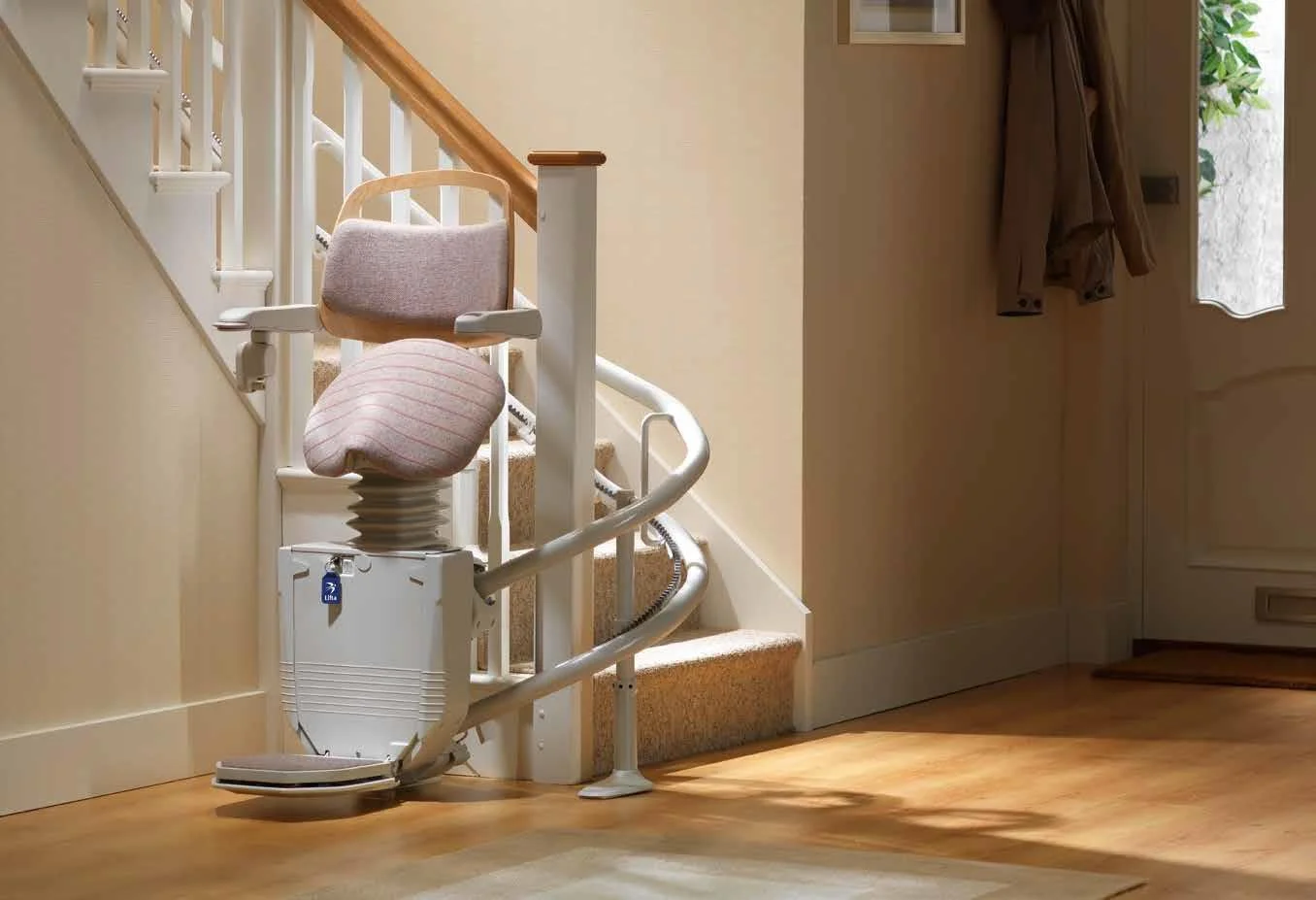
Winona County was founded on February 23, 1854, and the housing stock shows that long history. In the older parts of Winona, a staircase may be steep, narrow or turn partway up, and the condition of the stairway matters as much as its shape.
A straight staircase with no landing usually takes a straight rail, which is the simplest install. A stair that turns, splits at a landing or winds at the top needs a curved rail built to that exact staircase. We measure on site before recommending either one.
Split-level homes are their own case. They often have two short flights going in different directions, so the question becomes which level the person really needs to reach every day, and whether one lift covers it.
About 59.7% of the county's population lives in urban areas, concentrated in Winona and the other incorporated cities, and about 40.3% lives rural across the townships. In all, the county has 13 incorporated cities and 19 townships.
This is the driftless area, an unglaciated part of southeastern Minnesota with steep bluffs and rolling ground, and the Mississippi River forms the county's eastern border. The highest point, 1,365 feet, is two miles east of Wilson. On a hillside lot, the hardest climb is sometimes the steps from the driveway to the door, not the stairs inside.
For those entry steps, an outdoor-rated stair lift or a vertical platform lift can be the better fit. Hilly roads also mean longer drives for contractors and aging-services staff reaching rural households, so it helps to plan visits and paperwork early.
About 63.9% of county residents are homeowners. The rest includes people in townhouses, walk-up apartments and low-rise buildings, where shared stairways and building rules come into play.
If you rent, the owner has to approve any rail attached to the stairs. In a walk-up, a lift on a shared stairway also has to leave room for neighbors to pass, so bring the landlord into the conversation before scheduling a measurement.
Of the county's 38,249 residents, 18.1% are 65 or older, and many of them live in the same homes they have owned for decades. Adult children often start this conversation after a fall or a hospital stay, but measuring the stairs sooner gives more time to sort out funding.
The Winona County Veterans Services Office at 225 W Second Street in Winona, (507) 457-6455, can help a veteran understand which VA benefits apply before anything is ordered.
None of the programs listed below names stair lifts as a covered item on the sources we reviewed, and the VA HISA grant specifically excludes stair glides. Several do list home modifications or accessibility needs, so it is worth asking each one directly how they would treat a stair lift.
For seniors who may need nursing-facility-level care, Winona County Human Services at (507) 457-6350 is the usual starting point for the Elderly Waiver and CADI Waiver. For general aging help and referrals, call the Southeastern Minnesota Area Agency on Aging at (507) 288-6944. Homeowners in rural parts of the county can also look at USDA Section 504 repair loans and grants.
A Medicaid waiver for Minnesotans 65 and older who need nursing-facility-level care but want to stay home; it lists home modifications as a covered category, though stair lifts are not named on the source reviewed. Call (800) 333-2433 or start with the county Long-Term Care Consultation intake.
A Medicaid waiver for adults and children with disabilities who need nursing-facility-level care per a MnCHOICES assessment; it covers modifications to home or vehicle, but stair lifts are not itemized on the source reviewed. Call (866) 333-2466.
The designated Area Agency on Aging for Winona County, offering information and referral rather than direct cash grants; stair lifts are not itemized, but it recommends contacting them for home-modification referrals. Call (507) 288-6944.
State loans up to $37,500 for low-income owner-occupants, forgiven if you stay in the home through the loan term; the Emergency & Accessibility Loan funds accessibility needs for a resident with a disability, though stair lifts are not named. Call (651) 296-7608, and note the Semcac local link is a suggested contact, not a confirmed one.
City-run rehab help for Winona homeowners, including an Emergency Loans Program currently accepting applications; stair lifts and accessibility items are not itemized on the source reviewed. Call the Community Development office at (507) 457-8250.
Federal repair loans up to $40,000 at 1% and grants up to $10,000 for very-low-income homeowners 62 and older in eligible rural areas, with combined help up to $50,000. Accessibility items such as ramps and walk-in tubs are mentioned, but stair lifts are not named.
A VA grant of up to $6,800 or $2,000 lifetime for medically necessary home alterations, depending on disability status. Stair glides are explicitly excluded, so this grant does not pay for a stair lift.
VA grants for veterans with qualifying severe service-connected disabilities to build, buy or remodel a home for accessibility, with SAH up to $126,526 and SHA up to $25,350 for FY2026. Stair lifts are neither named as covered nor excluded on the source reviewed.
A Rochester-based nonprofit serving people with disabilities of any age in an 11-county region that includes Winona County, offering referral, assistive technology and homemaker and respite services; no stair lift benefit is itemized. Call (507) 285-1815 to confirm.
The general county contact point for aging, disability and long-term-care services, including Elderly Waiver and CADI applications; it is a referral point, not a funding program. Call (507) 457-6350.
Older adults
2720 Superior Dr. NW, Suite 300, Rochester, 55901
Veterans
225 W Second Street, Winona, 55987
Not through the HISA grant, which specifically excludes stair glides. The SAH and SHA grants do not name stair lifts either way, so a veteran with a qualifying severe service-connected disability should ask. The Winona County Veterans Services Office is at (507) 457-6455.
The source lists home modifications as a covered category but does not name stair lifts. The waiver is for people 65 and older who need nursing-facility-level care, with a 2026 income limit of $2,982 per month and an asset limit of $3,000 for a single applicant. Start with Winona County Human Services at (507) 457-6350.
The CADI Waiver serves adults and children with disabilities who need nursing-facility-level care, and it lists home modifications as a service. SEMCIL at (507) 285-1815 also serves people with disabilities of any age in Winona County.
USDA Section 504 repair loans and grants apply to eligible rural parts of Winona County. Very-low-income homeowners 62 and older who cannot repay a loan may qualify for a grant of up to $10,000, though stair lifts are not specifically named.
The Southeastern Minnesota AAA is at 2720 Superior Dr. NW, Suite 300, Rochester, 55901, and the phone is (507) 288-6944. It serves Winona County along with ten other southeastern Minnesota counties.
Often, yes. Split-levels usually have short flights that turn or run in different directions, so we look at which floor is needed day to day and whether a straight or curved rail fits that flight.
Tell us about the stairs in your home and we will explain which lift fits, what it costs and how installation works.
