Pipestone County sits in far southwestern Minnesota on the South Dakota border, about 466 square miles of low rolling hills with three towns: Pipestone, Edgerton and Holland. Downtown Pipestone is known for its Sioux quartzite buildings from the 1890s, but most people here live in owner-occupied, single-family rural homes typical of an aging farm-town county.
Many of those homes have stairs to an upper floor or a basement, and that is where a stair lift comes in. This page walks through how local homes affect the type of lift you need and which county, state, federal and nonprofit programs may help with the cost.
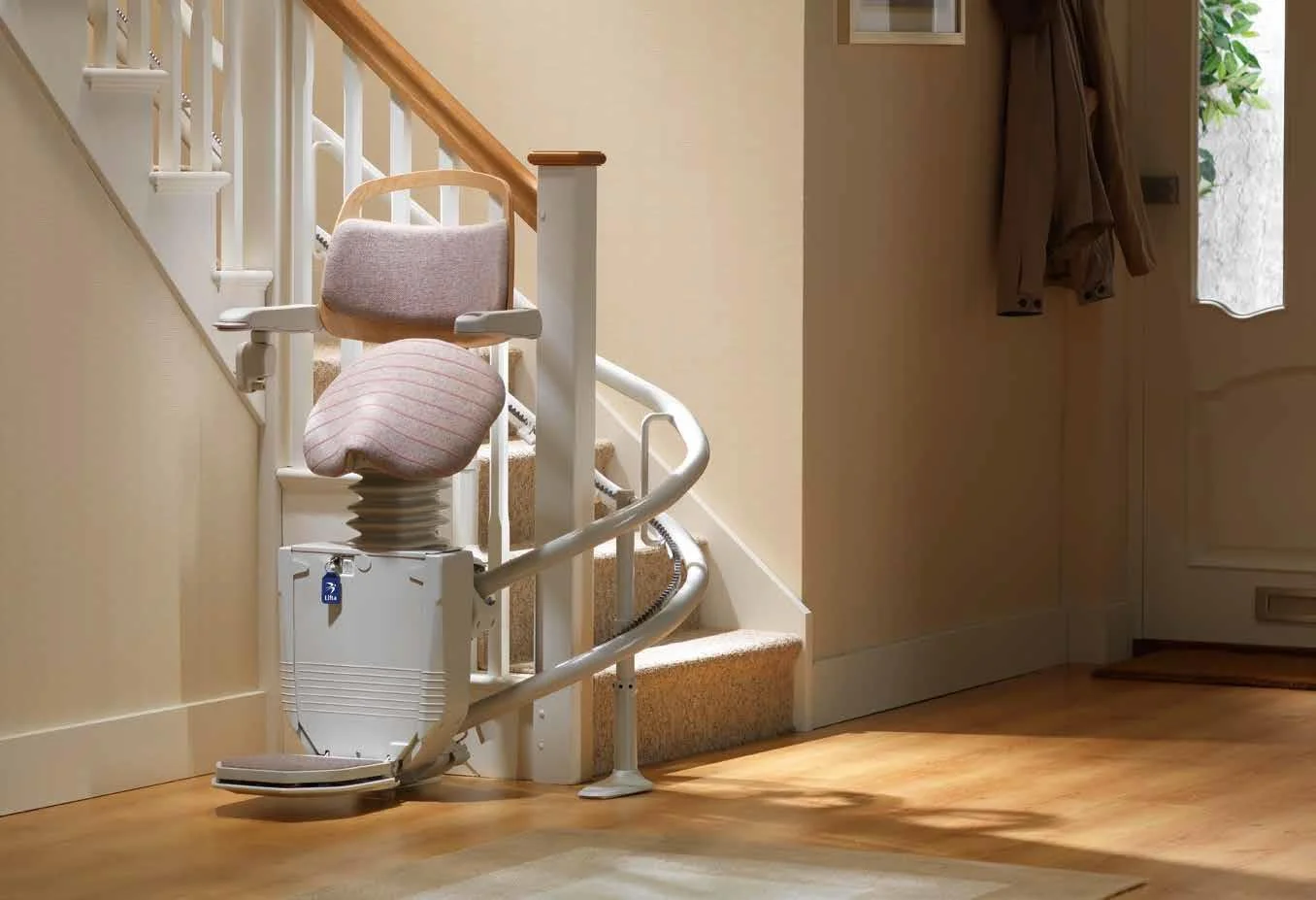
The housing here includes single-family homes, split-level homes, townhouses, walk-up apartments and low-rise buildings. Multi-level layouts are common, so the question is usually which staircase matters most: the one to the bedrooms or the one to the basement laundry.
A single straight run of stairs is the simplest case and takes a straight stair lift on a rail mounted to the treads. Split-level homes often have short flights with a landing or a turn, which can call for a curved lift or two straight lifts. We measure every staircase before recommending one.
Rural homes on rolling ground often have steps up to the front door or down from a porch, not just stairs inside. An outdoor stair lift is built to handle weather, and a platform lift can be the better choice for someone who uses a wheelchair and cannot transfer to a seat.
Plan the whole route from the car to the bedroom. A lift on the inside stairs does little good if the entry steps are still the hard part.
Pipestone County has about 5,620 residents and roughly 19.9 people per square mile. About 22.1% of residents are 65 or older, and about 76.4% of households own their homes, so many people want to stay put in a house they already own.
Low density also means fewer local contractors and accessibility installers, and the main channel for home-modification help runs through county-based and regional aging and disability programs. Starting the funding paperwork early keeps a lift from being delayed while approvals come through.
Minnesota's Elderly Waiver and CADI Waiver both list stair lifts among covered home modifications, for people 65 and older and under 65 respectively, if they meet income, asset and care-level rules. The Consumer Support Grant allows home modifications as a purchase for eligible Medical Assistance recipients.
For homeowners, Minnesota Housing and SMOC offer deferred loans up to $37,500 for accessibility and repair work, and USDA Section 504 offers repair loans and grants in rural areas, though none of these name stair lifts specifically. Details for each are in the program list below.
A Medicaid waiver for Minnesotans 65 and older who need nursing-facility level of care; stair lifts are listed as a covered accessibility modification. Call the Senior LinkAge Line at (800) 333-2433.
A Medicaid waiver for people under 65 with a disability who would otherwise need nursing-facility care; home modifications including lifts are covered. Call (800) 333-2433 to start.
A county-set monthly cash grant for Medical Assistance recipients who choose it instead of in-kind home care services; modifications to a home are an allowable purchase. The Arc Minnesota Help Desk is at (833) 450-1494.
A deferred loan up to $37,500 for low-income homeowners, forgiven if you keep owning and living in the home through the term of up to 15 years; accessibility improvements are eligible, but stair lifts are not named. Call (651) 296-8215.
A deferred loan up to $37,500 for low-income homeowners in Murray, Nobles, Pipestone and Rock counties, and you must apply for the Energy Assistance Program first; the source lists safety repairs and does not mention stair lifts. Call SMOC at (507) 376-4195.
Repair loans up to $40,000 and grants up to $10,000 for very-low-income rural homeowners, with grants limited to those 62 and older who cannot repay a loan. Accessibility examples include walk-in tubs and ramps; stair lifts are not named.
A lifetime VA benefit of up to $6,800 or $2,000 depending on disability status, for medically necessary home improvements. HISA specifically excludes stair glides; call the VA at (800) 827-1000 for other benefits.
Grants of up to $126,526 (SAH) or $25,350 (SHA) for veterans with qualifying severe service-connected disabilities; stair lifts are not mentioned in the source. Call (800) 827-1000.
A St. Paul, Minnesota nonprofit that provides donated and affordable stair lifts to veterans of any era or branch, with full or partial funding based on need. Family members can apply for a veteran by calling (888) 683-8543.
Referral and application help for veterans and dependents living in the county, located at 811 5th St SE (EMS Building) in Pipestone; it does not fund stair lifts directly. Call (507) 836-1608.
A Marshall-based center that helps people with disabilities and older adults apply for funding and runs ramp and low-rise step programs; stair lifts are not listed. Call (507) 532-2221.
An information and referral service for older adults and caregivers in the region, including Pipestone County, with no direct funding. Call (507) 387-1256.
Older adults
2401 Broadway Ave., Suite 4, Slayton, 56172
Veterans
811 5th St SE EMS Building, Pipestone, 56164
Yes. The Minnesota CADI Waiver serves people under 65 with a disability who would otherwise need nursing-facility care, and it covers home modifications including lifts. The income limit is about $961 a month for a single applicant. Call (800) 333-2433.
For 2026 the income limit is about $2,982 a month and the asset limit is $3,000 for a single person. You must be 65 or older and need nursing-facility level of care, which is decided through a MnCHOICES assessment.
No. The VA lists stair glides among the items HISA excludes. Veterans can look at Stair Lift for Vets at (888) 683-8543, and the Pipestone County Veteran Service Office at (507) 836-1608 can help with other VA applications.
Low-income homeowners can apply for a deferred loan up to $37,500 through Minnesota Housing, delivered locally by SMOC. It is forgiven if you keep owning and living in the home through the term, but stair lifts are not named, so ask before you apply. SMOC requires an Energy Assistance Program application first.
It depends on whether the flights connect with a turn or a landing. A curved lift can follow the turn, and sometimes two straight lifts make more sense. A measurement at the house settles it.
The Senior LinkAge Line at (800) 333-2433 handles statewide aging-services intake. In the region you can also reach the Minnesota River Area Agency on Aging at (507) 387-1256 or the Southwest Minnesota AAA office in Slayton at (507) 532-3260.
Tell us about the stairs in your home and we will explain which lift fits, what it costs and how installation works.
