Mower County runs along the Iowa border in southeastern Minnesota, with low rolling hills, the Cedar River and nine towns from Austin and Grand Meadow to Le Roy, Lyle, Adams and Rose Creek. Austin, the county seat, sits on the Cedar River near Mill Pond and holds a good share of early-20th-century houses next to newer split-level and ranch-style homes.
Those houses all have different stairs, and the stairs decide which lift works. On this page we walk through the home styles common in Brownsdale, Racine, Dexter and the rest of the county, what a Minnesota winter adds to the picture, and the programs that can help cover the cost.
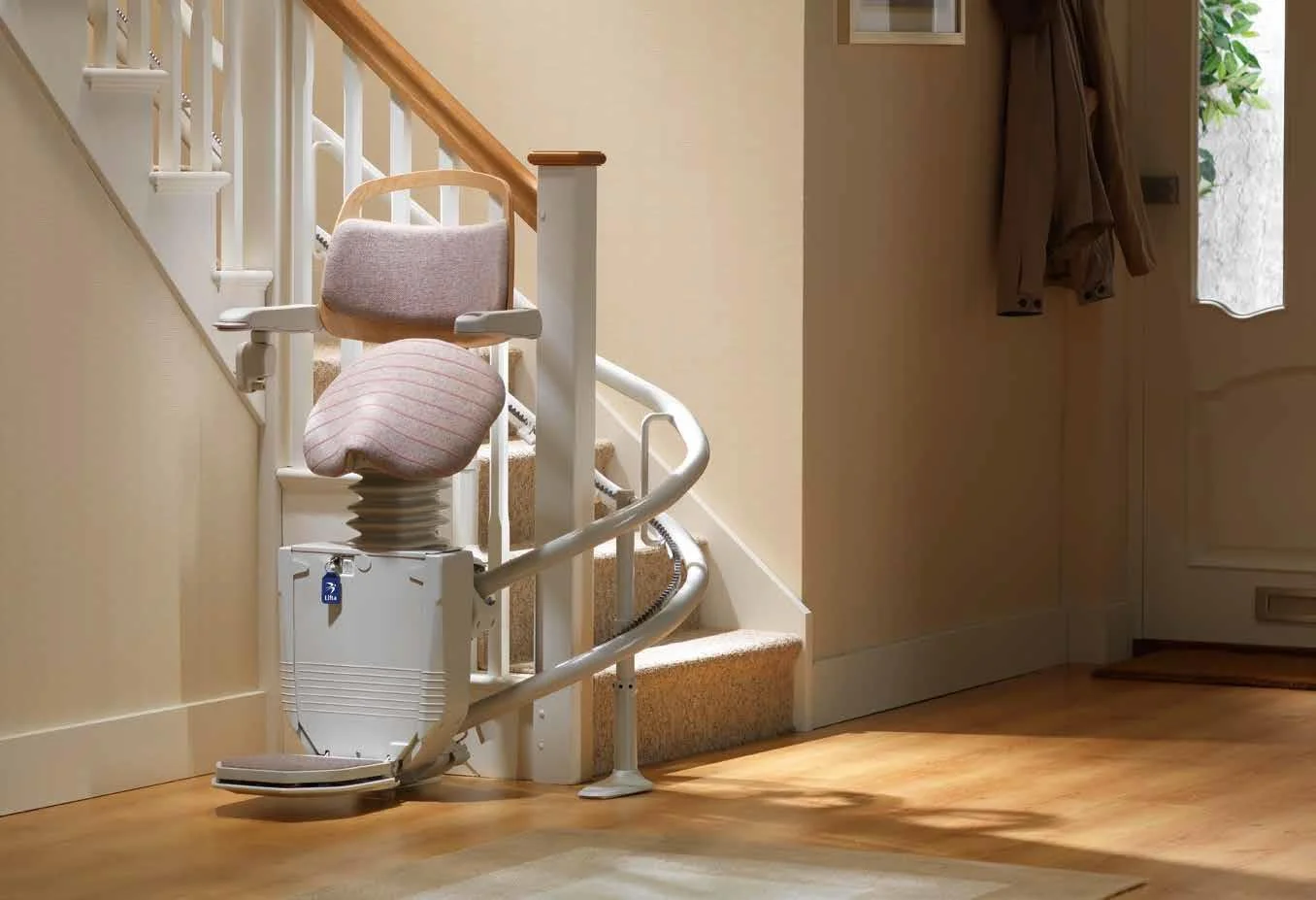
Most homes here are single-family homes, and many are split-level or ranch-style. A ranch home often has one straight flight to the basement, which is the simplest and usually the quickest stair lift install. A split-level has short flights between levels, so we look at each run separately and talk through which ones you actually use every day.
Austin's early-20th-century housing stock is a different job. Older staircases can have turns, landings or narrow widths, and a stair with a bend needs a curved rail built to fit that exact staircase rather than a straight rail off the shelf.
Townhouses and walk-up apartments come up too. A townhouse often has a straight flight that suits a standard lift, while a walk-up apartment usually means talking with the building owner before anything is mounted.
Mower County gets about 43.4 inches of snow in a normal year, and temperatures have ranged from -42°F to 102°F. Icy porch and deck steps raise the chance of a fall during winter, often more than the stairs inside.
If the front or back entry has several steps, an outdoor stair lift or a vertical platform lift may make more sense than a ramp on a tight lot. For many people, though, the real daily risk is the indoor stair to a bedroom or laundry, and that is where we start the conversation.
About 17.9% of Mower County residents are 65 or older, and 71.8% of households own their home. Owning the house matters, because a lift bolts to the stair treads and most funding programs require the applicant to own and live in the home.
The county's Veterans Services Office in Austin, at 201 1st Street NE, Suite 6, can be reached at (507) 434-2712 to sort out which VA benefits apply.
Two Minnesota Medicaid waivers, the Elderly Waiver for people 65 and older and the CADI Waiver for people with disabilities who enroll before 65, can pay for home modifications including stair lifts. Both start with an assessment, and Mower County Health & Human Services at (507) 437-9700 or the Senior LinkAge Line at (800) 333-2433 can start that process.
For homeowners who don't qualify for a waiver, the Mower County HRA offers a 0% interest deferred loan of up to $37,500 for improvements and accessibility needs, and USDA Section 504 offers repair loans and grants in rural areas. Neither names stair lifts in its materials, so ask before you apply. The full list is below.
A Minnesota Medical Assistance waiver for people with disabilities who enroll before 65, with home modifications, including stair lifts, capped at $40,000 per waiver year. Call Mower County Health & Human Services at (507) 437-9700.
A Medical Assistance waiver for people 65 or older who need nursing-facility level of care, and home modifications including stair lifts are a covered service. Call the Senior LinkAge Line at (800) 333-2433 to confirm the current limit and start an assessment.
Loans up to $40,000 at 1% interest and grants up to $10,000 for very-low-income rural homeowners, with grants for those 62 and older; the source mentions accessibility improvements but does not list stair lifts. Call USDA Rural Development at (651) 602-7800.
A lifetime benefit of $6,800 or $2,000 for medically necessary home changes for veterans, but the VA states that removable equipment such as stair glides is not covered. The Mower County Veterans Services Office at (507) 434-2712 can explain what it does pay for.
Up to $126,526 (FY2026) for veterans with certain severe service-connected disabilities to adapt a home they own; the VA does not mention stair lifts either way, so ask before planning on it.
Up to $25,350 (FY2026) for veterans with loss of use of both hands, certain severe burns or certain breathing injuries; stair lifts are not mentioned in the VA's description.
A free information and referral service for older adults and caregivers in Mower and ten nearby counties; its materials do not mention stair lifts, but it can point you toward programs. Call (507) 288-6944.
Ramps on a sliding-fee or private-pay basis, plus grab bars and low-rise steps, for people with disabilities of any age; stair lifts are not named on its service page. Call (507) 285-3917.
A 0% interest deferred loan up to $37,500 for improvements and accessibility needs for low-income Mower County homeowners; stair lifts are not named specifically. Call the Mower County HRA at (507) 434-5557.
Older adults
2720 Superior Dr. NW, Suite 300, Rochester, 55901
Veterans
201 1st Street NE, Suite 6, Austin, 55912
Yes, possibly. The CADI Waiver serves people on Medical Assistance based on disability who enroll before age 65, and it covers stair lifts as a home modification up to $40,000 per waiver year. Call Mower County Health & Human Services at (507) 437-9700.
Stair lifts are listed among covered home modifications. You need to be 65 or older, qualify for Medical Assistance and be assessed as needing nursing-facility level of care. The Senior LinkAge Line at (800) 333-2433 can confirm the current dollar limit.
The HISA grant specifically excludes stair glides. The SAH and SHA grants do not mention stair lifts either way. The Veterans Services Office in Austin at (507) 434-2712 can review your situation.
The Mower County HRA offers a 0% interest deferred loan of up to $37,500 for improvements and accessibility needs, for low-income homeowners who have lived in the home at least 6 months and have household assets under $25,000. Call (507) 434-5557 to ask whether a stair lift qualifies.
Not always. With about 43.4 inches of snow a year, icy entry steps are a real hazard, so it is worth looking at both the outside steps and the inside stairs during a home visit before deciding.
Usually, yes. A straight staircase takes a standard rail, while a stair with turns or landings needs a curved rail built to fit, so we measure first.
Tell us about the stairs in your home and we will explain which lift fits, what it costs and how installation works.
