From the older downtown blocks of Milaca and Princeton to the lake-cabin-style homes near Mille Lacs Lake, the houses in Mille Lacs County were mostly built one family at a time, not in big developments. Many are farmhouses and older multi-level homes with narrow stairwells and floor plans that were never designed around a stair lift.
That matters when stairs start getting hard. Across Princeton, Milaca, Isle, Foreston, Onamia, Vineland and Wahkon, the right lift depends on how your stairs are built, where they lead, and what funding you might qualify for. This page walks through both.
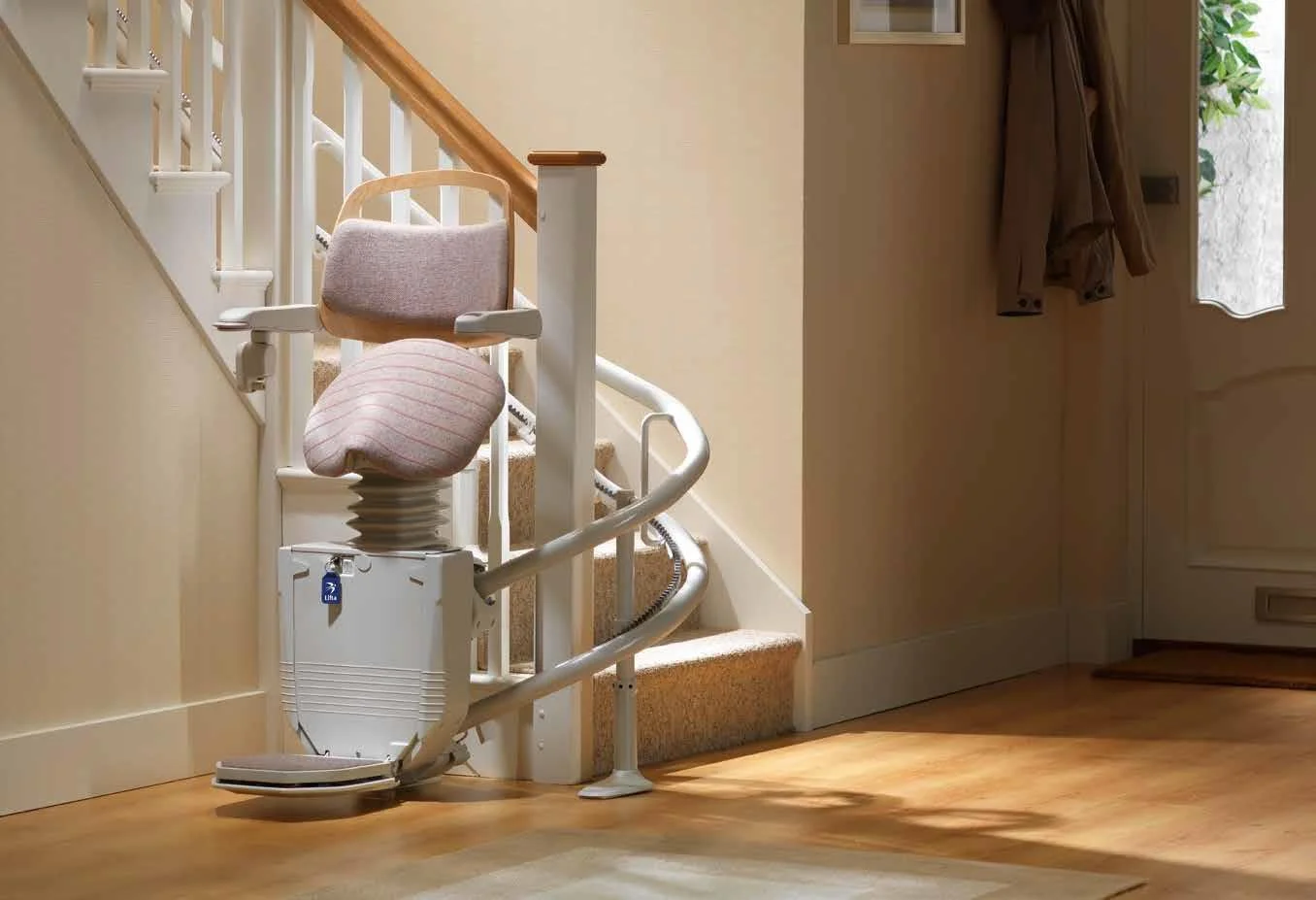
Single-family homes make up most of the housing here, along with townhouses, walk-up apartments, split-level homes and ranch-style homes. A straight staircase in a ranch-style home's basement or a two-story farmhouse is usually the simplest fit for a straight stair lift.
Split-level homes are different. Short runs of stairs between levels may each need their own lift, or a curved rail that follows the turn. Older homes near the rail-town cores of Milaca and Princeton often have tight, steep stairwells, so we measure the width and the landing space before recommending a model.
Walk-up apartments raise another question: who owns the stairs. If the staircase is shared, the building owner needs to approve any installation.
The county's terrain is wooded rolling hills carved by drainages, with farmland in the open areas and Mille Lacs Lake along much of the northern edge. Homes on sloped lots or near the lake often have exterior steps down to a walkout level or up to the front door.
For those spots, an outdoor stair lift or a platform lift may make more sense than an indoor model. Outdoor units are built to handle Minnesota weather, but the steps themselves need to be solid enough to anchor the rail.
Some 81.8% of residents live in rural areas, spread over 17 townships and 8 cities. That dispersed, lake-and-farmland geography lengthens travel times for home assessments and service calls, so it helps to start the conversation before a fall or hospital stay forces a rushed decision.
About 21.2% of the county's residents are 65 or older, and many plan to stay in the homes they already own. A stair lift is often what lets someone keep using a second-floor bedroom or the basement laundry instead of moving.
None of the programs below name stair lifts specifically in the sources we reviewed, so treat each as a question to ask, not a promise. Several do cover home modifications or accessibility improvements in general, and a caseworker can tell you whether a lift fits your care plan.
For Minnesota Elderly Waiver and CADI Waiver applications, the starting point is Mille Lacs County Community & Veterans Services at 525 2nd Street SE in Milaca, (320) 983-8208. The Central Minnesota Council on Aging in St. Cloud, (320) 253-9349, is the Area Agency on Aging for the county.
Note that the VA HISA grant lists stair glides among the removable equipment it will not cover, so veterans should ask about other VA options.
A state Medicaid waiver for residents age 65+ who need a nursing-facility level of care but want to stay at home; home modifications are a listed service, though stair lifts are not named. Apply through the county Long-Term Care Consultation process at (320) 983-8208.
For people under 65 at first enrollment with a certified disability, offering up to $40,000 per 365-day period for Environmental Accessibility Adaptations such as ramps and grab bars; stair lifts are not named. Call Mille Lacs County Community & Veterans Services at (320) 983-8208.
CMCOA is the Area Agency on Aging serving Mille Lacs County for people age 60+, but the reviewed Title III page does not list home modification or stair lifts among funded services. Call (320) 253-9349 to ask what assistance is currently available.
Offers 1% repair loans up to $40,000 and grants up to $10,000 for very-low-income rural homeowners, with grants limited to those age 62+ who cannot repay a loan; accessibility improvements are covered, but stair lifts are not named. Call (651) 602-7800 to check eligibility.
Pays up to $6,800 or $2,000 lifetime for medically necessary permanent alterations, but the VA source lists stair glides as removable equipment it will not cover. Call (320) 252-1670 for details.
Grants of up to $126,526 (SAH) or $25,350 (SHA) in FY2026 for veterans with qualifying severe service-connected disabilities, funding structural adaptations like accessible bathrooms and ramps; stair lifts are not mentioned. Call (320) 252-1670.
Helps low-income homeowners with basic permanent repairs, which can include handicap accessibility improvements; stair lifts are not named and loan amounts are not stated. Call Lakes and Pines at (800) 832-6082.
Offers information, referral, advocacy and peer support for people with disabilities rather than direct grants, and does not mention home modifications or stair lifts. Call (320) 529-9000 to confirm whether it serves Mille Lacs County.
Older adults
600 25th Ave. South, Suite 108, St. Cloud, 56301
Veterans
525 2nd Street SE, Milaca, 56353
It might. Home modifications are a listed Elderly Waiver service, but the source does not name stair lifts, and limits are set individually in your care plan. Start with the Long-Term Care Consultation at (320) 983-8208.
The CADI Waiver serves people under 65 at first enrollment with a certified disability, with up to $40,000 per 365-day period for accessibility adaptations. Stair lifts are not named, so ask your county caseworker at (320) 983-8208.
No. The VA source lists stair glides among removable equipment HISA will not cover. Veterans can call (320) 252-1670 to ask about SAH, SHA and other VA options.
Usually, yes, but split-level homes have short runs of stairs between levels. That may mean more than one straight lift or a curved rail, which we work out during the home assessment.
Outdoor stair lifts and platform lifts are built for exterior steps. The steps need to be sturdy enough to anchor the rail, which we check on site.
Most of rural Mille Lacs County is likely in an eligible USDA area, but you should confirm with the USDA eligibility map or call (651) 602-7800. Grants require age 62+ and very low income.
Tell us about the stairs in your home and we will explain which lift fits, what it costs and how installation works.
