New Ulm was laid out around Turner Hall, the county courthouse and a public school, and the older single- and multi-story houses that grew up around that compact downtown still have stairs between nearly every floor. Out in Sleepy Eye, Springfield, Hanska, Comfrey and Searles, the mix runs from single-family homes and split-level homes to townhouses, walk-up apartments and low-rise buildings.
This page walks through what those homes mean for a stair lift, how a Brown County winter changes the picture for outside steps, and which county, state and federal programs can help with the cost. Every phone number below goes to the office that handles that program.
Much of New Ulm's built environment dates to the 19th century. Houses from that era tend to have one long, steep staircase to the bedrooms, and often a second set down to the basement.
A straight staircase with no turns is the simplest case. A straight stair lift rides a rail bolted to the stair treads, not the wall, so plaster walls and old woodwork stay untouched.
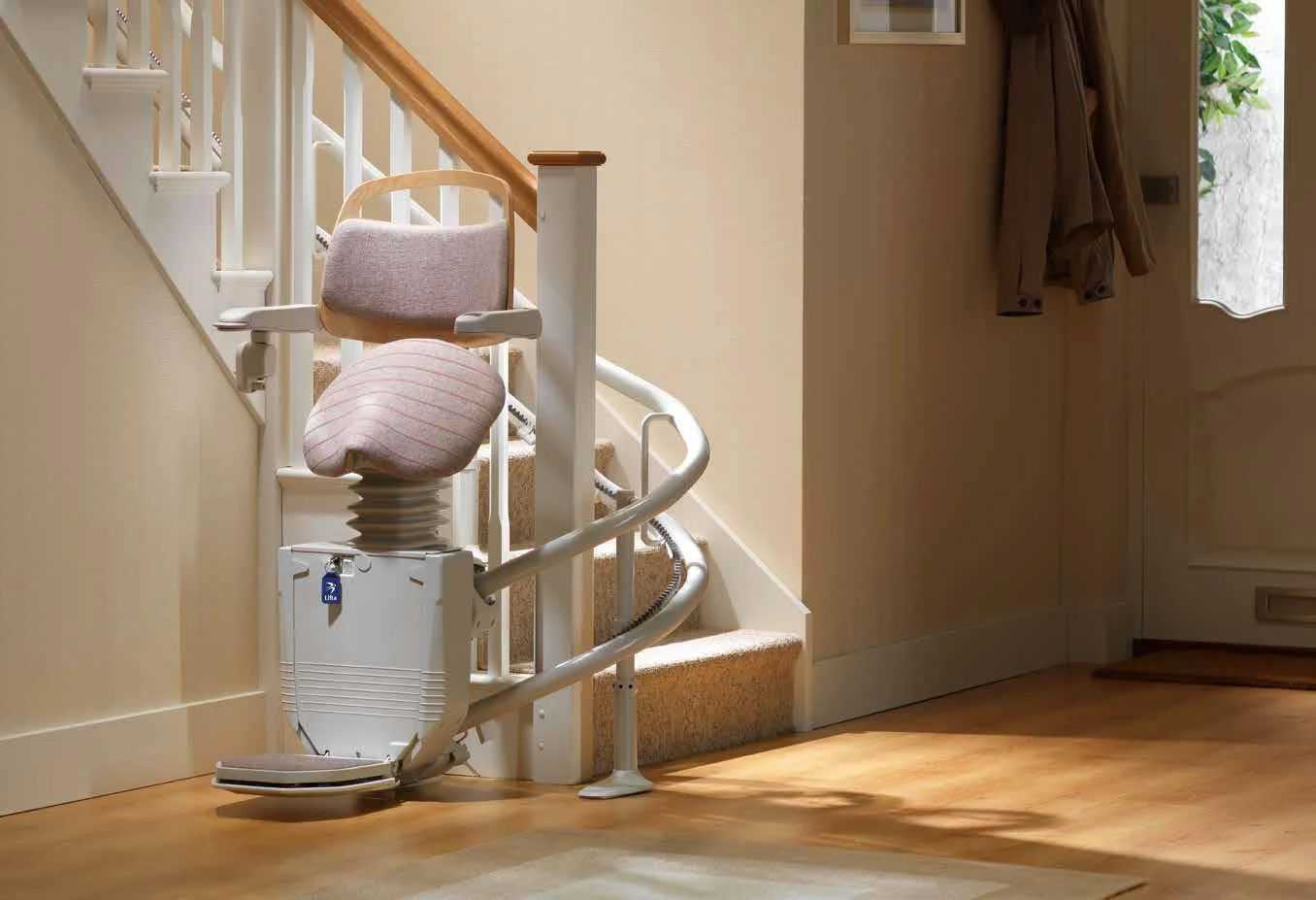
Where an old staircase turns at a landing or winds near the top, a curved rail is built to fit that exact stair. Curved lifts take longer to make, so it helps to measure early if a family member is heading home from the hospital.
Split-level homes are common across the county, and they come with short flights of a few steps between each level. One option is a lift on the flight used most, usually the one to the bedrooms. Another is a separate straight lift on each flight.
Townhouses usually have a straight run between floors, which suits a standard straight lift. In walk-up apartments and low-rise buildings, the stairs are often shared, so the building owner has to agree before anything is installed.
Brown County sits along the Minnesota River, with the Cottonwood and Little Cottonwood Rivers running through it. New Ulm averages a January low near 6°F, recorded -37°F in January 1984, and gets about 40 inches of snow a year.
Ice on porch steps and entry stairs is a real fall risk for anyone aging in place. An outdoor stair lift has a weather-resistant rail and seat for a back door or deck stairs. For a wheelchair user, a platform lift carries the chair itself and is often the better fit at an entrance.
Of Brown County's 20,612 residents, 21.4% are 65 or older, and 76.4% of households own their home. That is a lot of people living in houses they know well and would rather not leave.
For them, the Brown County Veterans Service Office at 14 S State Street in New Ulm is the place to start sorting out VA benefits.
The Minnesota Elderly Waiver (EW) is the one program here that lists Home Modifications as a covered benefit. It is for residents 65 and up who qualify for Medical Assistance and need a Nursing Facility Level of Care but choose to live at home. Brown County Human Services at 507-359-6500 or the Senior LinkAge Line can start the process.
Other statewide programs to ask about include the Alternative Care (AC) Program and the Community Access for Disability Inclusion (CADI) Waiver. For families who do not qualify for those, Minnesota Housing has loans for accessibility work, and the USDA Section 504 program serves very-low-income owners in eligible rural areas.
Veterans should know that the VA HISA grant specifically excludes stair glides. The program list below covers each option and who to call.
A Medicaid waiver for Minnesotans 65 and older who need a Nursing Facility Level of Care but live at home, and it covers Home Modifications, which includes stair lifts. Call (800) 333-2433 or Brown County Human Services at 507-359-6500; enrollment is capped statewide and a waitlist is possible.
An information, referral and caregiver support agency that can point families toward Elderly Waiver, USDA 504 and other home-modification help; its materials reviewed do not mention stair lifts. Call (507) 387-1256.
A nonprofit serving people with disabilities, with a custom ramp program and an assistive technology lending library; stair lifts are not mentioned in its services. Call (888) 676-6498 to ask about stair lift referrals or funding.
A county office that helps veterans and their dependents apply for county, state and federal benefits, including VA home-modification grants; it does not fund stair lifts itself. Call (507) 233-6636.
The county intake agency for seniors and people with disabilities, with Senior Services and Disability Services divisions; its overview does not list stair lifts or specific home-modification programs. Call (507) 359-6500.
A VA grant of up to $6,800 or $2,000 for medically necessary structural changes, but it does not cover stair glides or stair lifts. The Veterans Service Office at (507) 233-6636 can help with other uses of the grant.
Grants for veterans with qualifying severe service-connected disabilities to adapt a home they own, up to $126,526 for SAH and $25,350 for SHA; stair lifts are not named among the examples. Call the Veterans Service Office at (507) 233-6636.
Loans up to $40,000 at 1% and grants up to $10,000 for very-low-income homeowners in eligible rural areas, with the grant for owners 62 and older; it supports accessibility changes, though stair lifts are not named. Check the USDA Rural Development eligibility map for your address.
A statewide loan of $2,000 to $75,000, and the Accessibility loan version has no income limits; stair lifts are not named, but accessibility improvements can be financed. Call (651) 296-8215.
A loan up to $37,500 for low-income homeowners that is forgiven if you stay in the home for the term, with ELP aimed at accessibility needs for a resident with a disability; stair lifts are not named. Call (651) 296-8215.
Older adults
10 Civic Center Plaza, Suite 3, Mankato, 56001
Veterans
14 S State Street, New Ulm, 56073
Not through the HISA grant, which specifically excludes stair glides. The SAH and SHA grants do not name stair lifts either, so a veteran with a severe service-connected disability should ask the Brown County Veterans Service Office at (507) 233-6636 what applies.
The Elderly Waiver starts at 65, but the CADI Waiver is a statewide option for people with disabilities, and SMILES in New Ulm serves people with disabilities of any age. The Minnesota Housing Accessibility loan has no income limits.
Yes. Many split-levels get a straight lift on the main flight to the bedrooms, and some get a separate lift on each short flight.
With about 40 inches of snow a year and icy steps, many families find an outdoor lift or a platform lift at the entrance matters as much as the one inside. Outdoor models are built to handle the weather.
Section 504 only covers USDA-eligible rural areas. Check your address on the current USDA Rural Development eligibility map before applying.
Enrollment is capped statewide at about 40,083 participants, so a waitlist is possible. Starting the Long-Term Care Consultation through Brown County Human Services at (507) 359-6500 early helps.
Tell us about the stairs in your home and we will explain which lift fits, what it costs and how installation works.
