Mason County sits on the Lake Michigan shoreline, with Ludington at the mouth of the Pere Marquette River and the towns of Scottville, Custer and Fountain inland. Many older houses here date back to the lumber-boom era. The 1849 Caswell House, the county's first courthouse and now preserved at White Pine Village, shows how two-story homes of that time were built.
In homes like these, the bedrooms and bathroom are often upstairs, reached by one interior staircase. When those stairs get hard to manage, a stair lift is often the most practical fix. This page covers which lift fits which kind of Mason County home and where to look for help paying for it.
Ludington still has examples of 19th-century construction, including the NRHP-listed Warren A. and Catherine Cartier House. Houses from that period usually put sleeping rooms and baths on the second floor with no other way up.
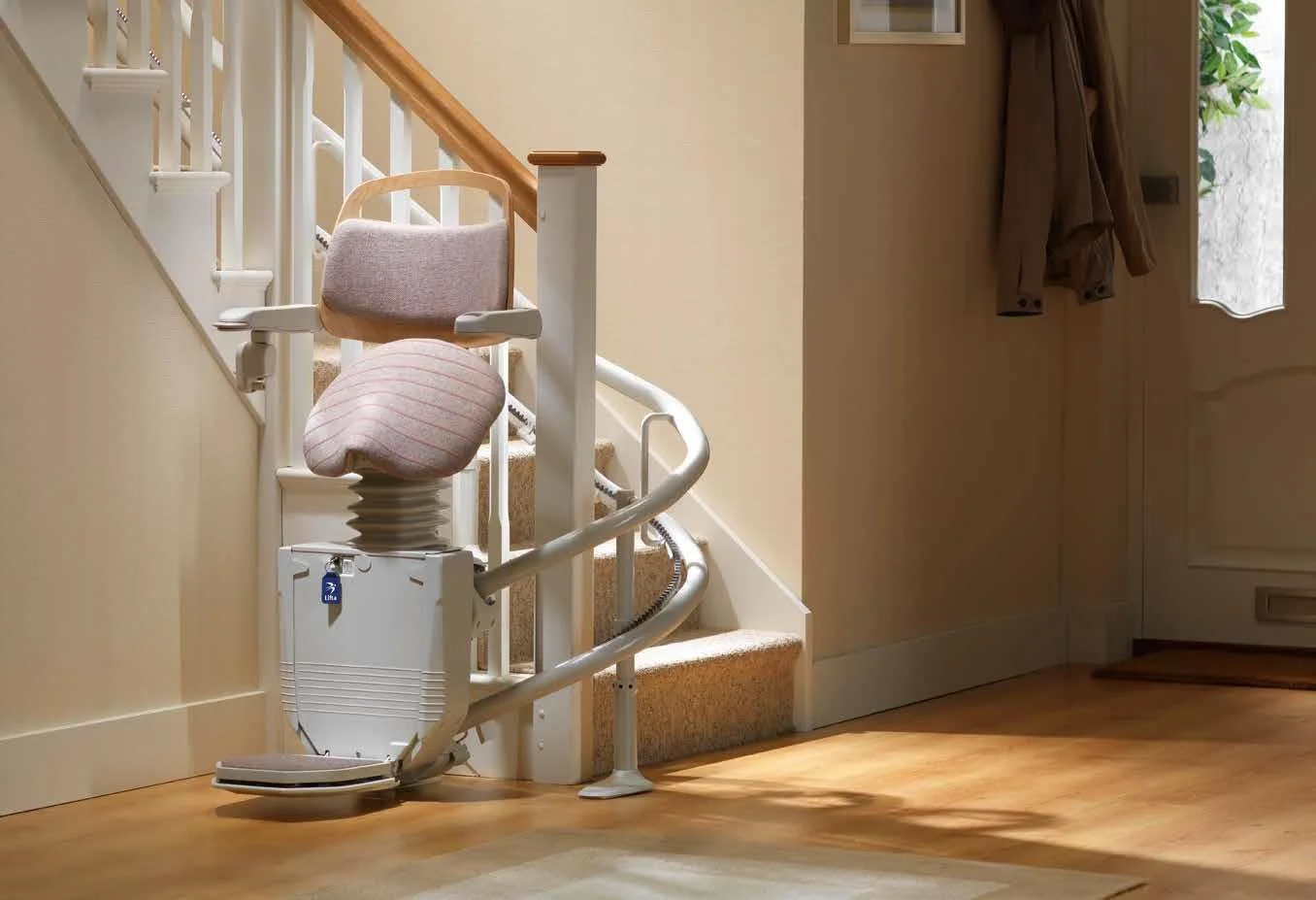
If that staircase runs in one straight line, a straight stair lift is usually the simplest and quickest install. Stairs that turn, have a landing or narrow near the top need a curved rail built to fit that specific staircase. We measure every staircase in person before recommending either one.
Split-level homes have short flights between levels, and a person may need to use more than one each day. Sometimes one lift on the most-used flight solves most of the problem, and sometimes a curved rail that follows the turns is the better choice.
Townhouses usually have a standard interior staircase that suits a straight lift. Walk-up apartments are different because the stairs are often shared, so the building owner has to approve any installation before work starts.
About 747 of the county's 1,242 square miles are water, and the Great Lakes location brings long, snow-heavy winters. Snow and ice make outside steps, ramps and walkways harder for anyone using mobility equipment.
If the trouble is getting from the driveway to the door, an outdoor stair lift or a platform lift may make more sense than an indoor model. Outdoor units are built for weather exposure, but the path to them still needs to be kept clear in winter.
That means a lot of families here are already thinking about how a parent will keep using the upstairs.
A lift usually helps most when the person can still sit and stand on their own but climbing has become slow, painful or risky. If balance or transfers are a concern, a platform lift or other options are worth discussing during the home visit.
Most help available here comes through veterans programs, disability resources and statewide programs. Read the program list below carefully, because not every grant pays for a stair lift. The VA HISA grant, for example, specifically excludes stair glides.
For older adults, the Region VII AAA in Muskegon at (616) 456-5664 can explain local aging services. Statewide programs to ask about include the MI Choice Waiver Program, MI Coordinated Health (formerly MI Health Link) and the MSHDA Property Improvement Program (PIP). Veterans can get help applying at the Veterans Service Office, 920 E. Tinkham Avenue, Ludington, at (231) 583-2028.
A VA grant for medically necessary structural changes, up to $6,800 lifetime for service-connected disabilities or $2,000 for other eligible non-service-connected disabilities. It does not cover stair lifts, since stair glides and other removable equipment are excluded, but it can fund permanent ramps, accessible bathrooms and entrance access; the Mason County Department of Veterans Affairs at (231) 583-2028 can help with applications.
A grant of up to $126,526 (FY2026 maximum) for veterans with severe service-connected disabilities to buy, build or modify a home they own, usable up to 6 times over a lifetime. The source names ramps and widened doorways but does not mention stair lifts; call (231) 583-2028 for help.
A grant of up to $25,350 (FY2026 maximum) for veterans with certain service-connected disabilities to adapt a home owned by the veteran or a family member. Stair lifts are not named among covered adaptations; call (231) 583-2028 to ask about your case.
A non-profit serving people with disabilities of any age in Mason, Muskegon, Oceana, Newaygo and Lake County with advocacy, peer support, skills training and referrals. It does not list stair lift or home modification funding, but it can point you toward other resources at (231) 722-0088.
Older adults
1335 W. Muskegon Dr., Muskegon, 49441
Veterans
920 E. Tinkham Avenue, Ludington, 49431
No. The HISA grant specifically excludes stair glides, porch lifts and other removable equipment. It can pay for fixed changes such as permanent ramps or accessible bathrooms.
The Veterans Service Office is at 920 E. Tinkham Avenue in Ludington, phone (231) 583-2028. They can help with HISA, SAH and SHA applications.
Usually, yes. Homes from the lumber-boom era often have a single interior staircase to the second floor, which is a common stair lift setup. We check the width, turns and landings during an in-home visit.
The Region VII AAA in Muskegon handles aging services for the area. Their phone is (616) 456-5664.
It does. Mason County's long, snow-heavy winters affect outside steps and walkways, so an outdoor lift needs to be a weather-rated model and the path to it has to be kept clear.
Disability Network West Michigan serves people with disabilities of any age in Mason County at (231) 722-0088. It does not fund stair lifts directly but offers advocacy and referrals.
Tell us about the stairs in your home and we will explain which lift fits, what it costs and how installation works.
